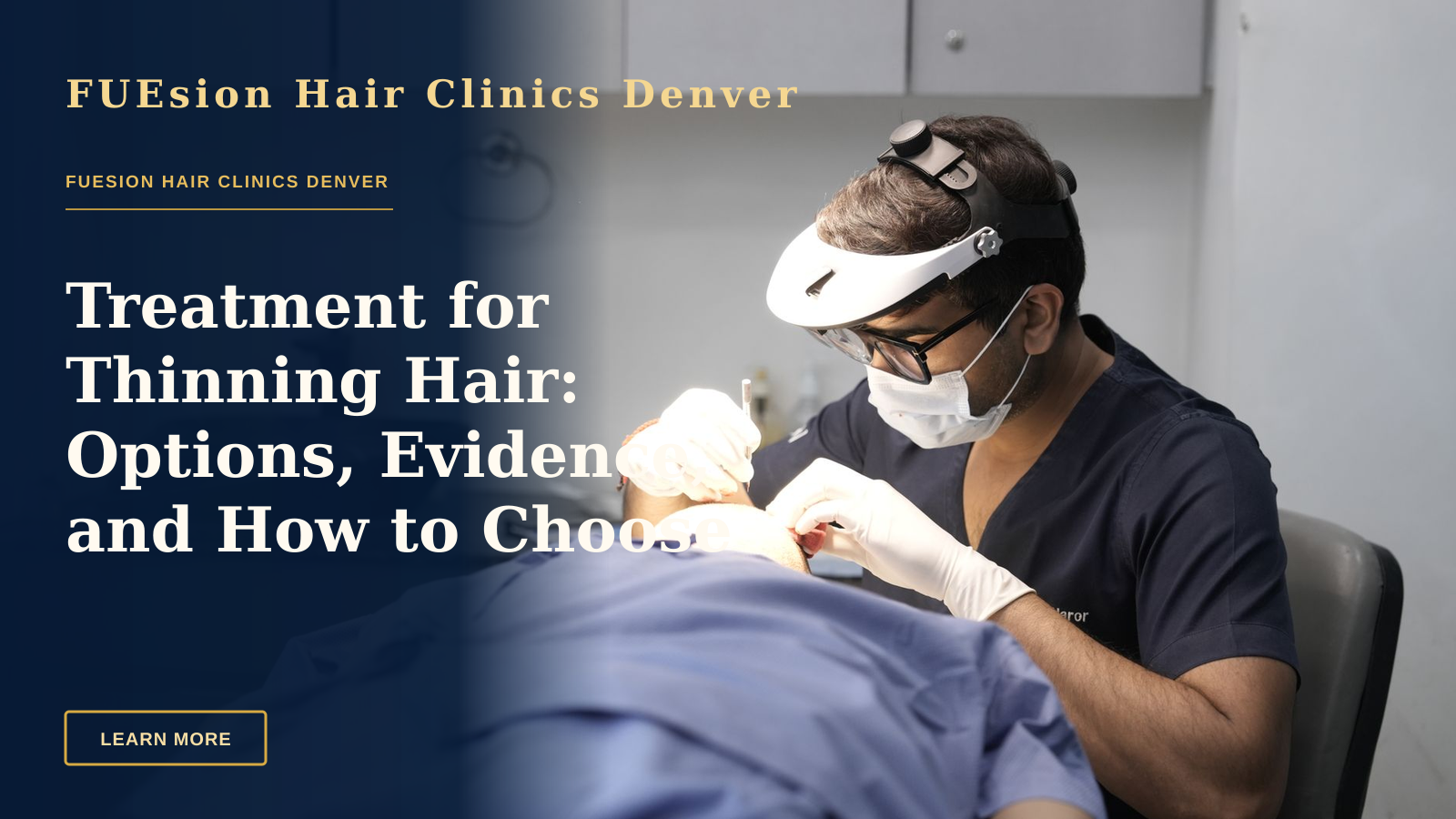
If you're searching for an effective treatment for thinning hair, the right option depends on the pattern and stage of loss, your goals, and how quickly you want visible change. Non‑surgical options such as topical medications, PRP and device-based therapies can slow shedding and stimulate regrowth for early‑to‑moderate thinning, while surgical approaches (modern FUE transplants) provide a permanent density solution when donor hair is adequate.
This guide explains the major treatments for thinning hair, what the clinical timeline looks like, and practical steps to evaluate providers and technologies. Where relevant, it explains how proprietary tools — like photo‑based AI simulation and non‑surgical infusion platforms — can help you visualize and plan results before committing to a procedure.
Patient Journey & Consultation
Starting treatment for thinning hair is easier when the process is clear. Initial contact typically begins with an online request or phone call and is acknowledged quickly; many practices confirm consultation requests within 24 hours and respond to general inquiries in 2–4 business hours. A structured consultation helps you convert uncertainty into a documented plan that aligns expectations, timelines and costs. According to Nutritional Correction for Hair Loss, Thinning of Hair, and Achieving New Hair Regrowth (scholarly source), this source provides relevant background for the discussion.
Most modern clinics offer a free virtual consultation option that pairs a photographic assessment with a conversational review of goals, medical history and prior treatments. During this stage you'll often be asked to run simple digital tools — such as a graft estimator or an AI photo simulator — so the surgeon or clinician can review a realistic target outcome before any in‑person visit.
At the surgeon consultation you'll receive a personalized roadmap: recommended treatments (non‑surgical, surgical or combined), estimated graft counts if transplant is indicated, and a documented hairline plan. This meeting is also where warranty or assurance terms are discussed and recorded so you know what benchmarks and follow‑ups to expect.
- Fast response and booking: consultation acknowledged within 24 hours.
- Free virtual consult: photo assessment, goals discussion and initial plan.
- Digital pre‑work: use of graft calculators and AI simulators to set expectations.
- Surgeon‑led planning: a documented aesthetic plan and treatment timeline.
- Formal 12‑month review: a standard checkpoint to measure growth and address shortfalls.
Together these steps reduce surprises and let you compare options on equal footing. If you'd like to start this process, book a free consultation with an expert surgeon to confirm candidacy and receive a clear, written plan: book your free consultation.
Ready to take the next step?
Speak directly with Dr. Sanders. No obligation. Completely free.
Find out if you're a candidate for FUE Hair Transplants or non-surgical hair regrowth options.
Book Your Free ConsultationSimulator
Before committing to any treatment for thinning hair, seeing a realistic preview of likely results reduces uncertainty. The AI Hair Simulator / AI Hair Studio analyzes a clear frontal photo, estimates grafts or coverage needs, and generates a visual before/after along with a personalized cost estimate. This is especially helpful when weighing non‑surgical regrowth versus transplant or when planning combined approaches.
The simulator workflow is straightforward: upload a well‑lit photo, let the AI analyze hair loss pattern and suggested graft counts, then review the generated preview. Surgeons find these simulations clinically useful because the images create an objective reference for the documented hairline design and density goals discussed during consultation.
Using the simulator ahead of your consultation lets you show the surgeon exactly which density and hairline you prefer. The tool also produces an instant cost estimate so you can compare options with transparent pricing information before you walk into a consult.
- Fast visual planning: see realistic before/after options using your own photo.
- Clinically informed estimates: AI analyzes likely graft needs and returns a cost range.
- Shareable results: save and bring simulation images to your surgeon consultation.
- No sign‑up required: quick access to visual planning with privacy considerations.
Try the AI Hair Simulator to convert questions into a visual starting point and an informed cost estimate: launch the AI Hair Simulator.
See your potential results before you commit
AI Hair Simulator
Our AI Hair Simulator uses your own photo to show realistic hairline, density and style options — and generates a personalized cost estimate so you walk into your consultation knowing exactly what you want and what it costs.
Get Free Access
Ready to take the next step?
Book a Free ConsultationWhy Treatments Differ: Non‑Surgical vs Surgical Options
Treatment for thinning hair falls broadly into two categories: therapies that stimulate or protect existing follicles (non‑surgical) and procedures that relocate healthy hair to thinning areas (surgical). Effectiveness depends on the cause and stage of thinning: early androgenetic thinning often responds to non‑surgical regimens, while long‑standing, extensive bald areas usually require transplantation for meaningful density.
Common non‑surgical options include topical minoxidil, oral agents where appropriate, PRP (platelet‑rich plasma) injections, low‑level laser therapy (LLLT), and device‑assisted infusion technologies designed to stimulate the scalp and deliver growth compounds. These can slow progression and induce regrowth over months. Surgical hair transplants — specifically modern follicular unit extraction (FUE) — relocate patient hair with permanent results when donor reserves are sufficient.
Combining approaches is often optimal: non‑surgical therapies can prime the scalp and maximize graft survival, while a transplant restores density where it matters most. Choosing the correct combination requires a surgeon‑led assessment of donor quality, hair calibre, and aesthetic goals.
- Non‑surgical: slows shedding and stimulates dormant follicles; best for early–moderate thinning.
- Surgical (FUE): permanent density solution; best when donor hair is adequate and pattern is stable.
- Combination approach: priming with non‑surgical therapy can improve transplant outcomes.
Understanding these differences helps you prioritize treatments that fit your timeline, tolerance for downtime, and desired permanence.
Services & Procedures
When considering treatment for thinning hair, a clear menu of services helps you match clinical outcomes to your goals. Our clinic offers both surgical and non‑surgical options so a single team can coordinate combined plans and aftercare. Each service is documented with expected procedure duration, anesthesia type, downtime, and typical timelines to visible results.
Key surgical and non‑surgical offerings include modern AI & AR‑assisted FUE transplants, targeted InFuze™ Restoration sessions using ScalpPulse Technology, and adjunctive therapies such as PRP and scalp micropigmentation. We emphasize surgeon‑performed procedures, microscopic donor assessment and calibrated extraction to preserve graft viability.
Below is a concise summary of core procedures and what to expect for each. These descriptions are intended to help you compare options before a personalized consultation.
- Hair Transplant (AI & AR Assisted FUE / FUEsion Hair Transplant) — Duration: 4–7 hours (larger cases up to 10 hours). Anesthesia: local. Downtime: return to work in 5–7 days. Results begin around 6 months, with full maturation at 12–18 months. Reported graft survival: >95%.
- Beard & Eyebrow Transplants — Precise graft placement for natural orientation. Beard counts typically 300–2,500 grafts; eyebrows 50–400 grafts per brow. Durations and downtime vary by area.
- Female Hair Transplant — Specialized protocols for female patterns, avoiding strip excision and preserving surrounding hair.
- InFuze Non‑Surgical / InFuze™ Restoration — Uses ScalpPulse Technology to stimulate the scalp and deliver targeted compounds with no surgery and zero downtime; suitable for early–mid stage thinning or as an adjunct to surgery.
- FUT (strip), PRP therapy, scalp micropigmentation, scar repair and hairline lowering are also available where clinically indicated.
Our Services page provides booking and detailed procedural information. For a visual sense of likely outcomes and to prepare for a consult, use the AI Hair Simulator and Graft Calculator before your appointment. Learn more or schedule a virtual visit via our main site: view services and book a consultation.
See your potential results before you commit
AI Hair Simulator
Our AI Hair Simulator uses your own photo to show realistic hairline, density and style options — and generates a personalized cost estimate so you walk into your consultation knowing exactly what you want and what it costs.
Get Free Access
Want personalized advice?
Schedule Your AssessmentTrust & Guarantee (FUEsion Assurance)
Choosing a clinic for thinning hair is as much about process and accountability as it is about technical skill. The FUEsion Assurance is an industry‑first comprehensive guarantee that outlines measurable remedies and aftercare commitments. It is discussed and documented during consultation and becomes part of the post‑op plan so expectations and activation points are clear.
The Assurance includes multiple pillars designed to protect your outcome and experience. Growth benchmarks are evaluated at a formal 12‑month review, and corrective remedies are provided under specific conditions if agreed targets aren’t met. Artistry, aftercare and overall satisfaction are also explicitly covered.
- Growth Assurance — If agreed growth benchmarks aren’t met at the 12‑month review, supplemental grafts are provided at no cost when clinically indicated.
- Artistry Assurance — The planned hairline and aesthetic blueprint are documented pre‑op; corrective work is available if execution deviates significantly from the agreed plan.
- Aftercare Assurance — Post‑operative care, routine follow‑ups and surgeon access during recovery and growth monitoring are included.
- Satisfaction Assurance — Concerns are addressed promptly with corrective steps toward the published outcome objectives.
The Assurance is activated through documentation at consultation and monitoring across the defined timeline; the 12‑month review serves as the formal checkpoint for Growth Assurance remedies. To discuss Assurance details during your assessment, request a consultation here: schedule a free consultation.
Ready to take the next step?
Speak directly with Dr. Sanders. No obligation. Completely free.
Find out if you're a candidate for FUE Hair Transplants or non-surgical hair regrowth options.
Book Your Free ConsultationHow to Choose the Right Treatment for Thinning Hair
Choosing a treatment requires matching clinical facts to your personal priorities: permanence, downtime, speed of visible change, and risk tolerance. Start by answering key diagnostic questions: Is your hair loss diffuse or in patterned areas? Do you have adequate donor hair? Has the loss been rapid or gradual? Prior treatments and medical history (including medication use and systemic conditions) matter for expected responses.
Next, compare the practical tradeoffs. Non‑surgical options generally require weeks to months of consistent use and periodic maintenance; they are lower‑risk and reversible. Surgical solutions such as FUE offer permanent density but require an initial recovery period and a longer maturation timeline (full results often by 12–18 months).
Finally, evaluate providers by three practical criteria: clinician credentials and who performs the procedure (surgeon vs technician), objective evidence of outcomes (before/after photos and documented survival rates), and guarantees or follow‑up policies that protect your investment. Request to see cases similar to your pattern and to review the documented plan you’ll sign before surgery.
- Diagnose pattern and stage: diffuse thinning often needs medical therapy; patterned loss may benefit from transplant.
- Assess donor reserve: sufficient donor hair is required for meaningful FUE density.
- Compare timelines: non‑surgical improvement in months; surgical fullness in 12–18 months.
- Verify provider credentials and outcome documentation before committing.
See how we can help you
Get Started TodayResults, Evidence & What to Expect
Realistic timelines matter. For many non‑surgical regimens you may notice reduced shedding and early regrowth by three months, clearer visible change by six months, and continued improvement up to a year with consistent treatment. For FUE transplants, grafts typically show shedding followed by regrowth beginning around three months, visible improvement by six months, and full maturation at 12–18 months.
Specific technologies influence outcomes. For example, calibrated micro‑punch extraction, microscopic donor assessment and proprietary graft holding solutions are intended to maximize graft viability; reported graft survival rates for optimized protocols can be notably higher than older techniques. Device‑assisted infusion platforms that combine scalp activation with targeted compound delivery may produce measurable regrowth without surgery when used appropriately.
To see representative cases and patient stories, review documented outcomes and testimonials so you can compare similar patterns and treatments. Visual evidence helps set realistic expectations and makes it easier to evaluate a proposed plan during consultation.
- Non‑surgical therapies: measurable regrowth often seen within 3–6 months with continued improvement.
- FUE transplants: visible regrowth by 6 months; full density typically 12–18 months.
- Documented outcomes and clinic guarantees improve predictability and peace of mind.
Locations & Access
Access to expert evaluation matters when choosing a treatment path. We operate 21+ locations nationwide and offer free virtual consultations for patients who aren’t near a clinic. Virtual consults connect you directly with surgical leadership and clinical teams, enabling surgeon‑led planning regardless of geography.
Our Littleton / Denver clinic serves Colorado patients with local in‑person care and coordinates virtual access to flagship surgeons. If you’re outside the area, a virtual consultation is an effective way to get a documented plan and to use the AI simulator before traveling for an in‑person procedure.
- 21+ nationwide locations with virtual consultations available internationally.
- Local clinic address (Littleton/Denver) for in‑person assessments and procedures.
- Virtual consults connect patients to surgeons without travel for initial planning.
Book a virtual consultation or find a local clinic to discuss candidacy and logistics: book a free consultation or view locations for in‑person options.
Conclusion
Treatment for thinning hair is not one‑size‑fits‑all. Non‑surgical options can effectively halt progression and stimulate regrowth in early stages, while modern FUE transplants provide a permanent density solution when donor hair is sufficient. Combining approaches — priming the scalp with medical and device‑assisted therapies before transplantation — often yields the best long‑term aesthetic outcomes.
To move forward confidently: run a graft estimate and AI simulation to visualize realistic goals, then schedule a surgeon‑led consultation to get a documented plan and timeline. Be sure to review outcome documentation, ask about who performs the procedure, and verify any post‑op guarantees or reviews that protect your result.
If you want a guided next step, start with a free virtual consultation and the AI Hair Simulator to convert questions into a personalized plan: try the simulator or book your free consultation.
FAQ
Q: What is the fastest way to see improvement for thinning hair?
A: Non‑surgical therapies like topical minoxidil, PRP and device‑assisted scalp stimulation can produce measurable change within 3–6 months when used consistently. Surgical transplants provide permanent density but require a longer maturation window (up to 12–18 months).
Q: How do I know if I need a transplant or non‑surgical therapy?
A: A surgeon or qualified clinician will assess your loss pattern, donor reserves and medical history. Early diffuse thinning often starts with non‑surgical care; patterned, stable loss with adequate donor hair may be best served by transplant or a combined plan.
Q: Can digital tools help me choose?
A: Yes. Tools like the AI Hair Simulator and Graft Calculator let you visualize outcomes and estimate graft needs before a consultation, which helps make surgeon discussions more productive and reduces surprises.
Medical Information Disclaimer
This content is provided for general educational purposes only. It is not a substitute for professional advice, diagnosis, or treatment. Readers are advised to consult qualified professionals for personalized recommendations.
Have questions? We have answers.
Speak With an Expert