treatment for receding hairline is the focus of this practical guide for clinicians and learners. A receding hairline is one of the most common and visible signs of male and female pattern hair loss. If you’re asking “what is the best treatment for a receding hairline?”, the short, practical answer is: the right treatment depends on your stage of loss, goals, donor hair quality and how quickly you need visible change. Early‑stage patients often respond well to non‑surgical therapies; more established hairline recession typically requires a hair transplant for permanent, natural restoration.
This article explains the full range of options—non‑surgical regimens that stimulate regrowth, modern follicular unit extraction (FUE) transplants for permanent restoration, and hybrid plans that combine both. Where relevant, we explain the technologies and guarantees used by leading surgical practices, how to evaluate effectiveness and safety, and concrete next steps so you can see realistic outcomes before you commit.
Patient Journey & Consultation
Choosing an effective treatment for a receding hairline starts with an accurate assessment and a clear plan. At most modern clinics, the patient journey begins with a short intake and a visual review of your hairline pattern, donor density and overall health. You can book an in‑person or virtual appointment; teams typically confirm consultation requests within 24 hours and answer general contact inquiries within a few business hours. According to SURGICAL TREATMENT OF THE RECEDING HAIRLINE (scholarly source), this source provides relevant background for the discussion.
During a free virtual consultation, a clinician will review your goals, examine photos or a live video feed, and discuss realistic outcomes for non‑surgical vs surgical options. Before that consult, running a photo‑based simulation or a quick graft estimate helps the conversation stay focused on what you want and what’s possible.
Key touchpoints in a typical patient flow include pre‑visit digital tools, a surgeon consultation to document the aesthetic plan, the procedure day (if applicable), and scheduled follow‑ups culminating in a formal 12‑month review for outcome benchmarking.
- Initial contact and scheduling with response targets (consult confirmations within 24 hours).
- Free Virtual Consultation that includes assessment and goal setting.
- Digital pre‑work: run a graft estimate and use a photo simulator before your consult.
- Surgeon consultation to document the hairline design and confirm the plan.
- Post‑op follow‑ups and a formal 12‑month review to verify results.
After the consult, your clinician will document a personalized plan (and any applicable guarantees) and outline the timeline and costs. If you’d like to get started, you can Book a Consultation to speak with a clinician and confirm candidacy for surgical or non‑surgical care.
Ready to take the next step?
Speak directly with Dr. Sanders. No obligation. Completely free.
Find out if you're a candidate for FUE Hair Transplants or non-surgical hair regrowth options.
Book Your Free ConsultationSimulator
Seeing a predicted result reduces uncertainty. The AI Hair Simulator (also called AI Hair Studio) creates a photo‑based preview of what a restored hairline might look like and pairs that preview with a personalized cost estimate. This gives you a concrete visual reference to discuss at consultation.
The simulator analyzes your frontal photo, estimates graft need, and generates before/after previews that reflect realistic density and hairline shape. Because the tool is trained to align with clinical planning, it’s a helpful bridge between aspiration and an evidence‑based surgical plan.
How it typically works: you upload a clear, well‑lit frontal photo; the AI analyses your current hair pattern and suggests a graft estimate; then it returns a preview and cost range. Save these outputs and bring them to your surgeon so you start the consultation aligned on goals and numbers.
- Quick visual preview of different hairline designs and densities.
- AI‑estimated graft counts used as the starting point for a surgeon’s plan.
- Instant cost estimate so you can compare options before booking a consult.
- Results you can save and share with your surgeon at the consultation.
The tool is free to use and intended to accelerate decision‑making: launch the AI Hair Simulator before your appointment to create a clear brief for your surgeon.
See your potential results before you commit
AI Hair Simulator
Our AI Hair Simulator uses your own photo to show realistic hairline, density and style options — and generates a personalized cost estimate so you walk into your consultation knowing exactly what you want and what it costs.
Get Free AccessReady to take the next step?
Book a Free ConsultationTreatment Options for a Receding Hairline
Treatments for a receding hairline fall into two broad categories: non‑surgical therapies that stimulate existing follicles and surgical transplantation that moves permanent donor hair into the hairline. The right choice balances your age, hair loss pattern, donor availability, budget and desired permanence.
Non‑surgical options include topical medications, in‑office biologic stimulations like PRP, low‑level laser therapy, and newer infusion platforms. One proprietary non‑surgical platform in contemporary practices is InFuze™ Restoration using InFuze™ ScalpPulse Technology, which combines scalp activation with targeted compound infusion and is offered as a no‑downtime option for early‑to‑mid stage loss.
When a hairline has advanced or when permanent density is required, modern follicular unit extraction (FUE) transplants are the preferred surgical option. Contemporary practices use AI & AR guidance during donor mapping and extraction to optimize graft quality and placement. For patients seeking a permanent solution, a procedure labeled a FUEsion Hair Transplant (performed with the FUEsion Technique) can restore a natural hairline with durable growth.
Comparative highlights:
- Topicals (minoxidil) and oral agents can slow loss and stimulate partial regrowth but require ongoing use.
- In‑office biologics (PRP) and infusion systems like InFuze can produce measurable regrowth without surgery.
- FUE transplants provide permanent, natural grafts; modern protocols emphasize micro‑punch extraction and precise recipient site angulation for natural lay.
To evaluate which path fits you, consider whether you want a permanent correction, how much donor hair you have, and the time you can invest in follow‑up care. If you prefer to visualize an outcome first, use the AI Hair Simulator and run a fast estimate with the Graft Calculator before your consult.
Services & Procedures
We offer a comprehensive, fully enumerated menu of surgical and non‑surgical hair restoration services so patients can choose the option that best addresses a receding hairline. Each procedure is described and timed to set expectations for duration, anesthesia, downtime and result timelines.
Our surgical options are anchored by the Services page and include modern FUE transplants, specialized female hairline protocols, beard and eyebrow transplants, and corrective scar repair. Non‑surgical choices include the InFuze Non‑Surgical system and adjunctive biologic therapies such as PRP. Every patient receives a documented plan and post‑op care.
The full menu supports flexible care pathways — from a short InFuze course to a single‑day FUE transplant. Below is a concise summary of key offerings and what patients should expect.
- FUEsion Hair Transplant (AI & AR Assisted FUE) — 4–7 hours (longer for large cases); local anesthesia; return to work in 5–7 days; visible growth at 6 months; full at 12–18 months; graft survival >95%.
- InFuze Non‑Surgical / InFuze™ Restoration — no surgery and no downtime; suitable for early–mid stage loss or as an adjunct to transplant.
- Beard & Eyebrow Transplants — focused graft counts and angulation to match natural hair lay.
- PRP therapy, Scalp Micropigmentation, Scar Repair — adjuncts for improved density, camouflage and refinement.
Each pathway includes a personalized post‑op plan with scheduled follow‑ups and access to your surgical team. For bookings and to explore each procedure in detail, please visit our Services page or Book a free consultation. See our before/after cases in the Results Gallery for representative outcomes.
See your potential results before you commit
AI Hair Simulator
Our AI Hair Simulator uses your own photo to show realistic hairline, density and style options — and generates a personalized cost estimate so you walk into your consultation knowing exactly what you want and what it costs.
Get Free AccessWant personalized advice?
Schedule Your AssessmentTrust & Guarantee (FUEsion Assurance)
When considering surgical correction for a receding hairline, one important differentiator is whether the clinic stands behind outcomes. The FUEsion Assurance is an industry‑first, multi‑pillar guarantee that covers growth benchmarks, artistry, aftercare and overall satisfaction for eligible procedures.
The Assurance is discussed and documented during your consultation and is formally checked at the 12‑month review, which is the activation point for Growth Assurance remedies if agreed benchmarks aren’t met. Knowing these terms up front reduces risk and aligns surgeon and patient expectations.
Important Assurance components include a growth safety net, documented artistry plan, included aftercare and a satisfaction commitment to address concerns promptly. For candidacy and how to document Assurance in your plan, schedule a consult and review the terms with your surgeon.
- Growth Assurance — supplemental grafts at the 12‑month review if your documented benchmark is not met.
- Artistry Assurance — the pre‑op hairline and aesthetic plan are documented and corrective work is available if execution deviates significantly.
- Aftercare Assurance — comprehensive follow‑up including surgeon access during recovery and monitoring.
- Satisfaction Assurance — the clinic commits to address concerns until outcome objectives are achieved.
To confirm how Assurance applies to your case and to see the full terms, please Book a Consultation. The Assurance is a practical tool to mitigate outcome uncertainty, especially for patients seeking permanent hairline restoration.
Ready to take the next step?
Speak directly with Dr. Sanders. No obligation. Completely free.
Find out if you're a candidate for FUE Hair Transplants or non-surgical hair regrowth options.
Book Your Free ConsultationTechnology & Technique: Why Modern FUE Matters
Advances in planning, extraction and implantation change long‑term outcomes for hairline restoration. Proprietary workflows that combine microscopic donor assessment with AI‑assisted donor mapping and micro‑punch extraction are designed to maximize graft yield and naturalness.
One contemporary approach, the FUEsion Technique, leverages AI & AR Assisted FUE for precision donor mapping, calibrated micro‑punch extraction and artistic recipient site creation with typical site angles of 20–45°. These protocols emphasize graft viability, documented in clinic materials as graft survival >95%.
Non‑surgical platforms like InFuze™ ScalpPulse Technology combine scalp activation with targeted compound infusion to stimulate dormant follicles without surgery. Many patients choose a combined pathway: accelerate regrowth with InFuze, then refine density with a transplant if needed.
For a deeper look at equipment, clinical steps and how these technologies translate to visible outcomes, explore our Hair Regrowth Technology page.
See how we can help you
Get Started TodayHow to Choose the Right Treatment for Your Hairline
Start by diagnosing your hair loss stage and setting realistic goals. If you want to slow progression and avoid surgery, begin with medically validated non‑surgical options. If your hairline has fully receded and you want permanent correction, a transplant is usually the most reliable approach.
Questions to guide selection include: How severe is the recession? Is your donor area dense enough? Do you want permanent results? Can you tolerate the recovery window of a surgical procedure? Discuss these topics during a surgeon‑led consult and bring your simulator outputs to focus the discussion.
Cost, downtime and long‑term maintenance are practical factors: topical and infusion therapies often require ongoing sessions or maintenance; transplants are a one‑time procedure with long‑term results once grafts take. Use the Cost Estimate and the AI tool to compare scenarios before booking.
Safety, Recovery, and What to Expect
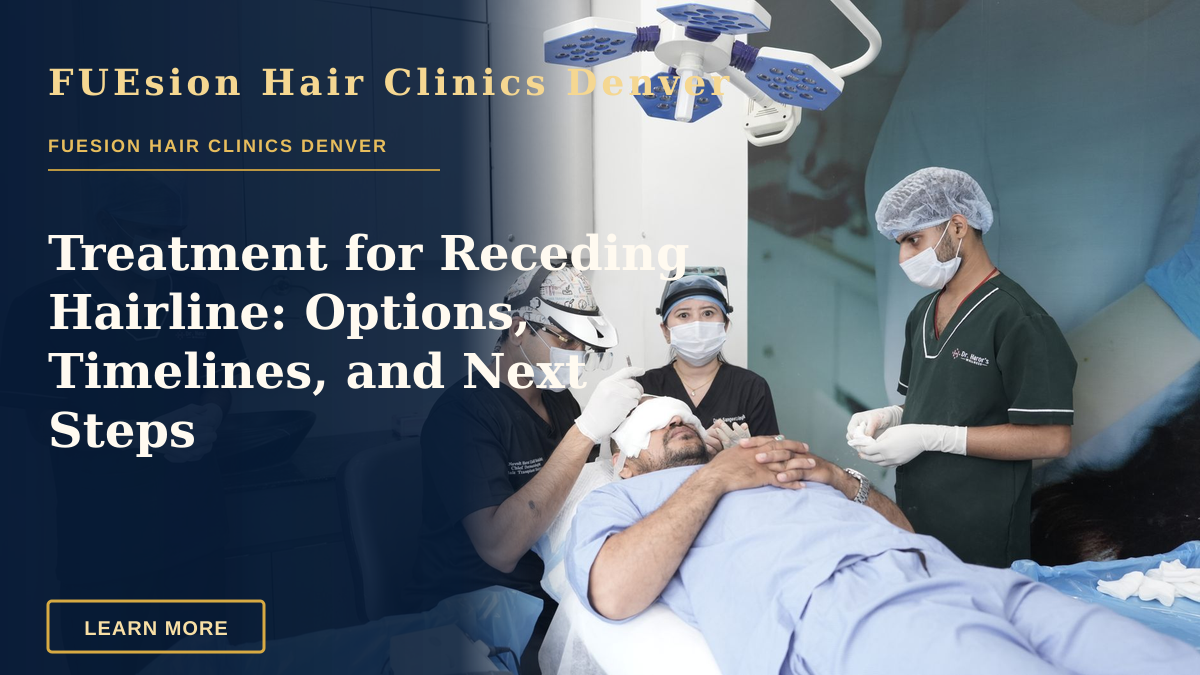
Safety begins with selecting a licensed medical provider and a documented plan. For FUE transplants performed under local anesthesia, expect procedure times from 4–7 hours (longer for larger cases) and a return to desk work in about 5–7 days. Initial shedding is normal, with new growth typically beginning around 3 months and full results visible between 12–18 months.
Non‑surgical InFuze sessions offer measurable regrowth with no downtime and are an attractive option when quick recovery is essential. All plans should include follow‑up visits to monitor healing and growth; the formal 12‑month review is where long‑term benchmarks are assessed.
Before any treatment, disclose medications, medical history and prior scalp procedures. A thorough pre‑op assessment minimizes risk and positions you for the best possible outcome.
Results & Social Proof
Visual evidence and patient stories help set realistic expectations. Clinics publish representative before/after galleries and testimonials showing typical recovery timelines and aesthetic outcomes for frontotemporal restoration. While individual results vary, reviewing documented cases is a practical way to evaluate a surgeon’s artistry.
If you want to compare examples, visit the Results Gallery or read testimonials that discuss both InFuze and FUE outcomes. Pair these examples with your AI simulator preview to create a realistic expectation for your own case.
Conclusion
Treatment for a receding hairline ranges from topical and in‑office non‑surgical therapies to permanent surgical restoration with modern FUE. Early or mild recession often responds to non‑surgical options; established hairline loss typically requires transplant for durable density and natural hairline shape. Newer platforms and workflows—AI‑assisted planning, calibrated micro‑punch extraction, and infusion technologies—have improved predictability and graft survival.
Your next practical steps: run a quick graft estimate and use the AI Hair Simulator to visualize outcomes, then book a surgeon consultation to document a plan and discuss timelines. If you want to proceed, the consultation team will confirm candidacy, review the FUEsion Assurance terms and schedule any chosen procedure.
Ready to see what’s possible? Start with the AI Hair Simulator to create a personalized preview, then Book a Consultation to speak directly with a surgeon about the best treatment for your receding hairline.
FAQ
Q: Can non‑surgical treatments reverse a receding hairline?
Non‑surgical treatments (topicals, PRP, infusion technologies) can stimulate regrowth and slow progression, and they’re best for early‑to‑mid stage loss. Significant, long‑standing recession usually requires transplantation for durable correction.
Q: How long until I see results after a transplant?
After FUE, shedding of transplanted hair occurs first; new growth typically starts around 3 months, with visible improvement by 6 months and full maturation between 12–18 months.
Q: How do I know if I’m a candidate?
Run the Graft Calculator for a fast estimate, use the AI Hair Simulator to preview outcomes, and then book a free consult to get a definitive surgical assessment.
Medical Information Disclaimer
This content is provided for general educational purposes only. It is not a substitute for professional advice, diagnosis, or treatment. Readers are advised to consult qualified professionals for personalized recommendations.
Have questions? We have answers.
Speak With an Expert