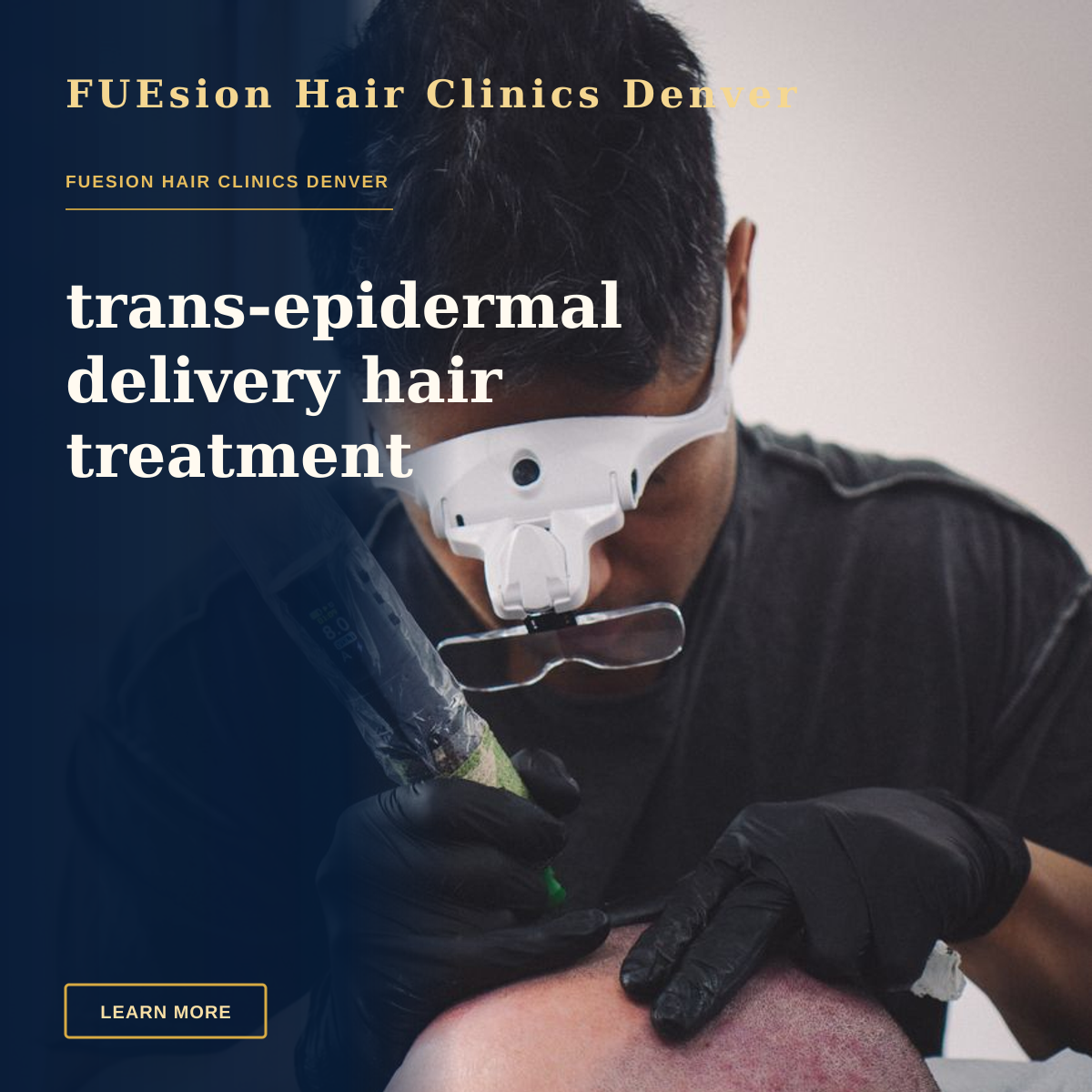
trans-epidermal delivery hair treatment is the focus of this practical guide for clinicians and learners. Trans‑epidermal delivery hair treatment refers to non‑surgical methods that enhance penetration of therapeutic compounds and stimulation through the scalp’s epidermis to reactivate or support hair follicles. For people exploring alternatives to surgery — or adjuncts to a hair transplant — these treatments aim to deliver growth‑supporting agents while minimizing downtime and scarring.
This article explains the basic science behind trans‑epidermal approaches, compares their benefits and limits to surgical options, and maps practical next steps so you can evaluate providers and technologies. Where relevant, we describe a brand example: InFuze™ Restoration, which combines multi‑modal scalp activation with targeted compound infusion (InFuze™ ScalpPulse Technology) to produce clinically measurable regrowth with no surgery and zero downtime. If you want to visualize likely outcomes before a consult, free tools such as the AI Hair Simulator and Graft Calculator are available to help you prepare.
Patient Journey & Consultation
Understanding the patient flow helps set expectations for time, decisions and outcomes. Initial contact typically starts online or by phone; for convenient access, many clinics offer a free virtual consultation so you can speak with a clinician before traveling. Response and scheduling windows are part of the patient experience: consultation requests are acknowledged quickly, and administrative teams usually confirm appointments within 24 hours. According to Roota Hair Growth Serum: Precision Delivery for Maximum Hair Growth (scholarly source), this source provides relevant background for the discussion.
During the free virtual consultation, the care team performs a hair loss assessment, discusses your goals, and reviews any simulation results you bring. Digital pre‑work — specifically running the Graft Calculator and the AI Hair Simulator — gives a photo‑based graft estimate and a visual preview that makes the consultation more productive and precise.
After the initial assessment, a surgeon or treatment specialist creates a personalized plan documenting target areas, recommended modalities (for example, a course of trans‑epidermal delivery treatments versus surgical transplant), estimated graft count if surgical work is recommended, and the timeline of follow‑up checks. Importantly, the formal 12‑month review is the agreed checkpoint for evaluating growth and any additional measures.
- Fast access: consultation scheduling acknowledged within 24 hours and general responses within 2–4 business hours.
- Prepare ahead: run the Graft Calculator and launch the AI Hair Simulator to bring concrete visuals to your consult.
- Personalized plan: surgeon consultation documents the roadmap and any assurance terms that apply.
- Follow‑up and monitoring: scheduled reviews including a formal 12‑month growth evaluation.
If you aren’t local, virtual consults connect you to the same clinical team and surgeons, enabling nationwide access to surgeon‑led planning. To book a free consult, use the clinic’s consultation page and be prepared to share a clear frontal photo for the simulator review.
Ready to take the next step?
Speak directly with Dr. Sanders. No obligation. Completely free.
Find out if you're a candidate for FUE Hair Transplants or non-surgical hair regrowth options.
Book Your Free ConsultationSimulator
Seeing is deciding. The AI Hair Simulator (also called AI Hair Studio on some pages) gives a clinician‑informed preview of possible results using your own photo. This simulation captures hairline shape, density choices and a personalized cost estimate so your consultation starts with a clear visual objective rather than a hypothetical conversation.
The simulator is designed to be fast and usable without sign‑up: upload a clear frontal photo, let the AI analyze your graft needs, and review the before/after preview and cost range. The output is most useful when you bring it to your free consultation — the surgeon can refine the simulated plan into a surgical or non‑surgical roadmap.
Practically, the simulation reduces uncertainty and improves informed consent. It’s especially helpful when comparing non‑surgical trans‑epidermal courses (which may require repeat sessions) versus a one‑time surgical solution that redistributes follicles.
- Upload a clear, well‑lit frontal photo for the most accurate simulation.
- The AI analyses your photo to estimate graft counts and recovery profiles.
- You receive a before/after preview and a personalized cost estimate to guide decision making.
- Save and share the result with your surgeon to accelerate treatment planning.
Launch the simulator to visualize options before your consult and to create a precise brief for the clinical team. Use the simulator alongside the Graft Calculator to compare non‑surgical expectations with transplant possibilities.
See your potential results before you commit
AI Hair Simulator
Our AI Hair Simulator uses your own photo to show realistic hairline, density and style options — and generates a personalized cost estimate so you walk into your consultation knowing exactly what you want and what it costs.
Get Free AccessReady to take the next step?
Book a Free ConsultationHow Trans‑Epidermal Delivery Hair Treatments Work
Trans‑epidermal delivery describes techniques that facilitate movement of active compounds and stimulatory signals across the outer skin layers into the hair follicle environment without surgical implantation. Approaches vary, but they commonly pair a mode of scalp activation (mechanical, acoustic, or electromagnetic) with topical or infusible compounds designed to support follicle health.
One practical example is InFuze™ Restoration with InFuze™ ScalpPulse Technology. This is a non‑surgical platform that combines multi‑modal scalp activation with targeted compound infusion. The treatment is intended to stimulate circulation and deliver growth‑supporting substances directly to the follicular environment with no surgery and zero downtime. Clinics report measurable regrowth in appropriately selected patients when this protocol is followed.
Compared with plain topical medications, trans‑epidermal systems aim to improve delivery efficiency — meaning more of the active material reaches the target tissue rather than being blocked at the surface. That can improve clinical response for early‑to‑mid‑stage thinning, or serve as an adjunct to a transplant to maximize the surrounding scalp health.
Who Is a Good Candidate?
Trans‑epidermal delivery is best suited to people with early to moderate hair thinning, those who prefer to avoid surgery, or patients who want to improve scalp health before or after transplant surgery. Treatment suitability depends on hair loss pattern, donor availability (when surgery is considered), and realistic expectations about timelines and outcomes.
Good candidates typically have some remaining follicular reserve and are seeking regrowth or stabilization rather than full alopecia reversal. For people considering a transplant, non‑surgical trans‑epidermal therapies may be recommended as an adjunct to improve scalp microenvironment and readiness for surgery.
During your consultation, the clinical team will evaluate your pattern of loss, medical history, and goals. If a surgical plan is indicated, the surgeon will document graft estimates and expected timelines; if non‑surgical therapy is recommended, the plan will include session frequency and monitoring milestones.
Want personalized advice?
Schedule Your AssessmentServices & Procedures
We offer both surgical and non‑surgical options, so patients can choose a standalone trans‑epidermal delivery program or a combined pathway that uses infusion treatments alongside a transplant. Our services are described transparently so you can compare time, recovery and expected timelines.
Key surgical and non‑surgical services include follicular unit extraction with advanced AI & AR guidance, targeted non‑surgical infusion using ScalpPulse Technology, and adjunctive regenerative therapies. Each option includes a documented plan and post‑op follow‑up to monitor results.
Below is a concise menu of our core offerings and what to expect from each modality:
- Hair Transplant (AI & AR Assisted FUE / FUEsion Hair Transplant) — Duration 4–7 hours (longer for larger cases); local anesthesia; return to work in 5–7 days; visible results from 6 months, full at 12–18 months; graft survival >95%.
- InFuze Non‑Surgical / InFuze™ Restoration — Uses ScalpPulse Technology for multi‑modal activation and targeted infusion; no surgery, no downtime; suitable for early–mid stage loss or as an adjunct.
- Beard and eyebrow transplants, female‑specific protocols, PRP, scalp micropigmentation, scar repair and hairline lowering — each with tailored timelines and recovery expectations.
- Free virtual and in‑person consultations, AI Hair Simulator and Graft Calculator to visualize and plan before committing.
The menu above links clinical choices to practical commitments: session length, anesthesia, downtime and when you’ll see results. For bookings and detailed procedural pages, start from our main site to view availability and to schedule an assessment at a local clinic or via virtual consultation.
Use the Services page for bookings and for deeper technical descriptions when you are ready to compare options.
See your potential results before you commit
AI Hair Simulator
Our AI Hair Simulator uses your own photo to show realistic hairline, density and style options — and generates a personalized cost estimate so you walk into your consultation knowing exactly what you want and what it costs.
Get Free AccessTrust & Guarantee (FUEsion Assurance)
We back procedures with the FUEsion Assurance, an industry‑first program that documents commitments across growth, artistry, aftercare and overall satisfaction. The Assurance is reviewed and confirmed during the consultation and becomes central to your post‑operative monitoring.
Growth benchmarks are evaluated at the formal 12‑month review, and if agreed targets aren’t met, supplemental grafting will be provided when clinically indicated. Artistry assurance ensures the agreed hairline and aesthetic plan are implemented; if the executed outcome deviates significantly, corrective measures are part of the Assurance.
Aftercare and surgeon access are included in every package, and the practice commits to addressing patient concerns until published outcome objectives are achieved. For specifics about activation and terms, these items are explained in the consultation and included in your post‑op plan.
- Growth Assurance — Supplemental grafts at the 12‑month review if growth benchmarks are not achieved.
- Artistry Assurance — Documented hairline plan; corrective work if execution deviates.
- Aftercare Assurance — Ongoing follow‑up and surgeon access included during recovery and monitoring.
- Satisfaction Assurance — Commitment to resolving concerns to meet published objectives.
If you want to confirm assurance details before booking, the clinical team discusses and documents them in your consult. To schedule that meeting and review Assurance terms, book a free consultation through the clinic’s consultation page.
Ready to take the next step?
Speak directly with Dr. Sanders. No obligation. Completely free.
Find out if you're a candidate for FUE Hair Transplants or non-surgical hair regrowth options.
Book Your Free ConsultationSee how we can help you
Get Started TodayComparing Non‑Surgical Trans‑Epidermal Delivery With Surgical Transplants
Non‑surgical trans‑epidermal delivery and surgical transplants serve different purposes and, in many cases, complement each other. Non‑surgical infusion is typically used to reactivate or support existing follicles and improve scalp health, while transplants redistribute permanent donor follicles to areas of thinning.
Key distinctions to consider:
- Recovery and downtime: non‑surgical infusions generally have no downtime, whereas FUE transplants typically have 5–7 days until you can return to work and a full visible timeline of 12–18 months.
- Durability: transplants provide permanent redistribution of donor follicles and high graft survival (reported >95% for the FUEsion Technique); non‑surgical results may require maintenance sessions depending on biology and the chosen protocol.
- Use case: choose non‑surgical routes for early thinning or as an adjunct to improve outcomes; choose transplant when donor follicles and goals indicate a permanent restoration is appropriate.
Discuss these trade‑offs with your surgeon. If you want a side‑by‑side visual and cost comparison, run the AI Hair Simulator and use the Graft Calculator to quantify surgical graft needs versus the expected course of non‑surgical therapy.
What To Ask Your Provider
When evaluating a trans‑epidermal delivery hair treatment, prioritize provider expertise, measurable endpoints, and a documented follow‑up plan. Useful questions include:
- What specific activation and infusion technologies will you use (brand and mechanism)?
- What endpoints and timelines should I expect, and how will progress be measured?
- Is the treatment intended as a standalone course or as part of a combined plan with surgery?
- What are the documented risks, and how is aftercare handled?
Also ask whether the clinic provides simulation or graft estimates ahead of the consultation — tools like the AI Hair Simulator and Graft Calculator make it much easier to set realistic expectations and compare options in a tangible way.
Conclusion
Trans‑epidermal delivery hair treatments offer a non‑surgical pathway to deliver growth‑supporting compounds and stimulate the scalp environment. They are particularly useful for early‑to‑mid‑stage thinning, for patients seeking no‑downtime options, or as complementary therapy around a transplant. Technologies such as InFuze™ ScalpPulse Technology exemplify how multi‑modal activation plus targeted infusion can be deployed clinically to produce measurable regrowth with minimal disruption to daily life.
Deciding between non‑surgical infusion and surgical transplant depends on your pattern of loss, donor availability, and how quickly you want durable density. Use the AI Hair Simulator and Graft Calculator to visualize outcomes and cost estimates before your consult, then document a personalized plan with your surgeon. If you’d like to discuss whether trans‑epidermal delivery is appropriate for you, book a free consultation and bring your simulator results so the team can tailor a plan based on your goals.
Next steps: try the AI Hair Simulator, run the Graft Calculator, and book a free virtual consultation to get a documented plan and Assurance terms.
FAQ
Q: Is trans‑epidermal delivery painful?
Most protocols emphasize comfort; many systems are non‑invasive and reported as well tolerated. Your provider will explain sensations and any topical anesthetic options during the consult.
Q: How soon will I see results?
With infusion‑based therapies, measurable changes may be seen within months; timelines vary by biology and protocol. When combined with surgery, shedding/new growth follows the usual transplant timeline (shedding around 2–3 months, visible growth by 6 months, full results by 12–18 months).
Q: Can trans‑epidermal delivery replace a transplant?
For some patients with early thinning, it may be an effective standalone option. For advanced loss or when permanent density is required, a transplant is often the definitive solution. A consult with a surgeon will clarify which path best matches your goals.
Medical Information Disclaimer
This content is provided for general educational purposes only. It is not a substitute for professional advice, diagnosis, or treatment. Readers are advised to consult qualified professionals for personalized recommendations.
Have questions? We have answers.
Speak With an Expert