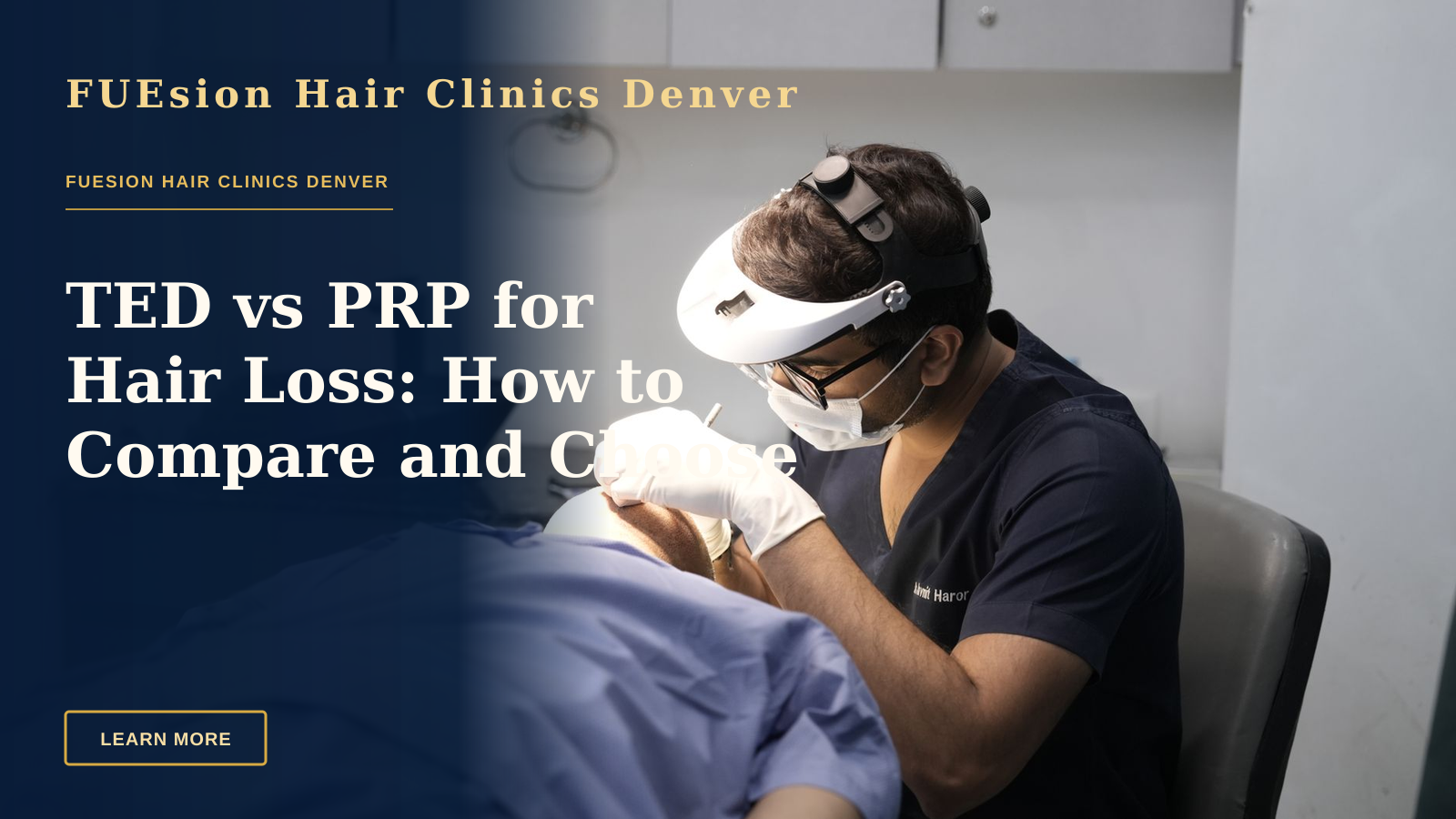
TED vs PRP for hair loss is a comparison many patients search for when weighing device-based therapies against biologic injections. The phrase "TED" is used in different contexts, so the first step is clarifying what you mean. This article explains how to evaluate any device‑style scalp therapy commonly labeled "TED" against platelet‑rich plasma (PRP), then shows when a clinic‑based option like PRP or FUEsion's non‑surgical InFuze™ ScalpPulse Technology may be appropriate.
If you already mean a specific device (for example LED/LLLT, microneedling with topical delivery, or a named transdermal delivery system), read the comparison framework below and use the practical checklist to map that device to your goals and hair‑loss stage. We also describe FUEsion's non‑surgical options and how PRP is used as an adjunct in clinical practice so you can make an informed next step.
Patient Journey & Consultation
Deciding between a device‑based approach (the thing you may be calling "TED") and PRP starts with a clear, documented assessment. At FUEsion Hair Clinics the patient journey begins with easy booking and a rapid response: consultation requests are acknowledged and typically confirmed within 24 hours, with general contact replies in 2–4 business hours. This early responsiveness helps you get an accurate baseline before any treatment is scheduled. According to Mesotherapy and PRP Treatment in Combination with Hair Loss in WomenCase Report (scholarly source), this source provides relevant background for the discussion.
Our complimentary Free Virtual Consultation includes a structured hair‑loss assessment, goal setting and a review of simulator visuals (if you run the simulator first). This is where specific terminology is clarified—so if you say "TED," the team will document exactly which device or protocol you mean and explain evidence and expectations for that therapy versus PRP.
Before a visit we encourage patients to use the digital tools that make consultations more productive. Running the Graft Calculator and AI Hair Simulator provides an image‑based graft estimate and a visual goal that the surgeon can reference during planning.
Key stages in the patient flow are designed to reduce uncertainty and create a written plan that maps to the chosen therapy. Typical milestones include a documented aesthetic plan, consensus on outcome measures, and a formal 12‑month review when applicable.
- Fast initial contact and scheduling with response SLAs for clarity.
- Free Virtual Consultation to confirm diagnosis and document goals.
- Pre‑work with the Graft Calculator and AI simulator to visualize outcomes.
- Surgeon or clinician consultation that defines the treatment roadmap and follow‑up schedule.
After the consult you should have a written plan that states whether PRP, a device therapy, a combined course, or a surgical pathway is recommended. Use the consultation page to book or ask questions about which test or trial session might be appropriate: Book your free consultation.
Ready to take the next step?
Speak directly with Dr. Sanders. No obligation. Completely free.
Find out if you're a candidate for FUE Hair Transplants or non-surgical hair regrowth options.
Book Your Free ConsultationSimulator
See your potential results before making a decision. Our AI Hair Simulator generates photo‑based previews and a personalized cost estimate so you enter the consultation informed and visually prepared. Because many device‑vs‑PRP choices hinge on expected visual density and hairline change, having an image‑centered goal reduces guesswork.
The simulator workflow is straightforward and fast: upload a clear frontal photo, let the AI estimate graft needs (or simulate device/PRP outcomes as appropriate), and save the preview to share with your clinician. The tool leverages FlowMediQ AI to produce clinically‑informed previews that are useful conversation starters in clinic.
Using the simulator before a consultation also helps tailor the discussion about whether a non‑surgical regimen (device or PRP) will meaningfully change your appearance, or whether a surgical option like FUE would be required to meet your goals.
- Quick photo upload (30 seconds–2 minutes) to get a preview and estimate.
- AI analyzes visible hair pattern and produces graft or treatment estimates.
- Personalized cost range so you can decide if the recommendation fits your budget.
- Saved previews make it easier to document agreed goals in your treatment plan.
Launch the simulator to visualize options and bring the results to your consultation: Get Free Access.
See your potential results before you commit
AI Hair Simulator
Our AI Hair Simulator uses your own photo to show realistic hairline, density and style options — and generates a personalized cost estimate so you walk into your consultation knowing exactly what you want and what it costs.
Get Free AccessReady to take the next step?
Book a Free ConsultationWhat "TED" Might Mean — And How To Frame The Comparison
When people search "TED vs PRP for hair loss" they may be referring to a range of device‑based or delivery technologies. Because the acronym isn't universally defined in hair‑restoration literature, we focus on the comparison framework you can apply regardless of which device you mean: mechanism, proven outcomes, treatment schedule, downtime, and how that choice fits your hair‑loss stage.
In practical terms many "TED‑style" offerings are forms of non‑invasive scalp stimulation or transdermal delivery (for example LED/LLLT, radiofrequency devices, or topical delivery platforms combined with microneedling). These are typically device‑driven protocols intended to stimulate follicles or improve topical uptake, while PRP is an autologous biologic injection meant to concentrate growth‑promoting factors at the follicle.
Use this checklist when comparing any device (your "TED") with PRP:
- Mechanism: Is it energy‑based stimulation (light, RF) or a biologic injection (PRP)? Which mechanism aligns with your hair‑loss biology?
- Evidence strength: Look for peer‑reviewed studies and clinical endpoints (density, terminal hair counts) rather than vendor testimonials.
- Treatment frequency and duration: Devices often require regular at‑home use or multiple clinic sessions; PRP is usually a series of clinic injections spaced weeks apart.
- Downtime & risks: Which option has fewer adverse effects and fits your lifestyle?
- Goals: Are you looking to slow thinning, thicken miniaturized hairs, or restore a receded hairline? PRP and devices vary by likely impact.
Applying this framework to your named device will give you a fair comparison against PRP. If you'd like help mapping a specific product to these criteria, bring the device name to your consultation and the clinical team will document expected outcomes and alternatives.
Services & Procedures
FUEsion offers a comprehensive menu of surgical and non‑surgical hair restoration services so that each patient can be matched to the right modality. Our surgical offerings include the proprietary FUEsion Technique with AI & AR Assisted FUE, while non‑surgical care includes InFuze™ Restoration with ScalpPulse Technology and adjunctive PRP therapy. Free virtual consultations and simulation tools are provided to guide decision making.
Below is an enumerated summary of core services and the key facts you need when comparing PRP to device‑based options. These entries summarize duration, anesthesia, downtime and expected timelines for visible results so you can line up realistic expectations with any device program you are evaluating.
- Hair Transplant (AI & AR Assisted FUE / FUEsion Hair Transplant) — Duration: 4–7 hours (4–10 hours for larger cases). Anesthesia: local. Downtime: return to work in 5–7 days. Results visible from 6 months, full at 12–18 months. Graft survival >95%.
- Beard & Eyebrow Transplants — Graft counts and angulation planned for natural orientation; typical durations and graft ranges vary by area.
- InFuze Non‑Surgical / InFuze™ Restoration — Uses ScalpPulse Technology for scalp activation and targeted compound infusion. No surgery and no downtime; suitable for early–mid stage loss or as adjunctive therapy.
- PRP Therapy — Offered as an adjunctive follicular stimulation option in clinic.
For a full list of services, additional details and to book specific procedures use our Services page: Hair Regrowth or view the full services menu at Services. If you want an instant estimate before booking, try the Cost Estimate.
See your potential results before you commit
AI Hair Simulator
Our AI Hair Simulator uses your own photo to show realistic hairline, density and style options — and generates a personalized cost estimate so you walk into your consultation knowing exactly what you want and what it costs.
Get Free AccessWant personalized advice?
Schedule Your AssessmentTrust & Guarantee (FUEsion Assurance)
Choosing any hair‑restoration path should include clear guarantees and documented checkpoints. The FUEsion Assurance program underpins our surgical and many non‑surgical offerings by committing to growth, artistry, aftercare and satisfaction. We discuss and document Assurance terms during consultation so expectations and remedies are agreed before work begins.
The program centers on a formal 12‑month review where the Growth Assurance benchmark is assessed. If agreed graft survival or growth benchmarks aren't met at that review, we will supplement results with additional grafts at no cost when clinically indicated. This formal review and remediation is one reason many patients prefer clinic‑based options for predictable outcomes.
Assurance also covers the aesthetic plan and aftercare access: the hairline design is agreed and documented pre‑op, and follow‑up appointments and surgeon access are included to monitor progress and address issues.
- Growth Assurance — Supplementary grafts at the 12‑month review if benchmarks aren't met.
- Artistry Assurance — Pre‑op documented hairline and corrective work if outcome deviates significantly.
- Aftercare Assurance — Follow‑ups and surgeon access included during recovery and growth monitoring.
- Satisfaction Assurance — Commitment to resolving concerns until published objectives are met.
To activate Assurance terms the plan is documented during consultation and confirmed in the post‑op plan; the 12‑month review is the formal checkpoint for Growth Assurance remedies. For more detail or to confirm how Assurance applies to a non‑surgical plan, schedule a consult here: Free Virtual Consultation.
Ready to take the next step?
Speak directly with Dr. Sanders. No obligation. Completely free.
Find out if you're a candidate for FUE Hair Transplants or non-surgical hair regrowth options.
Book Your Free ConsultationHow PRP Compares: Mechanism, Sessions, and Expected Outcomes
PRP (platelet‑rich plasma) uses your own blood to concentrate growth factors and cytokines that are injected into the scalp. In clinic, PRP is typically given as a series of sessions (often 3 monthly sessions followed by maintenance intervals) and is used to stimulate miniaturized follicles, increase thickness and slow further hair‑loss progression.
When considering PRP versus a device or combination therapy, note these practical differences: PRP is a biologic that depends on blood‑derived factors and injection technique; device therapies usually deliver energy or improve topical delivery and rely on repeated sessions or at‑home adherence. Many clinicians combine PRP with microneedling or device protocols to take advantage of complementary mechanisms.
PRP is often recommended for early‑to‑moderate thinning where follicles remain viable. It can be offered as an adjunct to surgical procedures (to support healing and graft growth) or as a stand‑alone attempt to improve density in diffuse thinning.
See how we can help you
Get Started TodayChoosing the Right Option: Practical Guidance
Follow this simple decision pathway to determine whether a device (your "TED"), PRP, or a combined plan is the best next step:
- Clarify the device: bring the device name/specifications to your consultation so clinicians can assess evidence and compatibility with your goals.
- Stage your hair loss: early miniaturization favors non‑surgical interventions; significant recession or vertex baldness may require surgical restoration for visible change.
- Consider commitment: device programs often demand ongoing sessions or home use; PRP requires clinic time but less frequent maintenance initially.
- Ask about combination plans: many successful regimens combine InFuze or device stimulation with PRP to amplify results.
Start by using the AI Hair Simulator to visualize realistic goals, then book a free consultation to map a clinic‑based plan and confirm whether PRP, a device, or a surgical course is the most reliable path to your goal.
Conclusion
"TED vs PRP for hair loss" is less a one‑size‑fits‑all question and more a decision about mechanism, evidence, and alignment with your hair‑loss stage and lifestyle. Devices (often cited as "TED‑type" therapies) can be useful for scalp stimulation or enhanced topical delivery, while PRP is a biologic injection that can thicken miniaturized hairs and is commonly used as an adjunct. Clinical decisions should be grounded in documented goals, realistic timelines and, when relevant, a clinic guarantee for follow‑up and remediation.
If you want a practical next step, run the AI Hair Simulator to see likely visual change and get an estimate, then schedule a Free Virtual Consultation to document a personalized plan that may include PRP, InFuze™ ScalpPulse Technology, or a surgical option. Our Assurance program means surgical patients have a documented 12‑month review and remedies if growth benchmarks aren't met.
Want help right now? Try the simulator and bring the result to your consultation so the team can map a clear, evidence‑based plan for you.
FAQ
Q: Is PRP better than device therapy for hair loss?
A: Neither is universally "better." PRP is an injection‑based biologic often used for early‑to‑moderate thinning, while device therapies vary widely in mechanism and clinical evidence. The best choice depends on your hair‑loss stage, treatment adherence, and documented goals.
Q: Can PRP and device treatments be combined?
A: Yes. Many clinicians combine PRP with microneedling or device stimulation to leverage complementary mechanisms. A consultation will clarify whether combination therapy makes sense for your pattern of loss.
Q: Does FUEsion offer PRP and non‑surgical options?
A: Yes. FUEsion provides PRP therapy as an adjunct and offers InFuze™ Restoration with ScalpPulse Technology as a non‑surgical option. Use the simulator and consultation links to determine which pathway suits you.
Medical Information Disclaimer
This content is provided for general educational purposes only. It is not a substitute for professional advice, diagnosis, or treatment. Readers are advised to consult qualified professionals for personalized recommendations.
Have questions? We have answers.
Speak With an Expert