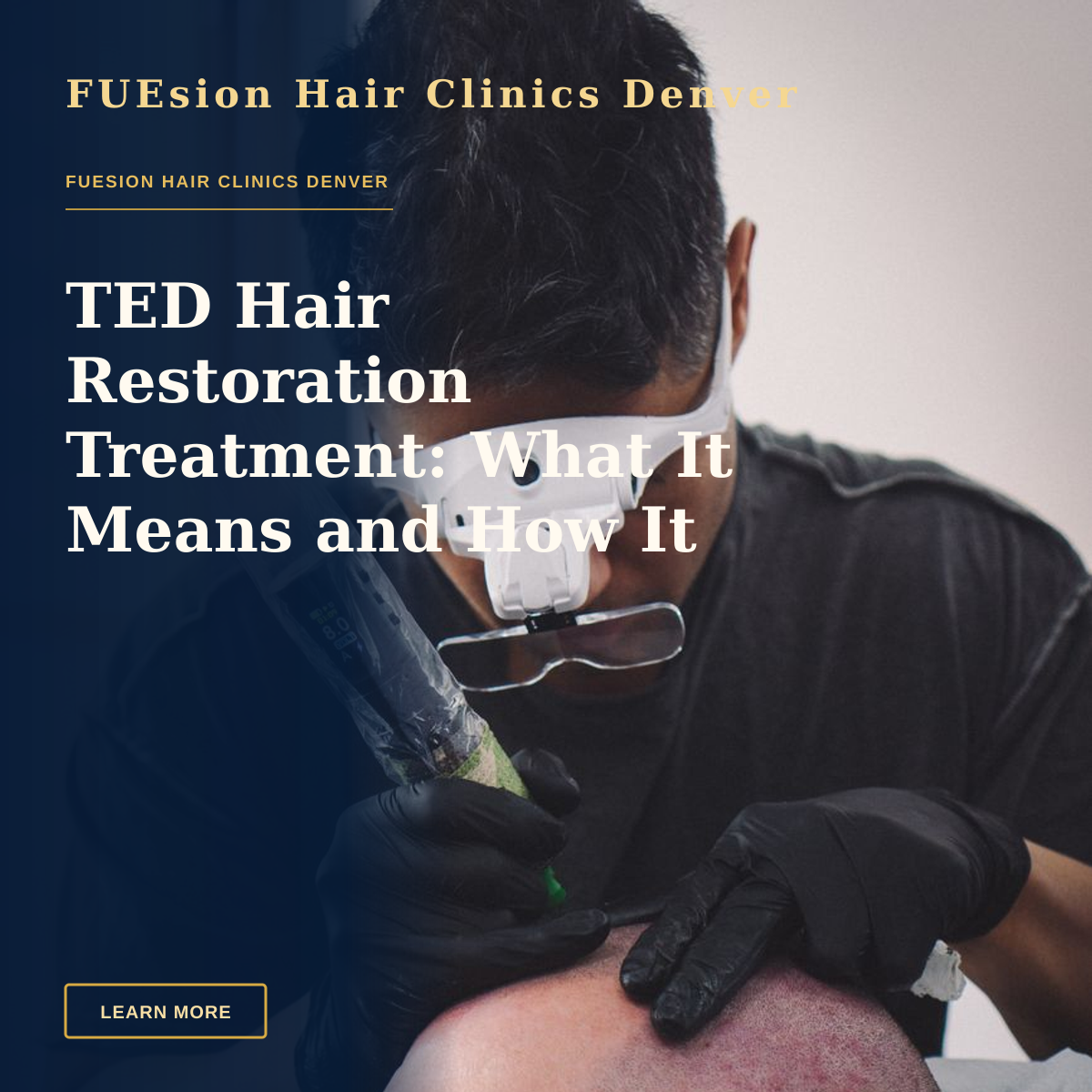
If you typed "TED hair restoration treatment" into a search bar, you may be looking for a specific device, a clinic brand, or a novel therapy described in a forum or a clinic brochure. There isn't a single, universally accepted medical definition for "TED" in hair restoration the way there is for FUE or PRP, so the first useful step is clarifying what someone means when they say "TED."
This article helps you do that: it explains common possibilities behind the label, shows the objective questions to ask about any treatment, and compares those options with evidence‑backed alternatives — both surgical and non‑surgical. Where relevant, it describes how FUEsion Hair Clinics’ proven options (AI & AR Assisted FUE, our InFuze™ ScalpPulse non‑surgical system and the AI Hair Simulator) align with the exact concerns you should have about a treatment called "TED." You’ll finish knowing what to ask, how to evaluate claims, and how to preview realistic outcomes before booking a consult.
Patient Journey & Consultation
Understanding any hair restoration workflow starts with the patient journey: how you go from first contact to a documented plan, a procedure (if needed), and follow‑up. At consultation you should expect clear timelines, documented goals and a pathway to evaluate results. Patients can start their journey online or by contacting a clinic; consultation requests are acknowledged quickly and a team member confirms within 24 hours, with general contact replies within 2–4 business hours. According to Medical Treatment of Hair Loss (scholarly source), this source provides relevant background for the discussion.
Most practices offer a free virtual consultation option so you can speak with a clinician without travel. In an effective consult you should receive a hair loss assessment, an explanation of relevant options, and—if available—a simulator preview that translates expectations into visuals. Digital pre‑work such as running a graft estimate and uploading photos to a simulator speeds the appointment and makes recommendations more precise.
Typical steps in a modern patient journey include booking, a virtual or in‑person consult, pre‑op or pre‑treatment planning (including photographs and simulator runs), the procedure or non‑surgical sessions, post‑op follow‑ups, and a formal review at 12 months to verify growth benchmarks. The 12‑month checkpoint is important if the clinic offers any growth or satisfaction guarantees.
- Fast booking and confirmation—consultation requests acknowledged within 24 hours.
- Free virtual consultation to review photos and treatment options remotely.
- Pre‑visit digital tools (graft estimates, photo simulators) to shape realistic goals.
- Structured follow‑up and a formal 12‑month review to verify growth and activate remedies if necessary.
Before you proceed, confirm how the clinic documents the agreed hairline/design, who performs the procedure (surgeon vs technician), and the expected timeline for visible improvement. If you’d like to start a consult now, you can book a free consultation with our team to discuss whether a treatment labeled "TED" matches your needs.
Ready to take the next step?
Speak directly with Dr. Sanders. No obligation. Completely free.
Find out if you're a candidate for FUE Hair Transplants or non-surgical hair regrowth options.
Book Your Free ConsultationSimulator
One of the fastest ways to judge any hair restoration claim—whether it’s called "TED" or something else—is to see a realistic, photo‑based preview of likely results. Our AI Hair Simulator / AI Hair Studio analyzes a clear frontal photo, estimates graft needs and returns an evidence‑informed before/after preview plus a personalized cost estimate. This reduces uncertainty and helps you evaluate whether a treatment’s promises match likely outcomes.
The simulator workflow is simple and designed to be clinically useful. Upload a clear, well‑lit frontal photo, let the AI analyze your hair pattern to estimate grafts or coverage needs, and review a simulated result you can save and share with a surgeon. The simulator’s estimate also feeds a transparent cost range so you walk into a consult informed.
Simulation doesn’t replace a medical exam, but it sets practical expectations and focuses the conversation on achievable density, hairline placement and style. When comparing treatments, ask the clinic to run your photo through their simulator and to explain precisely how the simulated result maps to their proposed technique, downtime and expected timeline.
- Upload a clear frontal photo for the most accurate preview.
- Receive an AI‑generated graft estimate and before/after simulation.
- Use the simulation to compare surgical vs non‑surgical pathways and costs.
- Save the result and bring it to your consultation to document your goals.
To see a photo‑based preview of how different approaches might look on you, try our AI Hair Simulator. It’s free, requires no signup, and helps turn vague promises into testable treatment plans.
See your potential results before you commit
AI Hair Simulator
Our AI Hair Simulator uses your own photo to show realistic hairline, density and style options — and generates a personalized cost estimate so you walk into your consultation knowing exactly what you want and what it costs.
Get Free AccessReady to take the next step?
Book a Free ConsultationWhat Does "TED" Mean — And How To Evaluate It
There is no single authoritative definition for "TED hair restoration" in peer‑reviewed literature or across major clinical guidelines. When you encounter the term, it usually falls into one of three possibilities:
- A proprietary or clinic‑specific brand name for a device or protocol (for example, a clinic may market a multi‑modal system as "TED").
- An acronym or shorthand used in advertising or forums that stands for a technical method (less common and often ambiguous).
- A mislabeling or conflation of established technologies (for example combining LED/laser, microneedling and topical infusion) under a catchy name.
How to evaluate a "TED" offering: first ask the provider to define exactly what technologies and active steps are included. Good answers should include the following details: the underlying mechanism (e.g., micro‑infusion + mechanical stimulation), who performs the treatment, how many sessions and intervals are needed, clinical evidence of efficacy, expected timeline and measurable benchmarks, downtime, and a transparent cost per session or package.
Compare those specifics to well‑documented alternatives. For example, non‑surgical systems that combine scalp activation with compound infusion — like InFuze™ Restoration using InFuze™ ScalpPulse Technology — clearly state mechanism (multi‑modal scalp activation + targeted infusion), no downtime, and measurable regrowth metrics when used as indicated. On the surgical side, a proprietary technique such as the FUEsion Technique (AI & AR Assisted FUE) details graft survival, extraction methods and physician involvement. Ask for before/after evidence and references to published outcomes or internal audits before you trust a novel label.
Services & Procedures
FUEsion Hair Clinics offers a comprehensive menu of surgical and non‑surgical options so you can match a clinical diagnosis to an evidence‑based solution. Each service is described here with the key facts patients use to compare techniques and set expectations. For more about our full menu and bookings, visit our main site at FUEsion Hair Clinics.
We perform physician‑led FUE, targeted facial hair transplants and non‑surgical scalp restoration. For surgical cases, we emphasize microscopic donor assessment, micro‑punch extraction calibrated to follicle characteristics and artistic recipient site creation. Non‑surgical options pair scalp stimulation with targeted infusion to reactivate follicles where appropriate.
- Hair Transplant (AI & AR Assisted FUE / FUEsion Hair Transplant) — 4–7 hours (up to 10 for larger cases), local anesthesia, return to work in 5–7 days, results from 6 months and full at 12–18 months; graft survival >95%.
- InFuze Non‑Surgical / InFuze™ Restoration — ScalpPulse Technology, no surgery, no downtime; suitable for early–mid stage hair loss and adjunctive therapy.
- Beard, Eyebrow, Female Transplants, FUT, PRP, Scalp Micropigmentation — Specialized protocols and graft counts tailored to each indication.
Benefits of a combined, clinic‑led service menu include continuity of care (the same clinical team manages non‑surgical and surgical phases), documented aesthetic planning, and integrated aftercare. Before you commit, compare procedure length, anesthesia type, downtime, expected visible timelines, and documented survival or regrowth benchmarks across offerings.
We encourage patients to use our digital tools before a consult: run the Graft Calculator to estimate graft counts and launch the AI Hair Simulator to visualize outcomes. For bookings and detailed procedural pages see our Services page, or view representative outcomes in the Results Gallery.
See your potential results before you commit
AI Hair Simulator
Our AI Hair Simulator uses your own photo to show realistic hairline, density and style options — and generates a personalized cost estimate so you walk into your consultation knowing exactly what you want and what it costs.
Get Free AccessWant personalized advice?
Schedule Your AssessmentTrust & Guarantee (FUEsion Assurance)
When evaluating any hair restoration label like "TED," consider the clinic's guarantees and how they operationalize outcomes. We back our work with the industry‑first FUEsion Assurance, a multi‑pillar guarantee covering growth, artistry, aftercare and satisfaction. The Assurance is documented during consultation and the formal 12‑month review is the activation point for growth remedies.
Key promises are clearly stated so patients know what to expect: growth benchmarks are agreed pre‑op; if those benchmarks aren’t met at the 12‑month review, supplemental grafts are provided at no cost when indicated. Artistry, aftercare and satisfaction are likewise managed with documented plans and surgeon access to resolve concerns.
- Growth Assurance — Minimum graft survival/growth benchmark; supplemental grafts at 12 months if agreed benchmarks are not met.
- Artistry Assurance — Aesthetic plan documented pre‑op; corrective work if execution deviates materially from the design.
- Aftercare & Satisfaction — Comprehensive follow‑ups and accessible surgeon support through recovery and growth monitoring.
Ask any clinic marketing a novel therapy how they guarantee and measure outcomes. If they can’t provide a clear remediation pathway, documented benchmarks, or surgeon involvement in follow‑up, take that as a red flag. To discuss candidate suitability and how our Assurance applies to your plan, book a free consultation and we’ll document goals and guarantee terms before you proceed.
Ready to take the next step?
Speak directly with Dr. Sanders. No obligation. Completely free.
Find out if you're a candidate for FUE Hair Transplants or non-surgical hair regrowth options.
Book Your Free ConsultationHow "TED" Might Compare To Proven Options
If a clinic offers a treatment called "TED," measure it against the following practical benchmarks: who performs the therapy, objective evidence of effectiveness, measurable timelines, safety profile, and whether results are permanent or require ongoing maintenance. Many novel systems are best thought of as adjuncts rather than replacements for established modalities.
For example, our InFuze™ ScalpPulse Technology is a documented non‑surgical system that combines multi‑modal scalp activation with targeted compound infusion and requires no downtime. It’s intended for early–mid stage loss and as an adjunct to surgery. Surgical restoration through our FUEsion Technique offers permanent, transplant‑based density with documented graft survival >95% under our protocols. If a "TED" protocol claims to combine benefits of both, ask for clear evidence and an explanation of how lesion depth, compound delivery and clinician involvement are managed.
See how we can help you
Get Started TodaySafety, Eligibility & Expected Timeline
Whether a treatment is surgical, device‑based, or topical, safety and candidacy come down to medical history, donor availability, and hair loss pattern. Expect a thorough medical history, scalp exam and documentation of expectations during your consult. Common timelines you should expect across modern therapies are:
- Early shedding and initial regrowth starting around 3 months.
- Visible improvement by 6 months for many protocols.
- Full, stable results for transplants by 12–18 months.
If a treatment labeled "TED" promises immediate full density in days or weeks with a single session and no maintenance, treat that claim skeptically. Most regenerative or infusion therapies require a course of treatments and measurable follow‑up to document efficacy. Surgical solutions carry a predictable recovery window (transplants often allow return to work in about 5–7 days) and permanent graft placement timelines that are well established.
Conclusion
"TED hair restoration treatment" is not a widely standardized medical term, so when you encounter it the most important actions are clarification and evidence‑seeking. Ask precisely what technologies and steps are included, who performs the procedure, and how success is measured. Use image‑based simulation and graft estimates to set realistic expectations before a consult, and insist on documented guarantees or remediation if growth targets are not met.
Proven alternatives to examine include physician‑led AI & AR Assisted FUE (for permanent, transplant‑based density) and clinically designed non‑surgical systems such as InFuze™ ScalpPulse Technology (for early‑to‑mid stage regrowth and adjunctive therapy). If you want to visualize an outcome and get a cost estimate before speaking to a clinician, try the AI Hair Simulator and run the Graft Calculator. When you’re ready, book a free consultation to get a documented plan and review any assurances in writing.
FAQ
Q: Is "TED" a recognized clinical procedure?
A: Not as a single, standardized clinical procedure. It more often appears as a proprietary name or marketing term. Always ask for a clear technical description and clinical evidence.
Q: How quickly will I see results from non‑surgical scalp infusion systems?
A: Typical early regrowth signals appear around 3 months, with visible results by about 6 months. Courses and results vary by system and baseline hair loss.
Q: Can a simulator predict exact results?
A: Simulators provide realistic, evidence‑informed previews to set expectations, but they do not guarantee exact outcomes. Use them as a planning tool paired with a medical exam.
Q: If my growth is insufficient, what remedies are available?
A: Ask whether the clinic documents growth benchmarks and what remediation is offered. Practices with formal guarantees, such as the FUEsion Assurance, document benchmarks and provide supplemental corrective steps at specified review points.
Medical Information Disclaimer
This content is provided for general educational purposes only. It is not a substitute for professional advice, diagnosis, or treatment. Readers are advised to consult qualified professionals for personalized recommendations.
Have questions? We have answers.
Speak With an Expert