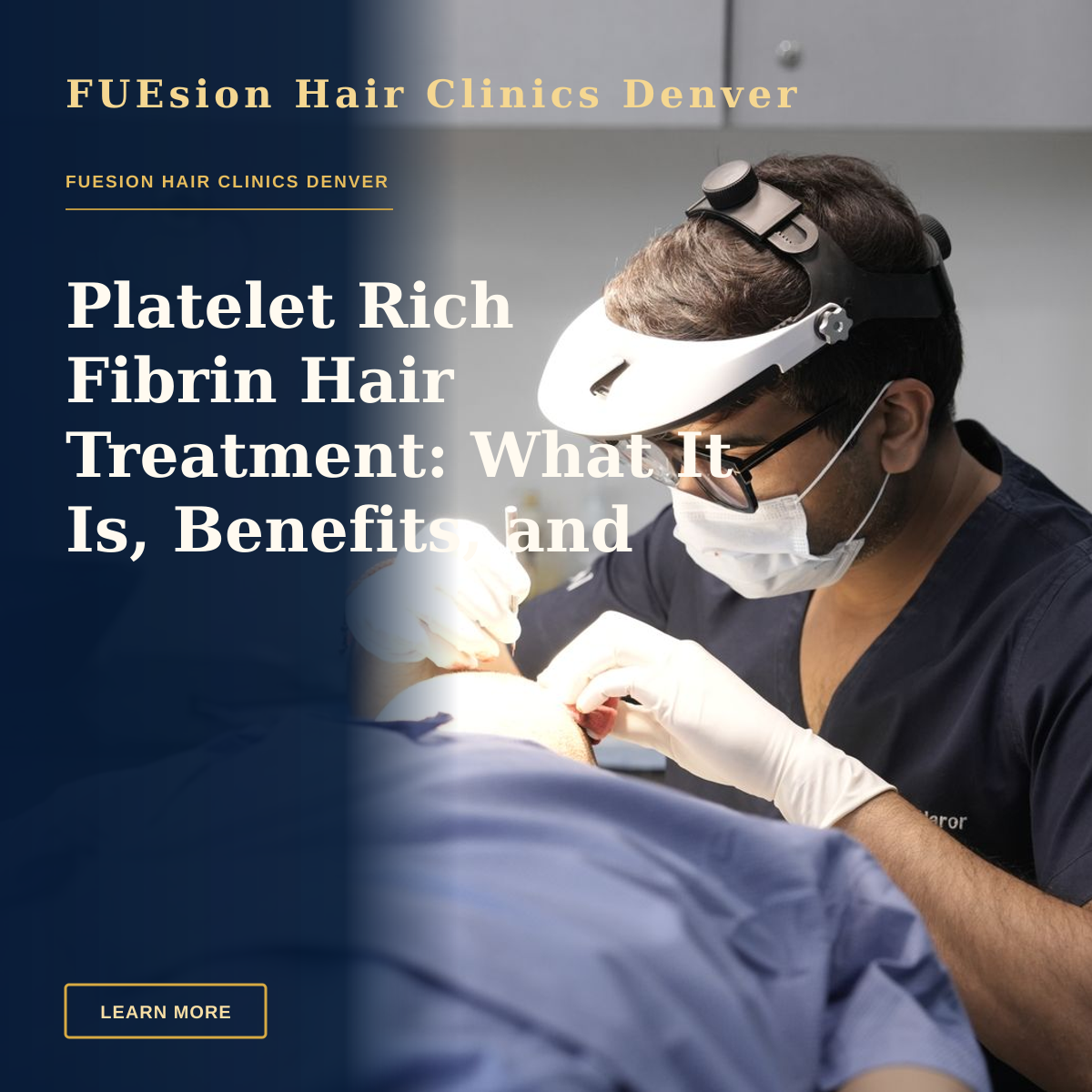
platelet rich fibrin hair treatment is the focus of this practical guide for clinicians and learners. Platelet rich fibrin (PRF) hair treatment is a blood‑derived therapy used to stimulate the scalp and support hair regrowth. If you're researching PRF because you want a non‑surgical option, this article explains exactly what PRF is, how it compares with platelet rich plasma (PRP), what to expect during treatment, the typical evidence and safety considerations, and how to decide whether PRF should be part of your plan.
FUEsion Hair Clinics offers a range of non‑surgical and surgical options — including PRP therapy as an adjunct and the InFuze™ Restoration platform with ScalpPulse Technology — so patients can compare PRF with other evidence‑based modalities. Read on to understand the clinical basics of PRF, realistic outcomes, and practical next steps to evaluate whether PRF fits your goals.
Patient Journey & Consultation
Choosing PRF or any scalp‑stimulating therapy starts with an accurate assessment and a clear plan. At our clinics the patient flow is designed to move from discovery to a documented treatment roadmap where expectations and measurements are agreed in writing. According to Comparative evaluation of mechanical properties of leukocyte rich platelet rich fibrin, advanced-platelet rich fibrin, titanium-platelet rich fibrin, selphyl platelet rich fibrin m (scholarly source), this source provides relevant background for the discussion.
Initial contact and booking are straightforward: you can request an appointment online or through our Contact/Consultation pages, and a team member will confirm within 24 hours for consultation requests (general inquiries are typically acknowledged within 2–4 business hours). The first clinical interaction is a free virtual consultation where a clinician evaluates your hair loss pattern, medical history, and goals.
We encourage patients to try digital pre‑work before their consult. Using the Graft Calculator and the AI Hair Simulator helps clarify realistic goals, generate a photo‑based graft estimate when relevant, and orient the clinical discussion around visual outcomes.
- Free Virtual Consultation — no obligation, covers assessment and goal setting.
- Digital pre‑work — run the Graft Calculator and AI Hair Simulator to show visual options and a cost range.
- Surgeon consultation & plan — a documented roadmap where treatment choices (PRF, PRP, InFuze™, or FUE transplant) are selected and timelines reviewed.
- Follow‑up and monitoring — routine post‑treatment visits with a formal 12‑month review for surgical cases.
After the consult, your clinician will recommend a course of action: a standalone non‑surgical program (for example, PRF, PRP, or InFuze™ treatments), a combined approach (PRF or PRP plus microneedling or a transplant), or a surgical plan. If you’re evaluating PRF specifically, bring any prior hair loss photos and your simulator results into the consultation to ensure the clinician tailors a plan to your needs.
Ready to take the next step?
Speak directly with Dr. Sanders. No obligation. Completely free.
Find out if you're a candidate for FUE Hair Transplants or non-surgical hair regrowth options.
Book Your Free ConsultationSimulator
Before committing to any treatment it helps to visualize realistic outcomes. Our AI Hair Simulator uses a frontal photo to generate clinically‑informed previews of potential improvements in hairline, density and style, and it returns a personalized cost estimate so you walk into your consultation informed.
Powered by FlowMediQ AI, the simulator performs a rapid analysis of your current hair pattern and estimates the grafts or treatment intensity required for the proposed outcome. For non‑surgical programs like PRF, the simulator can illustrate likely density improvements and help you compare non‑surgical versus transplant options visually.
How it works in four steps:
- Upload Your Photo – a clear, well‑lit frontal photo gives the most accurate simulation.
- AI Analyses Your Grafts – the tool scans and estimates grafts or treatment intensity needed.
- See Before & After + Cost – receive an instant preview and a personalized cost estimate.
- Share with Your Surgeon – save and bring results into your consultation for a tailored plan.
Using the simulator before your consult shortens the planning phase and focuses the clinician on the outcomes you value most. If you’re primarily considering PRF, run the simulator and then discuss those simulated density changes with your clinician to set realistic expectations for non‑surgical approaches versus surgical restoration.
See your potential results before you commit
AI Hair Simulator
Our AI Hair Simulator uses your own photo to show realistic hairline, density and style options — and generates a personalized cost estimate so you walk into your consultation knowing exactly what you want and what it costs.
Get Free Access
Ready to take the next step?
Book a Free ConsultationHow Platelet Rich Fibrin (PRF) Works — The Basics
Platelet rich fibrin (PRF) is an autologous (from your own blood) concentrate that contains platelets, growth factors and a fibrin matrix. It is derived by drawing a small amount of the patient’s blood, centrifuging it to separate components, and collecting the fibrin‑rich layer that contains platelets and signaling molecules thought to support tissue repair.
Compared with traditional PRP (platelet rich plasma), PRF typically contains a fibrin scaffold that provides a slow release of growth factors over time. Clinicians use PRF to potentially enhance local blood supply, reduce inflammation, and support follicular microenvironment — all intended to create a milieu more favorable to hair growth when follicles are still responsive.
In practice, PRF is administered into the scalp using injections or combined with microneedling to improve distribution. Treatment schedules vary, but many programs use a series of sessions spaced weeks apart followed by maintenance treatments. Your clinician will recommend a protocol based on your hair loss pattern and response.
PRF vs PRP: Key Differences
PRF and PRP are related but distinct platelet concentrates. The practical differences clinicians consider are:
- Composition: PRF includes a fibrin matrix along with platelets and leukocytes; PRP is a plasma fraction rich in platelets but without the same fibrin scaffold.
- Release kinetics: PRF is often described as providing a slower, sustained release of growth factors versus PRP’s more immediate release.
- Processing: PRF protocols typically use different centrifugation speeds and timings and do not require anticoagulants.
Which is better depends on the clinical context, practitioner experience, and the patient’s goals. During your consultation the clinician will explain the pros and cons and how PRF or PRP might integrate with other therapies like microneedling, topical regimens, InFuze™ ScalpPulse treatments, or surgical restoration.
Want personalized advice?
Schedule Your AssessmentWho Is a Good Candidate For PRF?
PRF is usually considered for patients with early to mid‑stage hair thinning who still have viable follicles. Ideal candidates are those who want a minimally invasive approach, have realistic expectations about non‑surgical results, and prefer autologous treatments that use their own blood.
PRF may be offered as a stand‑alone trial for diffuse thinning, or as an adjunct to other treatments — for example, PRF can be combined with microneedling, topical therapies, or used around the time of a hair transplant to support healing and graft integration (discuss this with your surgeon). Our clinics also offer InFuze™ Restoration with ScalpPulse Technology as a non‑surgical, device‑assisted alternative with targeted compound infusion and no downtime.
What To Expect During a PRF Session
A typical PRF visit includes a brief medical review, blood draw, centrifugation, and injections or microneedle application. Sessions are usually performed in an outpatient setting and can take anywhere from 30–90 minutes depending on whether you combine PRF with microneedling or other therapies.
Common practical notes:
- Preparation: Avoid blood thinners or NSAIDs as advised by your clinician in the days before treatment.
- Comfort: Local numbing or topical anesthetic is often used to minimize injection discomfort.
- Downtime: Minimal — most patients return to normal activity the same day, though temporary redness or mild soreness is common.
- Course: A typical program may include 3 monthly sessions followed by maintenance every 3–6 months, but protocols vary by provider and patient response.
See how we can help you
Get Started TodaySafety, Side Effects, and What The Evidence Shows
Because PRF is autologous, it carries a low risk of allergic reaction or transmission of infection when proper sterile technique and single‑use equipment are used. Common side effects are localized redness, tenderness, bruising at injection sites, and short‑term swelling.
Outcomes vary. Clinical literature on PRF and PRP shows mixed but promising results for improving hair thickness and density in selected patients. Non‑surgical options tend to produce subtler changes than surgical transplantation; realistic expectations, careful patient selection, and documented follow‑up are essential.
At our clinics, PRP therapy is offered as an adjunct where clinically indicated; your clinician will review risks, benefits, and expected timelines with you in writing.
Combining PRF With Other Treatments
PRF is often most effective as part of a multimodal program rather than a single therapy. Common combinations include:
- Microneedling + PRF — improved delivery and distribution through microchannels.
- Topical/regimen therapy — prescription topicals or nutraceuticals to support follicle health.
- Device therapies — low‑level laser or scalp stimulation platforms can be used alongside PRF.
- Surgical timing — PRF may be used peri‑operatively to support healing, though transplant-specific protocols should be discussed with your surgeon.
Our InFuze™ ScalpPulse Technology is a clinician‑delivered, non‑surgical option that uses multi‑modal scalp activation and targeted compound infusion for measurable regrowth with no downtime; compare these options during your consultation to choose the program best aligned with your goals.
Services & Procedures
We offer a comprehensive, fully enumerated menu of surgical and non‑surgical hair restoration services — each described with the key facts you need to reference in content. Whether you pursue PRF, PRP, InFuze™, or a surgical transplant, each option is planned and documented with your goals in mind.
Below is our core services list with the practical facts that patients most often ask about. Use our Services page for bookings and procedural pages for deeper technical details.
Key services include:
- Hair Transplant (AI & AR Assisted FUE / FUEsion Hair Transplant) — Duration: 4–7 hours (4–10 hours for larger cases). Anesthesia: local. Downtime: return to work in 5–7 days. Results: visible from 6 months, full at 12–18 months. Graft survival: >95%.
- Beard Transplant — Typical graft counts 300–2,500. Duration: 3–8 hours. Downtime: ~5 days. Permanent, natural growth.
- Eyebrow Transplant — 50–400 grafts per eyebrow. Duration: 2–4 hours with precise angulation.
- Female Hair Transplant — Specialized protocols for Ludwig, traction, and post‑partum patterns; no strip removal.
- InFuze Non‑Surgical / InFuze™ Restoration — ScalpPulse Technology, no surgery, no downtime; suitable for early–mid stage loss or adjunct to surgery.
- FUT (strip) — Offered when clinically indicated.
- PRP therapy — Platelet‑rich plasma as an adjunctive follicular stimulation option.
- Scalp Micropigmentation — Cosmetic density and scar camouflage.
- Scar Repair — Surgical correction and camouflage for accidents, burns, or prior strip surgery.
- Hairline Lowering — Aesthetic refinement procedures.
- Free Virtual Consultation — Complimentary expert surgical assessment.
- Virtual Consultations — Secure video visits with our team and flagship surgeons.
- AI Hair Simulator / AI Hair Studio — Photo‑based simulation & cost estimate with no sign‑up required.
- Graft Calculator — 3‑step graft estimate for planning and cost previews.
- Personalized treatment planning and post‑operative care — Included and backed by FUEsion Assurance.
These offerings let patients select conservative, device‑assisted, or surgical pathways depending on hair loss stage and personal preferences. For more details and to compare specific protocols, visit our Services page or book a consultation.
See your potential results before you commit
AI Hair Simulator
Our AI Hair Simulator uses your own photo to show realistic hairline, density and style options — and generates a personalized cost estimate so you walk into your consultation knowing exactly what you want and what it costs.
Get Free AccessTrust & Guarantee (FUEsion Assurance)
We back every procedure with an industry‑first, fully enumerated assurance program called the FUEsion Assurance. The Assurance is documented during consultation and confirmed in your post‑op plan so you know the measurement points and remedies in advance.
The Assurance has clear pillars that protect patients’ outcomes and experience. Our 12‑month review is the formal checkpoint for growth benchmarks and any necessary remedial work.
- Growth Assurance — We guarantee a minimum graft survival/growth benchmark. If your growth falls short of the agreed benchmark at the 12‑month review, we will supplement your result with additional grafts at no cost when indicated.
- Artistry Assurance — The hairline and aesthetic plan are agreed and documented prior to surgery. If the executed outcome deviates significantly from the agreed design, we will perform corrective work to achieve the intended artistry.
- Aftercare Assurance — Comprehensive post‑operative care, follow‑up appointments and surgeon access are included as part of every package.
- Satisfaction Assurance — We commit to addressing concerns promptly and working toward the published outcome objectives until you are satisfied.
The Assurance is discussed during consultation and becomes part of your written plan. If you want full terms or have specific questions about Assurance activation, we recommend reviewing the Assurance page and discussing benchmarks during your consultation.
Ready to take the next step?
Speak directly with Dr. Sanders. No obligation. Completely free.
Find out if you're a candidate for FUE Hair Transplants or non-surgical hair regrowth options.
Book Your Free ConsultationMaking the Decision: PRF, PRP, InFuze™, or Transplant?
The right choice depends on the degree of hair loss, donor reserve, patient priorities (non‑surgical vs permanent restoration), and timeline. Non‑surgical therapies like PRF or InFuze™ can be attractive for those wanting low‑downtime options; they can sometimes slow progression and improve thickness. Surgical FUE transplants remain the most predictable way to restore permanent density when donor hair is available.
Key decision factors:
- Severity of loss — early/mild thinning responds better to conservative treatments than advanced baldness.
- Desire for permanence — transplants move permanent donor follicles to thinning areas; PRF/PRP are supportive rather than permanently restorative in most cases.
- Downtime & recovery — PRF and InFuze™ offer minimal downtime; FUE transplants typically require a 5–7 day recovery before returning to work.
- Cost & plan — use the AI Hair Simulator and Graft Calculator to generate personalized cost estimates before your consult.
Discuss these factors with a clinician during your free consultation. If you value a data‑driven visual preview, start with the AI Hair Simulator and bring those results into the clinical discussion.
Conclusion
Platelet rich fibrin (PRF) is a minimally invasive, autologous scalp therapy intended to support follicular health and improve hair thickness in selected patients. It differs from PRP by including a fibrin scaffold that can offer sustained growth factor delivery. PRF is best considered for early–mid stage thinning, often as part of a multimodal program that may include microneedling, topical care, device therapies, or surgical planning.
Deciding whether PRF is right for you starts with assessment: run the AI Hair Simulator to visualize outcomes, use the Graft Calculator if you’re comparing transplant options, and book a free virtual consultation so a surgeon can document a personalized plan and review the FUEsion Assurance. If you’re curious about non‑surgical alternatives with measurable regrowth, ask about InFuze™ ScalpPulse Technology during your consult.
The most useful next step is to combine visualization with a clinical review: launch the AI Hair Simulator, gather your photos, and schedule a complimentary consultation to get a tailored recommendation and transparent cost estimate.
FAQ
Is PRF better than PRP for hair? PRF and PRP have different biological properties; PRF contains a fibrin matrix that may provide slower release of growth factors. Which one is better depends on clinical context and practitioner experience. Discuss comparative benefits during your consultation.
How soon will I see results after PRF? Non‑surgical treatments are gradual. Many patients notice subtle changes within 3–6 months, with full effects and best assessment after several sessions and ongoing monitoring.
Can PRF replace a hair transplant? For early thinning, PRF can be part of a conservative program; however, PRF is usually not a substitute for transplant when significant permanent density is needed. A transplant is the only option that relocates permanent donor follicles to balding areas.
Do you offer PRF at your clinics? Our clinics offer PRP therapy as an adjunct; speak with a clinician during your consultation to discuss whether PRF is available or indicated as part of your personalized plan.
Medical Information Disclaimer
This content is provided for general educational purposes only. It is not a substitute for professional advice, diagnosis, or treatment. Readers are advised to consult qualified professionals for personalized recommendations.
Have questions? We have answers.
Speak With an Expert