Is FUE hair transplantation permanent? Short answer: in properly performed cases, transplanted hair is generally permanent because the donor follicles come from areas genetically resistant to the hormones that cause pattern hair loss. That permanence depends on stable donor supply, correct surgical technique, graft survival and a realistic long-term plan that accounts for future hair loss.
This article explains what “permanent” means for Follicular Unit Extraction (FUE), the biological reasons transplanted hair typically endures, the common reasons results can change over time, and practical steps you can take to maximize long-term outcomes. Where helpful, we’ll describe how advanced approaches — including AI & AR Assisted FUE, micro‑punch extraction, graft holding protocols and non‑surgical adjuncts such as InFuze™ ScalpPulse Technology — influence permanence. We also explain the role of the industry‑first FUEsion Assurance program, which documents growth benchmarks and remedies should outcomes fall short.
Patient Journey & Consultation
Most patients begin with a free virtual or in‑person consultation to determine candidacy, set expectations and document a personalized plan. Consultation requests can be made online or via our Contact pages; the team aims to acknowledge consultation requests within 24 hours and general inquiries in 2–4 business hours. During the consult we review hair loss pattern, donor strength and your long‑term goals so the chosen approach supports permanence over the coming years. According to FUE – A Permanent Treatment for White Hair Removal? (scholarly source), this source provides relevant background for the discussion.
We encourage patients to run the Graft Calculator and launch the AI Hair Simulator before or during their consult. These tools provide an initial graft estimate and a photo‑based visual so surgeon and patient agree on target density and hairline design. Critical paperwork and the FUEsion Assurance terms are discussed and documented at the surgeon consultation.
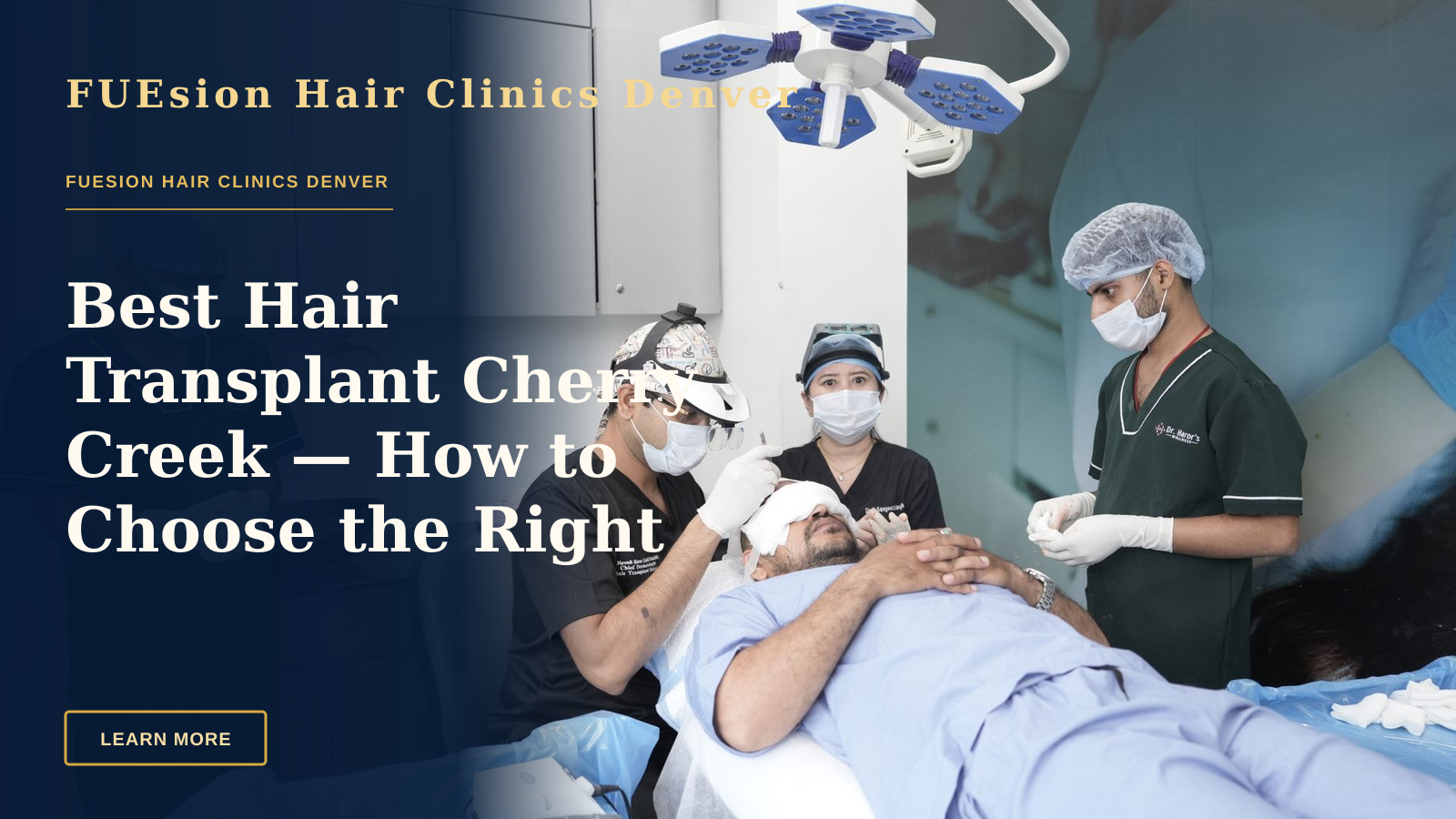
On procedure day for FUE, the typical workflow uses local anesthesia and the proprietary surgical protocol that emphasizes microscopic donor assessment, micro‑punch extraction and calibrated handling to protect follicles. Non‑surgical InFuze sessions use ScalpPulse activation and infusion with zero downtime.
- Quick access: free virtual consultations with nationwide availability.
- Data‑driven planning: run the Graft Calculator and AI Hair Simulator first.
- Surgeon‑led decisions: the aesthetic plan and Assurance are confirmed with a lead surgeon.
- Clear timeline: shedding begins ~3 months, visible change by 6 months, full results at 12–18 months.
Aftercare includes routine follow‑ups and a formal 12‑month review that evaluates growth benchmarks. To start the process, book your free consultation and bring your simulator results to the meeting.
Ready to take the next step?
Speak directly with Dr. Sanders. No obligation. Completely free.
Find out if you're a candidate for FUE Hair Transplants or non-surgical hair regrowth options.
Book Your Free ConsultationSimulator
Seeing a likely outcome before you commit clarifies expectations and helps evaluate permanence in your specific case. Our AI Hair Simulator analyses a clear frontal photo and generates an evidence‑informed preview of front and crown restoration along with a personalized cost estimate.
The Simulator is powered by FlowMediq AI and designed to reflect realistic restoration that a properly executed FUE procedure can achieve. It also provides an instant graft estimate to guide surgical planning and identify whether donor supply supports the desired density — a central question for permanence.
Use the tool before your consultation to speed decision‑making and to provide the surgeon with a shared visual reference for hairline and density. If the Simulator shows a plan that requires more grafts than your donor safely allows, your surgeon will discuss staged procedures or alternative strategies that preserve long‑term naturalness.
- Upload a clear, well‑lit frontal photo for best results.
- Receive an AI‑estimated graft count and cost in minutes.
- Save and share your simulation with the surgeon for a documented plan.
- Use simulations to compare single vs staged approaches when donor supply is limited.
The Simulator bridges discovery and planning: run it, save the results, and bring them to your consult. Get free access to the AI Hair Simulator and see a realistic preview of what permanence could look like for you.
See your potential results before you commit
AI Hair Simulator
Our AI Hair Simulator uses your own photo to show realistic hairline, density and style options — and generates a personalized cost estimate so you walk into your consultation knowing exactly what you want and what it costs.
Get Free AccessReady to take the next step?
Book a Free ConsultationWhy Transplanted Hair Is Usually Permanent
When people ask whether FUE hair transplantation is permanent, they mean: will the hairs placed in the balding area continue to grow long term? The biological basis for permanence is straightforward: grafts are harvested from donor sites (usually the back and sides of the scalp) that are genetically resistant to dihydrotestosterone (DHT), the hormone that causes male and female pattern hair loss. When these follicles are moved to the thinning area, they typically retain that resistance and continue to produce hair in their new location.
However, permanence is not absolute and depends on several procedural and patient factors. Key technical elements that increase long‑term survival include careful donor mapping, micro‑punch extraction tailored to follicle characteristics, minimal out‑of‑body time, and precise recipient site creation that preserves follicle orientation and blood supply. The proprietary FUEsion Technique — an AI & AR Assisted FUE workflow — is designed to optimize these variables; the clinic reports graft survival rates >95% when their calibrated protocols are followed.
Even with excellent technique, some loss of transplanted follicles can occur from mechanical trauma, poor graft handling, infection, or patient biology. That’s why both surgical protocol and post‑operative care matter: cooling and a graft holding solution, staged placement in high‑density areas, and clear activity restrictions during the healing window all protect grafts during the vulnerable first 10–14 days.
Services & Procedures
We offer a comprehensive menu of surgical and non‑surgical hair restoration options so patients can select the approach that best supports lasting outcomes. Each service is delivered using surgeon‑led protocols, microscopic donor assessment and calibrated extraction/implantation tools to protect graft viability and naturalness. Use our main site to view services, book a consultation or compare procedural details.
Procedural options span full FUE transplants to targeted aesthetic corrections and non‑surgical regrowth. For surgical cases we combine the FUEsion Technique with micro‑punch extraction, a proprietary graft holding solution and artistic recipient site creation to maximize survival and permanence. For patients who prefer non‑surgical care or need regrowth before a transplant, InFuze™ Restoration with ScalpPulse Technology is available as an adjunct or standalone therapy.
Below are concise facts to help you compare options and understand timelines, recovery and what permanence looks like across services:
- Hair Transplant (AI & AR Assisted FUE / FUEsion Hair Transplant): Duration 4–7 hours (4–10 hours for larger cases), local anesthesia, return to work in 5–7 days; visible growth from 6 months, full results 12–18 months; graft survival >95% reported under protocol.
- InFuze Non‑Surgical / InFuze™ Restoration: ScalpPulse Technology, no surgery and no downtime; suitable for early–mid stage loss or as adjunct to surgery for improved density and graft support.
- Beard & Eyebrow Transplants: Precise angulation and artistic placement; typical graft counts vary by area (beard 300–2,500; eyebrow 50–400 per brow).
- Adjuncts & Repairs: PRP therapy, scalp micropigmentation, scar repair and hairline lowering are available within comprehensive plans.
Each procedure includes personalized planning, post‑op care and follow‑up visits. For bookings and full procedural pages, visit our Services page and use the Simulator and Graft Calculator to start planning: Hair Regrowth. You can also view all services or book a free consultation.
See your potential results before you commit
AI Hair Simulator
Our AI Hair Simulator uses your own photo to show realistic hairline, density and style options — and generates a personalized cost estimate so you walk into your consultation knowing exactly what you want and what it costs.
Get Free AccessWant personalized advice?
Schedule Your AssessmentTrust & Guarantee (FUEsion Assurance)
The pathway from a successful surgery to a permanent, natural result includes clear, documented expectations. The FUEsion Assurance program is an industry‑first guarantee that outlines how growth, artistry and aftercare are handled — including remedies if outcomes deviate from the agreed plan. During consultation, the Assurance terms and the 12‑month review checkpoint are discussed and recorded to protect your investment and outcome.
The Assurance includes a formal 12‑month review where growth benchmarks are measured. If your graft survival falls short of the agreed growth benchmark at that review, the program provides supplemental grafts at no additional cost when indicated. The Assurance also covers aesthetic corrections if the executed hairline deviates significantly from the documented plan, and it includes structured aftercare with surgeon access during recovery.
- Growth Assurance: Agreed benchmarks with a 12‑month review and supplemental grafts if indicated.
- Artistry Assurance: Pre‑documented aesthetic plan and remedies for significant deviations.
- Aftercare & Satisfaction: Ongoing follow‑up, surgeon access and commitment to resolve concerns.
The Assurance is activated through the consultation and confirmed in the post‑op plan; for a detailed explanation and terms, consult with the surgical team during your appointment. To discuss Assurance and candidacy, book a free consultation and ask to review the full program details.
Ready to take the next step?
Speak directly with Dr. Sanders. No obligation. Completely free.
Find out if you're a candidate for FUE Hair Transplants or non-surgical hair regrowth options.
Book Your Free ConsultationFactors That Affect Long‑Term Permanence
Several patient and technical variables influence whether transplanted hair remains permanent and looks natural over decades. Understanding these factors helps set realistic expectations and supports durable outcomes.
Donor quality and reserve: permanence requires a sufficient number of robust donor follicles. If donor density is low, surgeons may recommend staged transplants or combined non‑surgical therapy to achieve a natural long‑term look without overharvesting.
Progression of native hair loss: FUE moves resistant follicles to the front or crown, but adjoining native hair can continue thinning. A long‑term plan often includes medical therapy or touch‑up procedures to maintain proportion and balance.
- Donor supply and follicle caliber — limits the total grafts available without visible thinning in the donor area.
- Surgical technique and graft handling — minimize trauma to maximize initial survival.
- Post‑op care and infection prevention — essential during the first 10–14 days when grafts are most vulnerable.
- Ongoing hair health and medical therapy — finasteride, minoxidil, PRP or InFuze may be advised to protect native hair and augment results.
A surgeon who plans for future hair loss and stages work conservatively will usually produce the most natural, long‑lasting outcome. That planning is part of our standard consultation and documented in the treatment roadmap.
See how we can help you
Get Started TodayNon‑Surgical Options & Maintenance
Not every patient needs or wants surgery. InFuze™ Restoration with ScalpPulse Technology is a non‑surgical alternative that combines scalp activation with targeted compound infusion to stimulate dormant follicles with no downtime. While non‑surgical measures can deliver measurable regrowth and improve density, they are typically not replacements for surgical redistribution of donor hair when substantial coverage is required.
Maintenance strategies complement transplantation and protect long‑term results. Medical therapies (topical or oral), PRP injections, low‑level laser therapy and periodic InFuze sessions can help maintain surrounding native hair and maximize the visual permanence of a transplant.
- InFuze™ ScalpPulse Technology — multi‑modal activation with infusion for measurable regrowth and zero downtime.
- PRP and medical therapies — used as adjuncts to support native hair and improve the long‑term appearance of a transplant.
- Periodic monitoring — routine follow‑ups and the 12‑month review ensure any shortfall is detected early and addressed under the Assurance program.
Combining surgical redistribution with non‑surgical maintenance often produces the most durable and natural appearance, particularly for younger patients with progressive hair loss.
Conclusion
Is FUE hair transplantation permanent? For most properly selected patients, yes: transplanted donor follicles retain their genetic resistance to hair loss and will continue producing hair long term when harvested and implanted with meticulous technique. Permanence depends on stable donor supply, careful surgical protocol (extraction, graft handling, recipient site creation), sensible staging for future loss, and post‑op maintenance.
Choosing a surgeon and a treatment plan that documents expected graft counts, growth benchmarks and contingencies is essential. The FUEsion Technique and supporting technologies — AI & AR Assisted FUE, microscopic donor assessment, calibrated micro‑punch extraction and graft holding solutions — are designed to maximize graft survival (>95% under protocol) and naturalness. The FUEsion Assurance program further protects patients with a documented 12‑month review and remedies if agreed benchmarks aren’t met.
If you’re considering FUE, start by running the AI Hair Simulator and the Graft Calculator, then book a free consultation to review surgeon recommendations and Assurance terms. Seeing a realistic simulation and getting a documented plan is the best way to determine whether a permanent FUE solution is appropriate for your goals.
FAQ
- Will my transplanted hair fall out after surgery?
- There is an initial shedding phase (telogen effluvium) in the first few weeks; this is normal. New growth typically begins around 3 months and becomes clearly visible by 6 months, with full results at 12–18 months. Long‑term, donor hair generally remains permanent if properly handled and implanted.
- Can hair loss continue after a transplant?
- Yes — native, non‑transplanted hair may continue to thin over time. Good surgical planning anticipates this and may recommend medical therapy, staged procedures, or adjunctive treatments like InFuze or PRP to preserve balance.
- What if my grafts don’t meet growth expectations?
- Under the FUEsion Assurance program, growth benchmarks are agreed before surgery and reviewed at 12 months. If your growth falls short of the agreed benchmark, supplemental grafting is provided at no additional cost when indicated.
Medical Information Disclaimer
This content is provided for general educational purposes only. It is not a substitute for professional advice, diagnosis, or treatment. Readers are advised to consult qualified professionals for personalized recommendations.
Have questions? We have answers.
Speak With an Expert