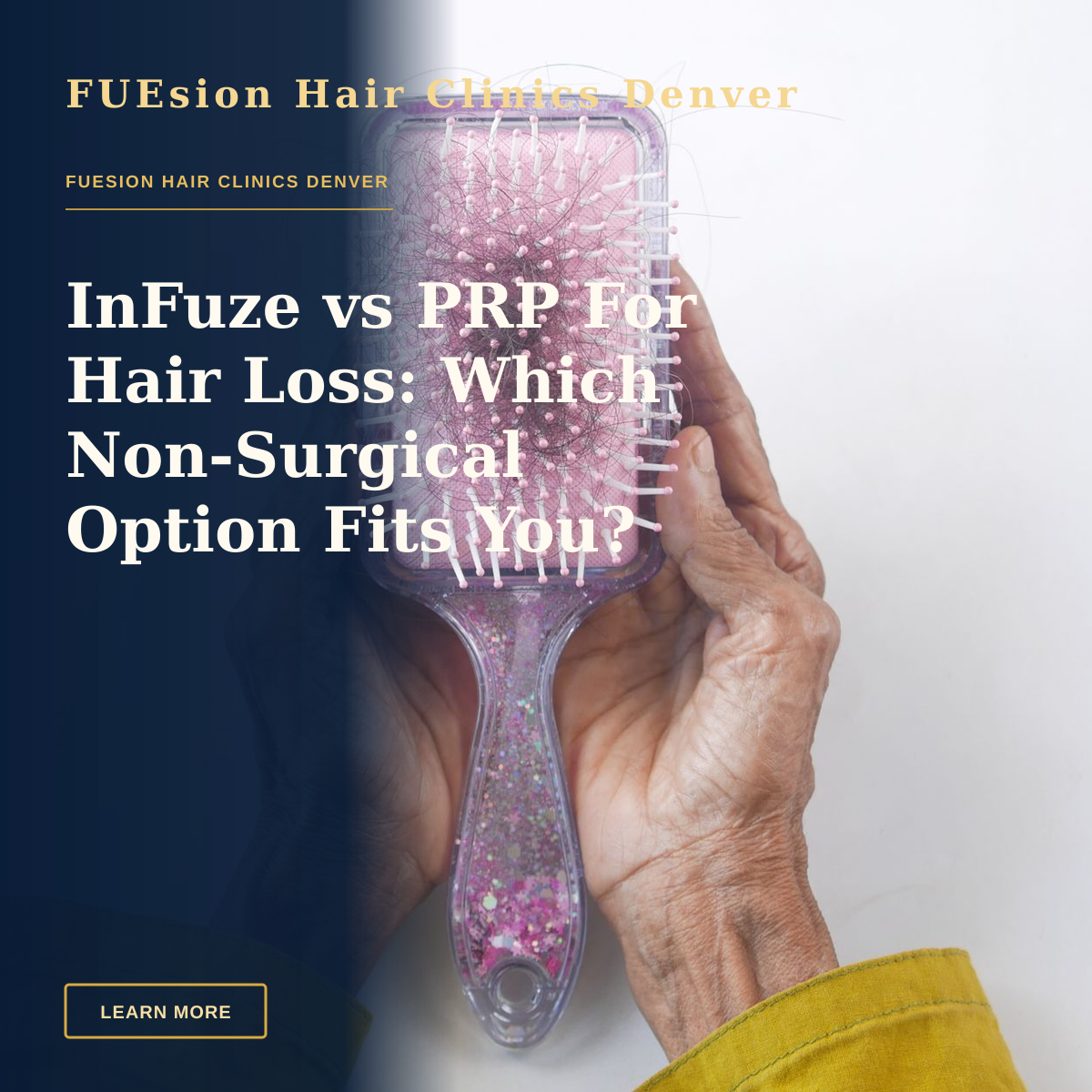
If you’re deciding between InFuze vs PRP for hair loss, the quick, evidence‑aware answer is this: InFuze™ (InFuze Non‑Surgical / InFuze™ Restoration with ScalpPulse Technology) is a multi‑modal, clinic‑delivered scalp activation and targeted infusion protocol designed to produce clinically measurable regrowth with no surgery and zero downtime; PRP (platelet‑rich plasma) is offered as an adjunctive, minimally invasive follicular stimulation option. Which is right depends on your pattern and stage of thinning, previous treatments, and goals for speed and consistency of response.
This article explains how each approach works within FUEsion’s non‑surgical toolkit, the practical differences in procedure and downtime, who typically benefits most, realistic timelines, and how to evaluate which approach to try first — including how to visualize outcomes with our AI Hair Simulator and book a free consultation.
Patient Journey & Consultation
Deciding between InFuze vs PRP begins with a clear, surgeon‑led assessment. At FUEsion Hair Clinics we guide patients through a defined flow that starts with easy contact options and ends with a documented plan and 12‑month review. You can request a free virtual or in‑person consultation online; consultation requests are acknowledged and scheduled promptly (site statements note confirmation within 24 hours and general contact responses within 2–4 business hours). According to Mesotherapy and PRP Treatment in Combination with Hair Loss in WomenCase Report (scholarly source), this source provides relevant background for the discussion.
During your free virtual consultation we review your history, photos and goals. We encourage running our Graft Calculator and AI Hair Simulator before the consult so you and the clinician start with the same visual goals and an estimated resource plan. The surgeon will discuss non‑surgical options (InFuze or PRP), whether these should be standalone treatments or used alongside surgical restoration, and the expected monitoring schedule.
Key steps in the patient journey are straightforward and transparent:
- Initial contact and booking via the Consultation or Contact pages, with response timelines for scheduling.
- Free Virtual Consultation that includes photo review, loss staging, and discussion of InFuze vs PRP candidacy.
- Digital pre‑work: run the Graft Calculator and AI Hair Simulator to generate images and a cost estimate to bring to your consult.
- Personalized plan and documentation of the proposed treatment, follow‑up schedule and assurance terms.
After the consult you’ll receive a documented plan that states recommended sessions, expected checkpoints and when the formal 12‑month review (the Growth Assurance checkpoint) will occur. If you’re ready to book a free consult, schedule one online via our Book a Free Consultation.
Ready to take the next step?
Speak directly with Dr. Sanders. No obligation. Completely free.
Find out if you're a candidate for FUE Hair Transplants or non-surgical hair regrowth options.
Book Your Free ConsultationSimulator
See your potential results before you commit. Our AI Hair Simulator / AI Hair Studio shows realistic before/after previews based on your photo and returns a personalized cost estimate so you walk into your consultation informed and confident.
Powered by FlowMediQ AI, the simulator analyzes your hair pattern and recommends options that match your goals. For patients comparing InFuze vs PRP, the simulator helps set realistic density expectations and illustrates whether a non‑surgical approach could meet your cosmetic goals or if a surgical plan is more appropriate.
How to use it in four steps:
- Upload a clear, well‑lit frontal photo for the most accurate preview.
- AI analyzes your hair and estimates grafts or treatment need where relevant.
- View instant before/after simulations and a personalized cost estimate.
- Save and bring the result to your surgeon for a focused consultation.
Launching the simulator before your consult speeds the planning process and ensures surgeon time focuses on a personalized roadmap. Try the AI Hair Simulator to visualize options and costs.
See your potential results before you commit
AI Hair Simulator
Our AI Hair Simulator uses your own photo to show realistic hairline, density and style options — and generates a personalized cost estimate so you walk into your consultation knowing exactly what you want and what it costs.
Get Free AccessReady to take the next step?
Book a Free ConsultationInFuze vs PRP: How They Work
At FUEsion the two non‑surgical options you’ll commonly compare are InFuze and PRP. Both are clinic‑administered, but they differ in technology, delivery and clinical positioning.
InFuze Non‑Surgical (InFuze™ Restoration) uses InFuze™ ScalpPulse Technology — a multi‑modal scalp activation system combined with targeted compound infusion. The protocol is designed to stimulate the scalp microenvironment and deliver topical/infused compounds directly to the target area. The brand materials describe InFuze as delivering clinically measurable regrowth with no surgery and zero downtime, and it’s positioned for early‑to‑mid stage thinning and as an adjunct to surgery when needed.
PRP therapy (platelet‑rich plasma) is offered as an adjunctive follicular stimulation treatment. PRP is prepared from the patient’s blood to concentrate platelets and is administered in clinic. At our clinics PRP is typically recommended as part of a broader plan when surgeons determine it may support follicular activity or be complementary to other therapies.
Primary differences
- Delivery: InFuze combines mechanical/energy scalp activation with targeted infusion; PRP uses injections of platelet‑rich plasma.
- Downtime: InFuze is described as having zero downtime; PRP involves brief injection‑related recovery (generally minimal).
- Clinical role: InFuze is positioned as a primary non‑surgical therapy for measurable regrowth; PRP is described on our site as an adjunct that can support follicular stimulation.
Which is better for you depends on your hair loss stage, previous response to therapies (minoxidil, finasteride, etc.), and whether you’ll need a surgical restoration for coverage. Your surgeon will explain whether a course of InFuze, PRP, or a combination is the most efficient path to your goals.
Services & Procedures
At our clinics we offer a full menu of surgical and non‑surgical hair restoration options so every patient can receive a tailored plan rather than a single‑tool approach. This menu includes both InFuze Non‑Surgical treatments and PRP therapy alongside surgical and cosmetic services, with clear timelines and recovery expectations documented for each service on our Services page.
Our offerings are designed to let surgeons combine modalities safely and effectively. For example, a patient may choose InFuze as the primary non‑surgical protocol and add PRP injections at intervals where the surgeon believes adjunctive stimulation will help. All pathways include documented aftercare and monitoring.
Key non‑surgical and surgical services we provide include:
- InFuze Non‑Surgical / InFuze™ Restoration with ScalpPulse Technology: no surgery, no downtime; suitable for early–mid stage loss or as adjunctive therapy.
- PRP therapy: platelet‑rich plasma as adjunctive follicular stimulation (clinic‑administered).
- FUEsion Hair Transplant (AI & AR Assisted FUE / FUEsion Hair Transplant): surgical option when permanent coverage is required.
- Beard, eyebrow and female hair transplant protocols; FUT where clinically indicated; scalp micropigmentation and scar repair.
For surgical services, procedure durations, anesthesia and recovery expectations are documented: FUE transplants typically take 4–7 hours (longer for larger cases), use local anesthesia, and patients often return to work in 5–7 days; graft survival is stated on our site as >95% for the FUEsion Technique. Non‑surgical sessions (InFuze or PRP) are clinic visits with minimal to zero downtime and scheduled series as recommended by your surgeon.
See the full list of treatments and procedural pages on our Services page to choose the option that best matches your goals. If you want to compare outcomes visually, run our AI simulator first and bring the results to your consult.
See your potential results before you commit
AI Hair Simulator
Our AI Hair Simulator uses your own photo to show realistic hairline, density and style options — and generates a personalized cost estimate so you walk into your consultation knowing exactly what you want and what it costs.
Get Free AccessWant personalized advice?
Schedule Your AssessmentTrust & Guarantee (FUEsion Assurance)
When evaluating InFuze vs PRP for hair loss it’s important to consider warranty and follow‑up. FUEsion backs every procedure with a published assurance program — the FUEsion Assurance — that addresses growth, artistry, aftercare and satisfaction. These commitments are documented with your treatment plan and formalized during consultation so expectations are clear from day one.
The Assurance is structured so patients know how outcomes are measured and what remedies are available if benchmarks aren’t met. The formal 12‑month review is the checkpoint for Growth Assurance activation and any agreed remedies (such as supplemental grafts for surgical cases) are discussed and documented in the consent and aftercare plan.
Assurance pillars include:
- Growth Assurance: a guaranteed minimum graft survival/growth benchmark, with supplemental grafts at no cost if agreed benchmarks aren’t met at the 12‑month review (when clinically indicated).
- Artistry Assurance: agreed hairline and aesthetic plan documented pre‑op, with corrective work if the outcome materially deviates from the agreed design.
- Aftercare Assurance: included post‑operative care, follow‑ups and surgeon access during recovery and monitoring.
- Satisfaction Assurance: a commitment to address concerns promptly and work toward published outcome objectives.
The Assurance applies to both surgical and integrated plans where non‑surgical protocols like InFuze are used alongside surgical approaches. For details about how the Assurance is activated and the formal terms, discuss this during your consultation or review the Assurance documentation when you meet with the team. Book your free consult to confirm Assurance coverage for your recommended plan: Book a Free Consultation.
Ready to take the next step?
Speak directly with Dr. Sanders. No obligation. Completely free.
Find out if you're a candidate for FUE Hair Transplants or non-surgical hair regrowth options.
Book Your Free ConsultationEvidence & Choosing Between InFuze and PRP
Evidence from our technology pages and service descriptions positions InFuze as a purpose‑built platform that combines scalp activation with topical/compound infusion to produce clinically measurable regrowth with no downtime. PRP is described as an adjunctive stimulation method. That positioning guides typical recommendations:
- InFuze is often recommended for patients with early to mid‑stage thinning who want a non‑surgical program with predictable, clinic‑delivered protocols.
- PRP may be recommended as a complementary therapy to support follicles, especially when used alongside other medical or surgical approaches.
- Patients with advanced, pattern baldness that requires coverage are typically counseled on surgical transplantation (FUE), with non‑surgical options used as maintenance or adjuncts.
Expected timelines for noticeable change are generally consistent across the clinic’s roadmap: shedding or early change around 3 months, visible improvement by 6 months, and fuller results by 12–18 months. Your clinician will set realistic expectations tailored to the chosen protocol and schedule follow‑up visits to document progress.

See how we can help you
Get Started TodayTechnology & Technique
FUEsion’s technology stack matters when comparing options. The clinic emphasizes proprietary systems that distinguish InFuze from generic in‑office treatments. Key technologies and technique points include the InFuze™ ScalpPulse Technology platform for multi‑modal scalp activation and targeted infusion, and surgeon‑led protocols that pair these non‑surgical modalities with surgical capabilities when needed.
For patients who may need transplantation later, our FUEsion Technique (AI & AR Assisted FUE) and surgical protocols (microscopic donor assessment, micro‑punch extraction and proprietary graft preservation) offer a clear path from non‑surgical maintenance to permanent coverage. Explore the clinic’s technology page to understand how InFuze fits into a complete restoration strategy: Technology & Technique.
Conclusion
If your question is simply “Which is better — InFuze vs PRP for hair loss?” the practical answer is: neither is a one‑size‑fits‑all winner. InFuze™ ScalpPulse Technology is positioned as a clinic‑delivered, multi‑modal non‑surgical protocol that yields clinically measurable regrowth with zero downtime and is a primary option for many early‑to‑mid stage patients. PRP remains a valuable adjunctive therapy that surgeons may add to a broader plan. The right choice depends on your degree of loss, previous treatments, and whether you need eventual surgical coverage.
Next step: visualize your options with the AI Hair Simulator and then book a complimentary consultation so a surgeon can review your photos, explain a recommended protocol, and document how the FUEsion Assurance applies to your plan. If you want to proceed now, book a free consultation — or start with the simulator to see a realistic preview and cost estimate.
FAQ
Q: Is InFuze better than PRP for most patients?
A: InFuze is positioned as a primary non‑surgical therapy offering clinic‑delivered, multi‑modal activation and targeted infusion with no downtime. PRP is offered as an adjunctive stimulation option. Your surgeon will recommend the best path based on your hair loss stage and goals.
Q: How long until I see results?
A: Typical monitoring timelines used at our clinics show early changes around 3 months, visible improvement by 6 months, and fuller results by 12–18 months. Your clinician will set specific expectations for your chosen protocol.
Q: Can I combine InFuze and PRP?
A: Yes — clinicians may recommend combined or sequential therapies when they believe adjunctive stimulation will improve outcomes. The treatment plan and follow‑up schedule will be documented during your consultation.
Medical Information Disclaimer
This content is provided for general educational purposes only. It is not a substitute for professional advice, diagnosis, or treatment. Readers are advised to consult qualified professionals for personalized recommendations.
Have questions? We have answers.
Speak With an Expert