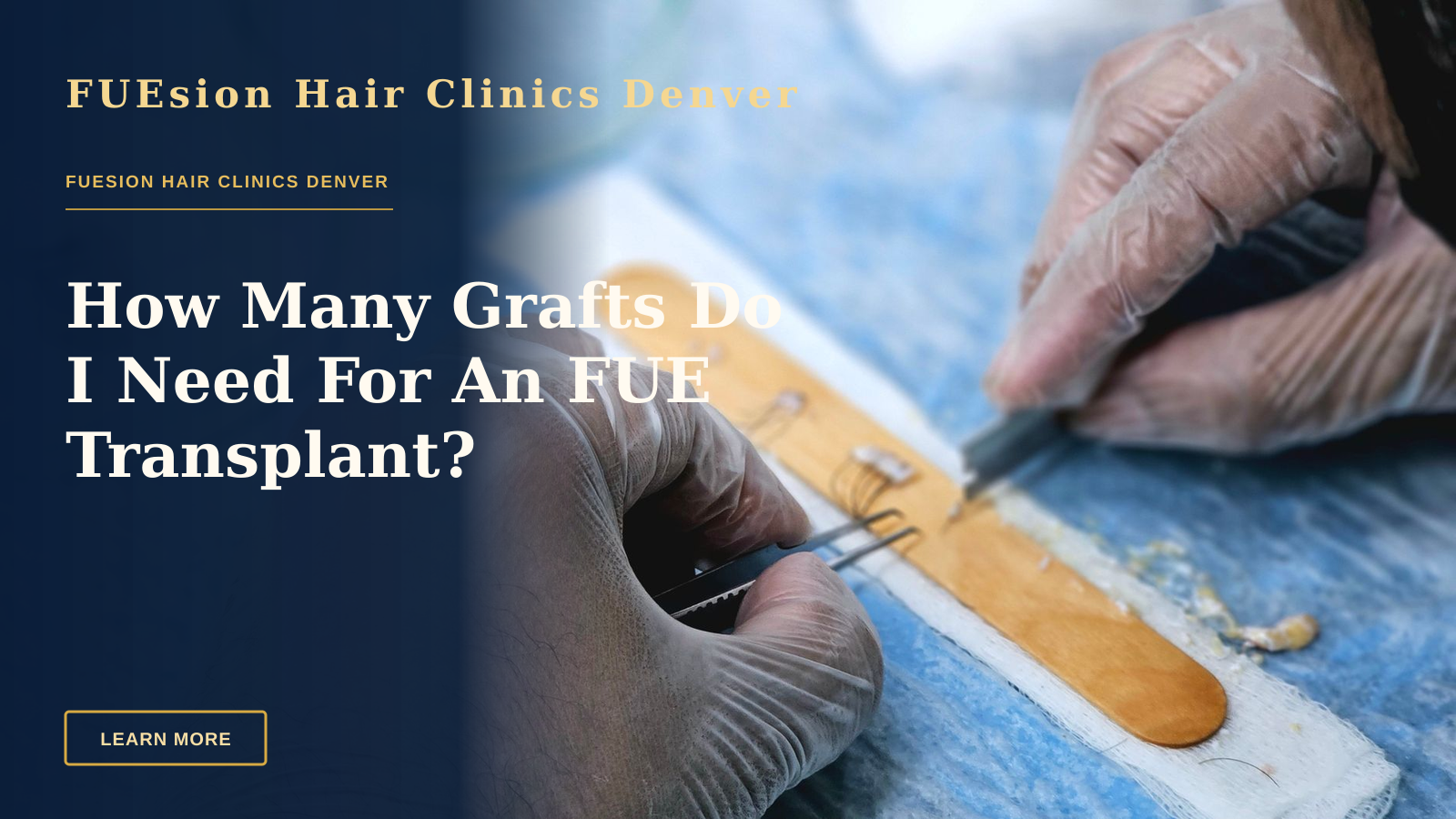
How many grafts do I need for an FUE transplant? That’s the single most practical question most patients ask once they’ve decided to explore surgical hair restoration. The short answer: there is no single universal number — graft requirements are individualized and depend on the area you want to cover, your donor density and hair characteristics, and the density and aesthetic outcome you want to achieve. Use the rest of this article to understand the factors surgeons measure, how graft estimates are calculated, and realistic next steps to get a personalized count.
If you want a fast, personalized estimate before speaking with a surgeon, you can run your own photo through the AI Hair Simulator and the Graft Calculator to get an immediate, image-based graft estimate and a cost range. Later sections explain the clinic workflow, what to expect on the day of surgery, and how FUEsion’s technologies and guarantees factor into planning and final graft survival.
Patient Journey & Consultation
The process to go from “How many grafts do I need?” to a confirmed treatment plan begins with initial contact and a structured consultation. Patients can book online or through our Contact pages, and consultation requests are typically acknowledged quickly — site statements show consultation confirmations are processed promptly and care teams aim to respond within business hours. According to How Many Transplant Centers Do We Need? (scholarly source), this source provides relevant background for the discussion.
Your free virtual consultation is where a surgeon or experienced clinician assesses your hair loss pattern, reviews photos or an AI simulation, and documents realistic goals. The consultation also clarifies donor availability and identifies whether non‑surgical options such as InFuze™ Restoration are appropriate as primary or adjunctive therapies.
We encourage using the AI Hair Simulator and Graft Calculator in advance of your consult; these free tools give both you and the surgeon an objective starting point. During your surgeon consultation the aesthetic plan is finalized, graft counts are documented, and the FUEsion Assurance terms are introduced and recorded.
- Fast initial contact and scheduling — book online or by phone.
- Free Virtual Consultation — photo review, graft estimate and goals discussion.
- Pre‑work with the Graft Calculator and AI simulation to save time and clarify expectations.
- Surgeon consultation where final graft count and plan are agreed and documented.
After the consult you will receive a written plan that states the estimated graft count, recommended technique (surgical FUE or InFuze™ Restoration), and a timeline for procedure and follow‑ups. If you want to schedule a consult now, you can book your free consultation and bring your simulator results to the appointment.
Ready to take the next step?
Speak directly with Dr. Sanders. No obligation. Completely free.
Find out if you're a candidate for FUE Hair Transplants or non-surgical hair regrowth options.
Book Your Free ConsultationSimulator
See your potential graft needs before you arrive. The AI Hair Simulator analyzes a clear frontal photo, estimates graft requirements, and produces a realistic before/after preview plus an AI-derived cost estimate. This tool is designed to be clinically informed and to shorten your consult by providing objective data up front.
Using the simulator is straightforward: upload a well-lit frontal photo, let the app estimate grafts based on your current hair pattern, and review multiple density or hairline options. Save or share the results with your surgeon during the consultation so the clinical team can fine‑tune the plan and confirm the graft count.
The simulator is powered by FlowMediq AI and connects directly with our treatment planning workflow. It’s especially useful when you want to compare how different target densities or hairline positions will change the required graft count and overall cost.
- Upload a clear, well‑lit frontal photo for best accuracy.
- Instant AI estimate of grafts and cost with side‑by‑side preview.
- Share simulator files with your surgeon to speed up the personalized plan.
Launch the simulator before your consult so that your surgeon can use the image analysis as the foundation of the final graft calculation. Try the AI Hair Simulator to get your quick estimate and visual preview.
See your potential results before you commit
AI Hair Simulator
Our AI Hair Simulator uses your own photo to show realistic hairline, density and style options — and generates a personalized cost estimate so you walk into your consultation knowing exactly what you want and what it costs.
Get Free AccessReady to take the next step?
Book a Free ConsultationHow Surgeons Estimate Graft Needs
Surgeons estimate graft needs by combining objective measurements with aesthetic goals. The three core inputs are the donor supply, the recipient area size, and the target density. A precise count is derived by measuring the area to be filled and deciding how many follicular units (grafts) per cm² are needed to achieve the patient’s desired look.
Key factors that change the math include hair caliber (thick hair covers more area), hair curl and grouping (curly or wavy hair provides more apparent coverage), and the existing hair left in the recipient zone. Scarring, prior surgeries, and the distribution of donor hair also influence how many grafts can be safely harvested and transplanted.
Clinicians use microscopic donor assessment and digital donor mapping (part of advanced protocols) to estimate the total available grafts without compromising long‑term donor appearance. The surgeon then balances coverage goals with conservative harvesting to preserve future options.
- Measure the recipient area (cm²) and choose a target grafts/cm².
- Adjust the density target for hair caliber, curl, and existing coverage.
- Confirm donor availability with donor mapping and microscopic assessment.
Because every patient’s anatomy and goals differ, the most reliable way to get a precise graft count is to run the Graft Calculator and follow up with a surgeon who can translate the simulator’s estimate into a safe, staged surgical plan if needed.
Services & Procedures
FUEsion Hair Clinics offers a full menu of surgical and non‑surgical hair restoration services. Each option has predictable procedural timelines, anesthesia plans, downtime expectations, and documented results so you can compare them side‑by‑side and choose the one that matches your goals.
For patients considering graft counts, it’s important to know that different procedures require different planning. For example, an AI & AR Assisted FUE transplant is a multi‑hour surgical session with localized anesthesia and recovery expectations, while InFuze™ Restoration is non‑surgical and intended for early‑to‑mid stage loss or as a complement to surgery.
Below is a concise overview of the main services you’ll discuss in consultation. Use the Services page to book or to read deeper procedural descriptions and expected outcomes.
- Hair Transplant (AI & AR Assisted FUE / FUEsion Hair Transplant): 4–7 hours (4–10 hours for larger cases); local anesthesia; return to work in 5–7 days; visible results from 6 months and full results at 12–18 months; graft survival >95%.
- Beard Transplant: 300–2,500 grafts depending on coverage; 3–8 hours; ~5 days downtime.
- Eyebrow Transplant: 50–400 grafts per eyebrow; 2–4 hours; precise angulation for natural lay.
- InFuze Non‑Surgical / InFuze™ Restoration: Uses ScalpPulse Technology for measurable regrowth with no surgery and zero downtime; suitable for early or adjunctive therapy.
Other services include FUT where indicated, PRP/PRF adjunctive therapy, scalp micropigmentation, scar repair, hairline lowering and comprehensive post‑operative care that’s included with every procedure. For bookings and deeper procedural pages, see our Services section or book a free consultation.
See your potential results before you commit
AI Hair Simulator
Our AI Hair Simulator uses your own photo to show realistic hairline, density and style options — and generates a personalized cost estimate so you walk into your consultation knowing exactly what you want and what it costs.
Get Free AccessWant personalized advice?
Schedule Your AssessmentTrust & Guarantee (FUEsion Assurance)
The FUEsion Assurance program is our industry‑first patient guarantee that clarifies outcomes and remedies before you proceed. Assurance terms are discussed and documented during consultation and the formal 12‑month review is the checkpoint used to determine if Growth Assurance remedies are indicated.
The Assurance has four pillars: Growth, Artistry, Aftercare and Satisfaction. If growth falls short of the agreed benchmark at the 12‑month review, we will supplement your result with additional grafts at no cost when clinically indicated. Artistry and aftercare remedies are similarly documented and actionable.
We recommend discussing Assurance details during your surgical planning so you understand how benchmarks are set and how the 12‑month review is performed. You can read more about terms during your consult and examine the full terms on the Assurance page if you want additional detail.
- Growth Assurance: Supplementary grafts at no cost if agreed benchmarks aren’t met at 12 months.
- Artistry Assurance: Documented hairline and aesthetic plan with corrective remedies if execution deviates.
- Aftercare & Satisfaction: Surgeon access, follow‑ups and problem resolution included through recovery and monitoring.
The Assurance provides a clear safety net for patients concerned about variability in growth or aesthetic outcomes. If you’d like to discuss how Assurance applies to your graft estimate, book your free consultation and your surgeon will document the plan and benchmark criteria.
Ready to take the next step?
Speak directly with Dr. Sanders. No obligation. Completely free.
Find out if you're a candidate for FUE Hair Transplants or non-surgical hair regrowth options.
Book Your Free ConsultationChoosing the Right Graft Count: Practical Examples
Some procedures have well‑established typical graft counts that help set expectations. For beard and eyebrow transplants the clinic publishes typical ranges: beard transplants commonly range from 300–2,500 grafts depending on coverage, and eyebrow transplants typically require 50–400 grafts per eyebrow for full shaping. These published ranges give concrete starting points for facial hair restoration planning.
For scalp procedures, the final graft count is individualized. To help you interpret estimates, here’s a hypothetical example showing the calculation method (this illustration is for education and will differ by patient): you and your surgeon measure a frontal zone of X cm², choose a target graft density, and multiply the area by grafts/cm² to produce a graft count. The surgeon then confirms donor availability before scheduling.
Rather than rely solely on ranges, use the free Graft Calculator and the AI Hair Simulator to obtain an image‑based, clinically informed estimate that the surgical team can refine into a safe plan.
See how we can help you
Get Started TodayRecovery, Results Timeline & What Affects Final Yield
Understanding timelines helps set expectations for when you’ll see the outcome of the grafts placed. Typical growth patterns include initial shedding and early regrowth, with new hairs often visible from about 3 months, clearer improvement by 6 months, and full results by 12–18 months. These timelines apply to FUE transplants and are part of standard patient education.
FUEsion’s clinical protocols — microscopic donor assessment, micro‑punch extraction calibrated to follicle characteristics, proprietary graft holding solution and artistic recipient site creation (site angles typically 20–45°) — are designed to optimize graft viability. The clinic’s published graft survival benchmark is >95% under the FUEsion Technique when performed by licensed medical professionals.
Factors that can reduce final yield include smoking, uncontrolled medical conditions, poor post‑op compliance, or suboptimal donor supply. The Assurance program and routine follow‑ups ensure surgeon involvement if growth is below benchmark at the formal 12‑month review.
Conclusion
So, how many grafts do you need for an FUE transplant? The precise number is unique to each patient — driven by the size of the area to be covered, your donor characteristics, hair caliber and curl, and the target density you and your surgeon agree on. The quickest way to get a personalized, realistic graft estimate is to run the Graft Calculator and AI Hair Simulator, then bring those results to a free surgeon consultation where donor mapping and final planning will produce a definitive graft count.
If you’re ready to estimate your graft needs now, try the AI Hair Simulator for an instant visual preview and graft estimate, or book a free consultation to speak directly with a surgeon and review the FUEsion Assurance in detail. Those two steps will give you the clearest, evidence‑backed answer tailored to your anatomy and goals.
FAQ
- Will the number of grafts estimated at consultation always be the number used during surgery?
- Not always. The consultation estimate is an informed plan. On procedure day the surgeon confirms donor quality and may adjust the final graft count to preserve donor integrity or stage the reconstruction if needed.
- How long until I know whether grafts have survived?
- Early signs of regrowth can appear at about 3 months, with clear progress at 6 months and final results at 12–18 months. The formal 12‑month review is the checkpoint for the FUEsion Assurance Growth remedy if agreed benchmarks aren’t met.
- Can non‑surgical options reduce the number of grafts I need?
- Yes. Non‑surgical therapies such as InFuze™ Restoration with ScalpPulse Technology can improve scalp health and density and may be recommended alone for early loss or as an adjunct to reduce the extent or number of surgical grafts required.
Medical Information Disclaimer
This content is provided for general educational purposes only. It is not a substitute for professional advice, diagnosis, or treatment. Readers are advised to consult qualified professionals for personalized recommendations.
Have questions? We have answers.
Speak With an Expert