How does an FUE hair transplant work? If you're researching hair restoration, that single question drives the rest of the decisions — from choosing a surgeon to planning recovery and comparing non‑surgical options. In plain terms, Follicular Unit Extraction (FUE) relocates healthy hair follicles from a donor area to thinning or balding regions one follicular unit at a time, preserving a natural hairline and avoiding a linear scar.
This article explains the FUE workflow step‑by‑step, describes the technologies and protocols that improve outcomes, and shows how patients can evaluate clinics and use free tools — including our AI Hair Simulator and Graft Calculator — to visualize results and estimate graft needs before a consultation. Where the brand is relevant, we'll reference clinical capabilities and guarantees that affect patient choice so you finish knowing what to expect and how to evaluate providers.
Patient Journey & Consultation
Understanding the patient journey clarifies how an FUE hair transplant works in practice: it’s not just the day of surgery but the assessment, planning and follow‑up that determine success. At intake you’ll submit photos or book a free virtual consultation; the team typically acknowledges consultation requests within 24 hours, with general contact responses in 2–4 business hours. This early contact establishes goals, medical suitability and next steps. According to Controversies: Does FUE change donor planning? (scholarly source), this source provides relevant background for the discussion.
Before you meet a surgeon, we recommend using the Graft Calculator and AI Hair Simulator to create a photo‑based starting point. These tools inform the surgeon’s in‑person or video consultation and allow a documented aesthetic plan to be agreed upon. The surgeon documents graft estimates, hairline design and expected timelines — all of which feed into the formal post‑op plan and the 12‑month review.
On procedure day, local anesthesia is used and FUE procedures typically last 4–7 hours depending on graft count. Non‑surgical alternatives such as InFuze™ Restoration use ScalpPulse Technology and require no anesthesia or downtime. Aftercare includes routine follow‑ups, surgeon access, and the formal 12‑month review where growth benchmarks are evaluated.
Key practical points patients frequently ask about are summarized below. Use these during booking and pre‑op conversations to make sure everyone is aligned on expectations.
- Initial assessment and photo submission speed up accurate graft estimates and planning.
- Surgeon consultation documents the hairline and graft plan — this is where design and guarantees are agreed.
- Procedure day is performed under local anesthesia; recovery includes short‑term activity limits and follow‑up visits.
- The 12‑month formal review is the clinical checkpoint for measuring growth and discussing corrective options if needed.
These steps help you convert interest into a concrete plan while preserving transparency about timeline and outcomes. To book a free consultation, visit our consultation page.
Ready to take the next step?
Speak directly with Dr. Sanders. No obligation. Completely free.
Find out if you're a candidate for FUE Hair Transplants or non-surgical hair regrowth options.
Book Your Free ConsultationSimulator
See your potential results before you commit. Our AI Hair Simulator uses a clear, well-lit frontal photo to generate clinically-informed before/after previews and an instant, personalized cost estimate. The simulator's workflow is designed to reduce uncertainty: upload a photo, let the AI estimate grafts, then review a visual preview that you can bring to your consultation.
Simulation empowers both patient and surgeon. When you share simulator results during the consultation, the surgeon can refine graft counts, hairline shape and density targets in a documented plan. The tool runs quickly (30 seconds–2 minutes depending on input) and requires no signup, so it’s practical to try before booking.
How the simulator fits into the decision process:
- Upload a good frontal photo for the most accurate preview and graft estimate.
- The AI analyzes hair pattern and returns an estimated graft count and visual before/after images.
- Use the generated cost estimate to compare options and set realistic expectations before a consult.
- Save or share your simulation with the surgeon to accelerate planning and ensure the desired outcome is documented.
The simulator reduces uncertainty and helps ensure your consultation proceeds from an informed starting point. Try the tool at the AI Hair Simulator page.
See your potential results before you commit
AI Hair Simulator
Our AI Hair Simulator uses your own photo to show realistic hairline, density and style options — and generates a personalized cost estimate so you walk into your consultation knowing exactly what you want and what it costs.
Get Free AccessReady to take the next step?
Book a Free ConsultationHow an FUE Hair Transplant Works — Step‑By‑Step
At its core, FUE is a surgical relocation of individual follicular units. Modern, clinic‑led FUE combines precise donor mapping, micro‑punch extraction, graft handling and artistic recipient site creation. Below is a stepwise summary of how a typical, high‑quality FUE case proceeds.
1. Pre‑operative planning and donor mapping
The surgeon examines donor density, hair calibre and follicle grouping using microscopic donor assessment. This mapping determines how many grafts can be safely harvested without visible thinning and guides punch sizing. Good pre‑op planning also finalizes the hairline design and distribution plan to achieve natural density.
2. Local anesthesia and donor harvesting (micro‑punch extraction)
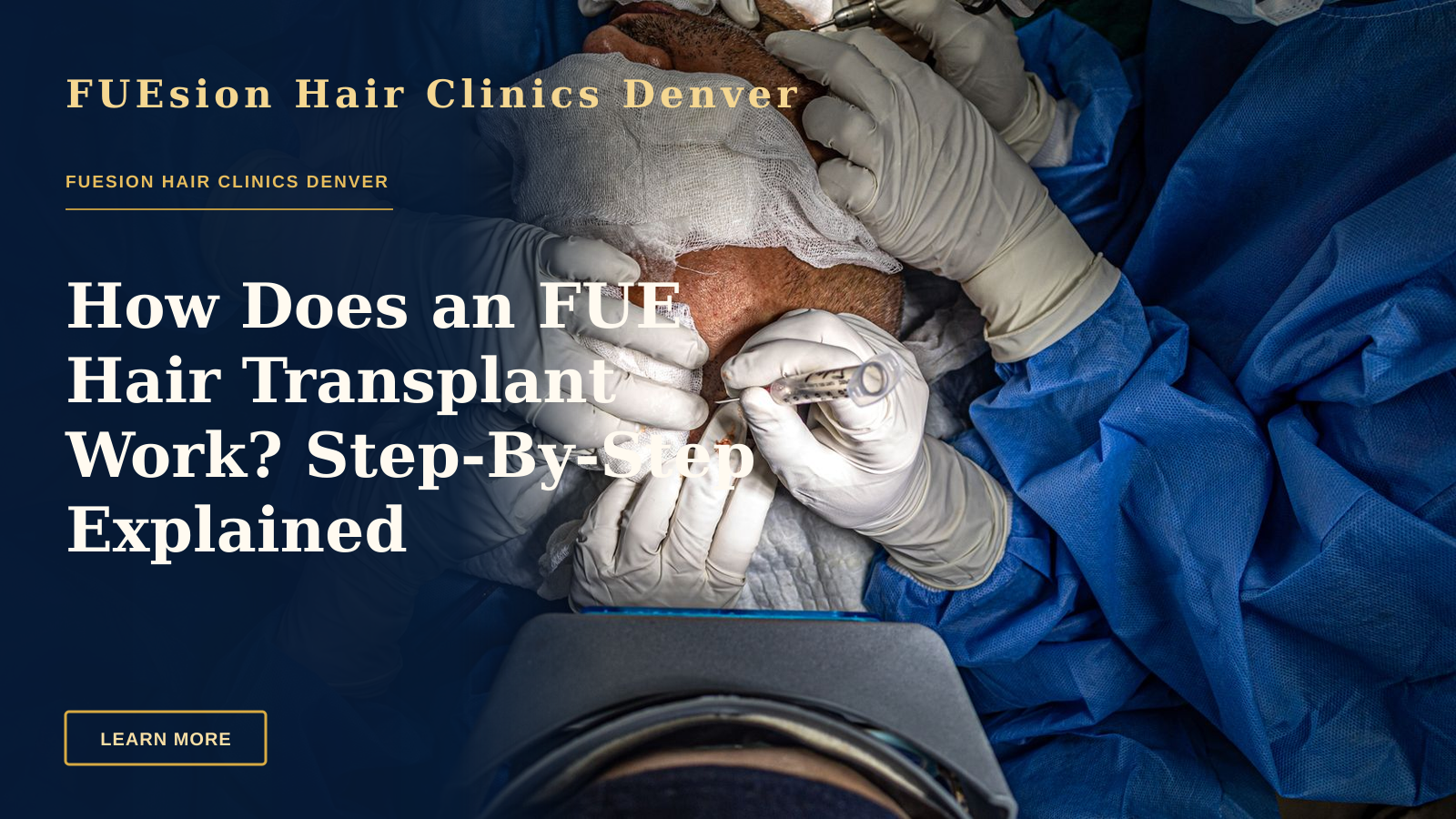
Under local anesthesia, the surgeon extracts follicular units individually using micro‑punch tools calibrated to each follicle’s characteristics. This micro‑punch extraction minimizes transection (cutting the follicle) and leaves no linear scar. The extraction is performed by licensed medical professionals trained in AI & AR Assisted FUE workflows to optimize geometry and yield.
3. Graft handling and preservation
Harvested grafts are inspected under a microscope, sorted and stored in a proprietary graft holding solution to preserve cell viability. Controlled out‑of‑body time and careful hydration are critical; many clinics use specialized solutions and temperature control to maximize survival.
4. Recipient site creation and implantation
The surgeon hand‑crafts recipient sites at precise angles (commonly 20–45°) to reproduce natural hair lay, density and direction. Implants are placed with attention to depth and grouping. When performed with calibrated tools and experienced artistry, results look natural and integrate with existing hair.
5. Immediate post‑op and recovery
Patients typically return to work within 5–7 days. Short‑term swelling or crusting at recipient sites is expected and managed with standard aftercare. Shedding of transplanted hairs occurs in the months after surgery (a normal phase), with new growth beginning around 3 months and visible improvement by 6 months; full results develop between 12–18 months.
Perioperative factors that affect success
Graft survival is influenced by punch technique, transection rate, graft handling, implant timing and post‑op care. Proprietary workflows such as AI & AR Assisted FUE and controlled graft solutions aim to improve graft survival rates.
Services & Procedures
FUEsion Hair Clinics offers a full menu of surgical and non‑surgical hair restoration services tailored to different goals and patterns of loss. Each service is described here with the key facts you need to compare options and plan timelines. Use our Services page for bookings and procedural pages for deeper technical details.
We provide both permanent surgical options and non‑surgical therapies — and we document timelines, anesthesia and expected downtime so you can plan work and life around your procedure. Below is a concise list of our core offerings and what to expect from each.
- Hair Transplant (AI & AR Assisted FUE / FUEsion Hair Transplant) — Duration: 4–7 hours (up to 10 for large cases). Anesthesia: local. Downtime: 5–7 days. Results visible from 6 months; full at 12–18 months. Graft survival: >95% per FUEsion protocols.
- Beard Transplant — Typical graft counts 300–2,500 depending on coverage. Duration: 3–8 hours. Downtime: ~5 days. Permanent growth with natural orientation.
- Eyebrow Transplant — 50–400 grafts per eyebrow. Duration: 2–4 hours. Precise angulation to reproduce natural brow lay.
- Female Hair Transplant — Specialized protocols for female patterns; no strip removal and preservation of surrounding hair.
- InFuze Non‑Surgical / InFuze™ Restoration — Uses InFuze™ ScalpPulse Technology for scalp activation and infusion. No surgery, no downtime; suitable for early‑to‑mid stage loss or adjunctive therapy.
Beyond these primary services, we also offer FUT where clinically indicated, PRP therapy, scalp micropigmentation, scar repair, hairline lowering and comprehensive post‑operative care. Every package includes personalized planning and ongoing post‑op follow‑up under our standard protocols.
To preview potential results and a personalized cost estimate before your consult, try the AI Hair Simulator or run the Graft Calculator. For bookings or procedural questions, visit our Services and Consultation pages.
See your potential results before you commit
AI Hair Simulator
Our AI Hair Simulator uses your own photo to show realistic hairline, density and style options — and generates a personalized cost estimate so you walk into your consultation knowing exactly what you want and what it costs.
Get Free AccessWant personalized advice?
Schedule Your AssessmentTrust & Guarantee (FUEsion Assurance)
Reputable outcomes depend on technique and a transparent guarantee. The FUEsion Assurance is an industry‑first program that documents growth, artistry, aftercare and satisfaction commitments as part of the treatment plan. The Assurance is discussed and confirmed during consultation and formalized in your post‑op plan; the 12‑month review is the checkpoint for Growth Assurance activation.
The Assurance outlines how shortfalls are handled and what remedies are available. It is intended to reduce procedural risk for patients by providing documented expectations and concrete steps if benchmarks aren’t met. To discuss how Assurance applies to your case, start a no‑obligation consult on our consultation page.
Core promises of the FUEsion Assurance include the following pillars and remedies.
- Growth Assurance — Agreed minimum growth benchmarks; if unmet at the 12‑month review, supplemental grafts are provided at no cost when indicated.
- Artistry Assurance — The planned hairline and aesthetic design are documented; corrective work is provided if the executed result materially deviates.
- Aftercare Assurance — Post‑operative care, follow‑ups and surgeon access are included throughout recovery and growth monitoring.
- Satisfaction Assurance — The clinic commits to addressing concerns promptly and pursuing the published outcome objectives until they are resolved.
The Assurance is activated through documented pre‑op planning and the formal 12‑month review. Full terms and FAQs are available on the Assurance page; these policies add an important layer of accountability when evaluating providers.
Ready to take the next step?
Speak directly with Dr. Sanders. No obligation. Completely free.
Find out if you're a candidate for FUE Hair Transplants or non-surgical hair regrowth options.
Book Your Free ConsultationTechnology & Technique — Why Method Matters
Not all FUE is created equal. Advanced techniques and devices change the risk profile and the expected graft survival. Our proprietary FUEsion Technique integrates AI & AR Assisted FUE guidance, microscopic donor assessment, calibrated micro‑punch extraction and a proprietary graft holding solution to maximize graft viability and achieve natural aesthetic results.
Key elements that improve outcomes include precise donor mapping, punch sizing matched to follicle characteristics, and hand‑crafted recipient site creation at controlled angles (typically 20–45°). AI & AR assistance can reduce transection by guiding extraction geometry and optimizing placement density. The combination of these technologies and surgeon expertise is designed to raise graft survival and produce consistent naturalness.
For patients who prefer non‑surgical care or who are early in their hair‑loss journey, InFuze™ Restoration using InFuze™ ScalpPulse Technology offers a multi‑modal scalp activation and targeted infusion approach. It’s a no‑downtime option that can be used as an adjunct to surgery or as an alternative when surgery isn’t yet indicated.
Learn more about the systems and clinical rationale on our Technology page or launch the AI Hair Simulator to see how these techniques are applied to your photos.
See how we can help you
Get Started TodayResults & Social Proof
Outcomes depend on baseline characteristics, graft count and surgical artistry; representative cases and testimonials help set realistic expectations. We maintain a Results Gallery of before/after images and a Testimonials page documenting patient experiences so prospective patients can review real cases and understand variability.
Published site claims include graft survival metrics and measurable improvements with InFuze technology. While individual results vary, visual evidence in the gallery and patient stories are valuable decision aids when paired with a documented surgical plan and the clinic’s assurance program.
To see examples of real patient outcomes or read patient feedback, visit the Results Gallery and Testimonials.
Conclusion
In summary, an FUE hair transplant works by extracting individual follicular units from a healthy donor area and implanting them into thinning or balding regions. Success depends on thorough pre‑operative mapping, precise micro‑punch extraction, careful graft preservation, artistic recipient site creation, and disciplined aftercare. Modern enhancements — AI & AR guidance, specialized graft solutions and documented assurance programs — can raise predictability and patient confidence.
If you’re evaluating whether FUE is right for you, start with the free tools that narrow uncertainty: run the Graft Calculator, launch the AI Hair Simulator, and book a no‑obligation consultation to align on a documented plan and assurance terms. That sequence — visualize, consult, plan — is the fastest way to understand what an FUE transplant will look like on you and to choose a provider whose technique and guarantees match your expectations.
FAQ
Will an FUE transplant leave a visible scar?
FUE avoids a linear strip scar because individual follicular units are removed with micro‑punches. Tiny circular extraction points heal discreetly and are generally not noticeable, especially with short hairstyles.
How long until I see new hair growth?
Transplanted hairs typically shed in the weeks after surgery (a normal phase). New hair generally emerges around 3 months, with visible improvement by 6 months and full maturation between 12–18 months.
What influences graft survival?
Graft survival is affected by extraction technique and transection rate, graft handling and holding solution, implant timing, and post‑op care. Proprietary protocols like AI & AR Assisted FUE and controlled graft preservation aim to improve survival.
Can I try non‑surgical options instead?
Yes. For early‑stage loss or for those who prefer non‑surgical care, InFuze™ Restoration with ScalpPulse Technology offers a no‑downtime option that can stimulate regrowth and be used as an adjunct to surgery when appropriate.
If you want a realistic preview and a personalized plan, try the AI Hair Simulator and schedule a free consultation at Book Your Free Consultation. These steps will give you a clear picture of how an FUE hair transplant would work for your individual hair loss pattern.
Medical Information Disclaimer
This content is provided for general educational purposes only. It is not a substitute for professional advice, diagnosis, or treatment. Readers are advised to consult qualified professionals for personalized recommendations.
Have questions? We have answers.
Speak With an Expert