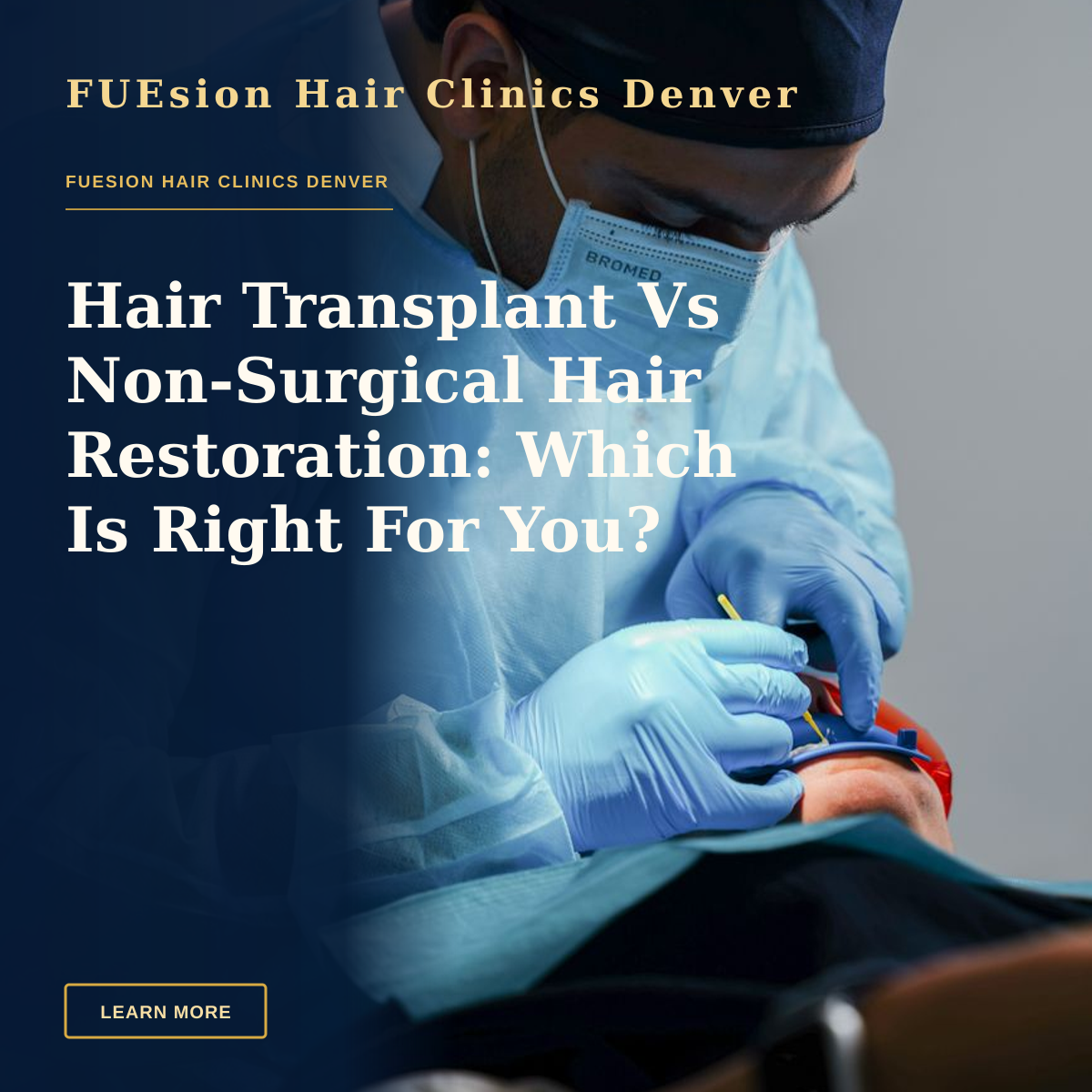
Deciding between a hair transplant vs non-surgical hair restoration is one of the first big choices for anyone with progressive thinning or pattern hair loss. A hair transplant relocates permanent follicles to thinning areas and produces long-lasting, natural growth; non-surgical approaches focus on stimulating dormant follicles and improving scalp health without incisions or downtime.
If you want a side-by-side understanding of how each path works, who benefits most, the typical timelines and realistic expectations, this guide walks through the medical differences, decision factors and practical next steps. Where relevant, we’ll also explain how proprietary tools and services — like AI-powered simulation, surgeon-led FUE technique and non-surgical InFuze ScalpPulse Technology — affect outcomes and the consultation process.
Patient Journey & Consultation
Understanding the full patient journey helps you decide which option fits your goals and schedule. Initial contact starts online or by phone and leads to a free virtual consultation; according to site statements, consultation requests are typically acknowledged and confirmed within 24 hours, and general contact responses are within 2–4 business hours. The free virtual consult includes a clinical hair loss assessment, discussion of goals and review of any images or simulator results. According to Surgical Hair Restoration in Women (scholarly source), this source provides relevant background for the discussion.
Before your consult, we encourage using the Graft Calculator and the AI Hair Simulator to generate a photo-based graft estimate and a realistic preview of possible outcomes. These tools speed the clinical assessment and let the surgeon start with a documented aesthetic plan. Surgeon consultations are where an individualized roadmap is created and the FUEsion Assurance terms are reviewed and agreed.
On procedure day you’ll receive local anesthesia for surgical FUE cases; transplants typically last 4–7 hours depending on graft count, while InFuze non‑surgical sessions have no surgery and no downtime. Post-op care and follow-up are part of every package, and a formal 12‑month review is used to check growth benchmarks.
Key steps at a glance:
- Book a free consult online or by phone — consultation pages confirm response times and scheduling.
- Run the Graft Calculator and AI Hair Simulator to bring photos and a graft estimate to the consult.
- Receive a surgeon-defined plan, documented hairline design and agreed assurance terms.
- Proceed to procedure day, then follow the structured aftercare and the 12‑month growth review.
This structured pathway—discovery → visualization → surgeon planning → procedure → monitoring—reduces surprises and aligns expectations. To start, book your free consultation with our team and bring your simulator results so the surgeon can produce a precise plan.
Ready to take the next step?
Speak directly with Dr. Sanders. No obligation. Completely free.
Find out if you're a candidate for FUE Hair Transplants or non-surgical hair regrowth options.
Book Your Free ConsultationSimulator
Seeing a likely outcome before you commit is a powerful decision aid. The AI Hair Simulator analyzes your frontal photo, estimates graft requirements and generates a realistic before/after preview plus a personalized cost range. This gives you clear visual expectations and helps focus the surgeon consultation on the specifics you care about.
Powered by FlowMediq AI, the simulator is designed to be quick and clinically informed. Upload a clear, well-lit frontal photo and the tool will scan your hair pattern, estimate grafts and show an immediate simulated result that you can save or share with your surgeon. The simulator also funnels results into a cost estimate so you walk into the consult informed.
How the simulator fits into the process:
- Upload a photo (30 seconds–2 minutes). Clear lighting and straight-on framing improves accuracy.
- The AI analyzes donor density and recipient area to approximate graft needs.
- You receive a before/after preview and an AI-generated cost estimate to use in consults.
- Bring the saved simulation to your free consultation to refine the plan with the surgeon.
Using the simulator before your consult reduces back-and-forth and helps the surgeon create a documented aesthetic plan at the first visit. Try the AI Hair Simulator to visualize realistic hairline, density and style options before booking a consultation.
See your potential results before you commit
AI Hair Simulator
Our AI Hair Simulator uses your own photo to show realistic hairline, density and style options — and generates a personalized cost estimate so you walk into your consultation knowing exactly what you want and what it costs.
Get Free AccessReady to take the next step?
Book a Free ConsultationHow They Compare: Hair Transplant Vs Non-Surgical Hair Restoration
At a high level, the primary difference is permanence and mechanism. A hair transplant (FUE) physically moves healthy follicular units from a donor zone to thinning or balding areas; non-surgical approaches such as InFuze™ Restoration or PRP/LLLT focus on stimulating dormant follicles, improving scalp microcirculation and supporting hair health.
Expectations, timeline and maintenance differ:
- Durability: Transplanted follicles are permanent because they come from genetically resistant donor zones. Non-surgical options stimulate native follicles and often require repeat sessions or ongoing maintenance to sustain gains.
- Timeline: Surgical results begin to show new growth after shedding/new growth phases: shedding around 2–3 months, visible gains by 6 months and fuller results at 12–18 months. Non-surgical protocols can show measurable regrowth earlier but typically need ongoing treatment for best effect.
- Downtime and risk: FUE has a brief recovery window (return to work typically 5–7 days) and requires a surgical procedure under local anesthesia; InFuze and other non-surgical modalities have no downtime and are lower-risk but deliver different magnitudes of improvement.
- Coverage and density: For large areas or advanced hairline reconstruction, transplants can deliver much greater density. Non-surgical options are often best for early–mid stage thinning or as adjuncts to surgery.
Choice depends on goals: if your priority is permanent, natural restoration of density and hairline design, a surgeon‑performed FUE transplant provides a definitive solution. If you prefer to avoid surgery, have early thinning or want to delay surgery, non‑surgical regrowth (including InFuze™ ScalpPulse Technology) can produce meaningful improvement with no downtime.
Services & Procedures
We provide a full menu of surgical and non-surgical hair restoration services so you can match treatment to need. Each option is described, timed and framed so you know the expected anesthesia, downtime and realistic results window. Surgical hair transplants use our proprietary FUEsion Technique with AI & AR Assisted FUE guidance; non-surgical options include InFuze™ Restoration and ScalpPulse Technology for measurable regrowth without surgery.
Below is the comprehensive list you should reference when comparing options—each entry includes the key facts patients ask about: duration, anesthesia, downtime and expected result timing. Use our main services page to book or read deeper procedural details.
- Hair Transplant (AI & AR Assisted FUE / FUEsion Hair Transplant): Duration 4–7 hours (4–10 for larger cases); local anesthesia; return to work 5–7 days; visible results from 6 months, full at 12–18 months; graft survival >95%.
- Beard Transplant: 300–2,500 grafts depending on coverage; duration 3–8 hours; ~5 days downtime; permanent, natural growth.
- Eyebrow Transplant: 50–400 grafts per eyebrow; 2–4 hours; precise angulation for natural lay.
- Female Hair Transplant: Protocols tailored to female patterns (Ludwig/traction/post‑partum); no strip removal used.
- InFuze Non‑Surgical / InFuze™ Restoration: Uses ScalpPulse Technology; no surgery, no downtime; suitable for early–mid stage loss or as an adjunct to surgery.
- FUT (strip): Offered where clinically indicated.
- PRP therapy, Scalp Micropigmentation, Scar Repair, Hairline Lowering: Adjunctive and corrective services for comprehensive outcomes.
These services are supported by advanced surgical protocols: microscopic donor assessment, micro-punch extraction calibrated to follicle characteristics, a proprietary graft-holding solution, and artistic recipient site creation at typical angles of 20–45°. For bookings or to review detailed procedural pages, visit our main site at FUEsion Hair Clinics or explore the individual service pages.
Key ways patients use this menu:
- Early thinning → try InFuze non‑surgical protocols and monitor response.
- Established hairline recession → plan a surgeon‑led FUEsion Hair Transplant for permanent restoration.
- Combined strategy → InFuze as pre- or post-op adjunct to improve scalp health and graft yield.
See your potential results before you commit
AI Hair Simulator
Our AI Hair Simulator uses your own photo to show realistic hairline, density and style options — and generates a personalized cost estimate so you walk into your consultation knowing exactly what you want and what it costs.
Get Free AccessFor quick access to service pages, booking and visuals, use our Services page, book a free consultation, or view representative outcomes in the Gallery.
Want personalized advice?
Schedule Your AssessmentTrust & Guarantee (FUEsion Assurance)
Choosing a clinic is as much about results as it is about accountability. The FUEsion Assurance is an industry-first, comprehensive assurance program that spells out remedies, follow-up and expectations so patients know how outcomes are measured and supported. The Assurance is discussed and documented during consultation and confirmed in the post‑op plan.
The program has four primary pillars: Growth Assurance, Artistry Assurance, Aftercare Assurance and Satisfaction Assurance. If agreed growth benchmarks are not met at the formal 12‑month review, the Growth Assurance provides for supplemental grafts at no cost when indicated. Artistry Assurance guarantees the documented hairline and aesthetic plan; corrective work is provided if the outcome deviates significantly from the agreed design.
Other practical benefits include surgeon access during recovery, structured follow-ups, and a commitment to resolve concerns until published outcome objectives are met. This clarity reduces uncertainty about what happens if results fall short of expectations.
- Growth Assurance: Minimum graft survival/growth benchmarks with supplemental grafts available at the 12‑month review where indicated.
- Artistry Assurance: Agreed, documented hairline and aesthetic plan with corrective work available for significant deviations.
- Aftercare Assurance: Comprehensive post-op care, follow-up visits and surgeon access included.
- Satisfaction Assurance: Commitment to address concerns and work toward the published outcome objectives.
The Assurance is confirmed during the surgeon consultation and included in the written post-operative roadmap. For questions about activation or formal terms, book your free consultation so a clinician can review Assurance specifics tailored to your plan. For full terms and FAQs see the Assurance page.
Ready to take the next step?
Speak directly with Dr. Sanders. No obligation. Completely free.
Find out if you're a candidate for FUE Hair Transplants or non-surgical hair regrowth options.
Book Your Free ConsultationTechnology & Technique
Technique and technology strongly influence outcomes. Proprietary systems—like the FUEsion Technique and InFuze™ ScalpPulse Technology—are designed to increase precision, graft survival and regrowth potential. The FUEsion Technique is an AI & AR Assisted FUE workflow performed only by licensed medical professionals and board‑certified surgeons; it emphasizes microscopic donor assessment, micro‑punch extraction, proprietary graft holding solution and artistic site creation to maximize graft viability and naturalness.
Key technology components include AI & AR guidance during donor mapping and implantation, calibrated micro‑punches to minimize transection, and a graft holding protocol to preserve cell viability. The clinical materials state a graft survival claim of >95% under the FUEsion protocol. For non-surgical work, InFuze™ ScalpPulse Technology combines scalp activation (microcirculation stimulation) with targeted compound infusion to reactivate dormant follicles with no downtime.
The result of combining surgeon skill with these technologies is a reproducible workflow: accurate donor planning, high-yield extraction, careful graft handling and surgeon-crafted recipient site creation with typical angulation at 20–45° for natural hair lay. To explore detailed tech pages and the clinical rationale, see the Technology section or launch the AI Hair Simulator to visualize outcomes informed by these methods.
See how we can help you
Get Started TodayWho Is A Good Candidate?
Candidate selection depends on hair loss stage, donor reserve, aesthetic goals and tolerance for surgery. Hair transplant candidates usually have sufficient donor density in the back/sides of the scalp, stable expectations for permanent density restoration, and a desire for a defined hairline or increased coverage. Non-surgical candidates are typically in earlier stages of thinning, prefer to avoid surgery, or want to improve scalp health as part of a staged plan.
Practical selection factors include:
- Extent of hair loss: Transplants are preferable for significant recession or Norwood-style patterns that need permanent donor redistribution.
- Donor quality: Adequate donor density and hair characteristics (calibre, curvature) are necessary for dense transplant outcomes.
- Timeline and downtime tolerance: If you cannot take several days off for recovery, non-surgical options reduce disruption.
- Long-term goals: If you want a one-time durable restoration, FUE transplants offer permanence; non-surgical plans may require maintenance.
Use the Graft Calculator and AI simulator before your consult to assess candidacy and to get a personalized cost estimate. A licensed surgeon will finalize suitability during the surgeon consultation and document the plan under the FUEsion Assurance framework.
Conclusion
Choosing between hair transplant vs non-surgical hair restoration comes down to permanence, amount of coverage needed, downtime tolerance and long-term maintenance. Surgical FUE transplants provide permanent donor-based density, artistic hairline design and high graft survival when performed with precision techniques like AI & AR Assisted FUE and the FUEsion Technique. Non-surgical options such as InFuze™ Restoration and ScalpPulse Technology offer measurable regrowth with no downtime and are best for early–mid stage loss or as adjuncts to surgery.
If you’re undecided, start with the visualization and data tools: run the Graft Calculator and try the AI Hair Simulator to get a photo-based preview and an AI-informed cost estimate. Then bring those results to a free surgeon consultation where candidacy, a personalized plan and the FUEsion Assurance terms will be documented. That pathway—visualize → consult → plan—keeps decision-making objective and aligned with your goals.
Primary next step: try the AI Hair Simulator to see a realistic preview and cost estimate, then book your free consultation to speak with a surgeon and review the Assurance-backed plan.
FAQ
Q: Which shows results faster—surgical transplant or non-surgical treatment?
A: Non-surgical protocols can show measurable improvements sooner because they stimulate existing follicles, but full, stable results for a transplant typically appear between 12–18 months as transplanted hairs mature.
Q: Is non-surgical regrowth permanent?
A: Non-surgical treatments such as InFuze™ ScalpPulse Technology stimulate dormant follicles and can deliver measurable regrowth, but they generally require ongoing or repeated sessions to maintain gains. Transplanted follicles, by contrast, are permanent because they come from genetically resistant donor zones.
Q: How do I know if I need a transplant or can try non-surgical first?
A: Use the Graft Calculator and AI Hair Simulator to get an initial assessment, then book the free surgeon consultation. The surgeon will evaluate donor reserve, hair characteristics and your goals to recommend surgery, non-surgical therapy, or a combined approach.
Q: Does FUE leave a linear scar?
A: The FUEsion Technique uses micro-punch extraction and is designed to produce zero linear scarring. Incisions are tiny and discrete; your surgeon will explain donor care and scarring expectations during the consultation.
Medical Information Disclaimer
This content is provided for general educational purposes only. It is not a substitute for professional advice, diagnosis, or treatment. Readers are advised to consult qualified professionals for personalized recommendations.
Have questions? We have answers.
Speak With an Expert