OG Title: Hair Transplant Surgery Denver: What to Expect (FUEsion)
OG Description: Explore hair transplant surgery Denver with FUEsion Hair Clinics Denver. Learn the steps, candidacy, timeline, and how we plan natural density. Book a Consultation.

Hair transplant surgery Denver is one of the most searched solutions for people experiencing thinning, recession, or crown loss—and for good reason. When it’s done well, modern follicular unit extraction (FUE) techniques can help restore a natural-looking hairline, improve density where it matters most, and support your confidence with long-term results.
At FUEsion Hair Clinics Denver, we focus on precision planning, surgeon-led execution, and technology-assisted workflow designed to support high-quality outcomes. In this guide, we’ll explain what hair transplant surgery typically involves, who it’s best for, how recovery works in real life, and how we help Denver patients make decisions with clarity.
What “Hair Transplant Surgery” Means in Denver
When people say hair transplant surgery Denver, they usually mean transferring healthy hair follicles from a donor area (commonly the back and sides of the scalp) into areas of thinning or baldness. The goal is to create coverage that looks natural—especially at the hairline—while using a donor supply that can support your long-term pattern of loss.
In our practice, we align the plan with the way hair grows on your scalp, your Norwood or Ludwig pattern (as applicable), and your aesthetic priorities. That’s why a consultation isn’t just “how many grafts do you need?” It’s also about how we design density, direction, and placement to match your facial features and existing hair.
Why FUEsion Hair Transplant Planning Matters
Not all hair transplant results look the same, even when two patients receive similar graft counts. The difference often comes down to planning and execution: extraction strategy, graft handling, implantation depth, angle, and the artistic design of the hairline.
That’s where we emphasize a surgeon-led approach and technology-assisted support. Our team uses AI and AR-assisted workflows to help refine planning and improve consistency across micro-decisions—without replacing the surgeon’s clinical judgment.
Who performs the procedure?
At FUEsion Hair Clinics Denver, our surgeons are directly involved in the process. We believe patient outcomes improve when a highly trained surgeon is responsible for key decisions rather than relying on a purely technician-driven pipeline.
What should you expect from a consultation?
During your visit, we evaluate:
- Your hair loss pattern and stability
- Donor density and donor health
- Scalp characteristics that affect graft placement
- Your goals (hairline restoration, crown density, temples, or scar repair)
- Realistic timelines and maintenance options
Hair Transplant Surgery Denver: The FUE Process Explained
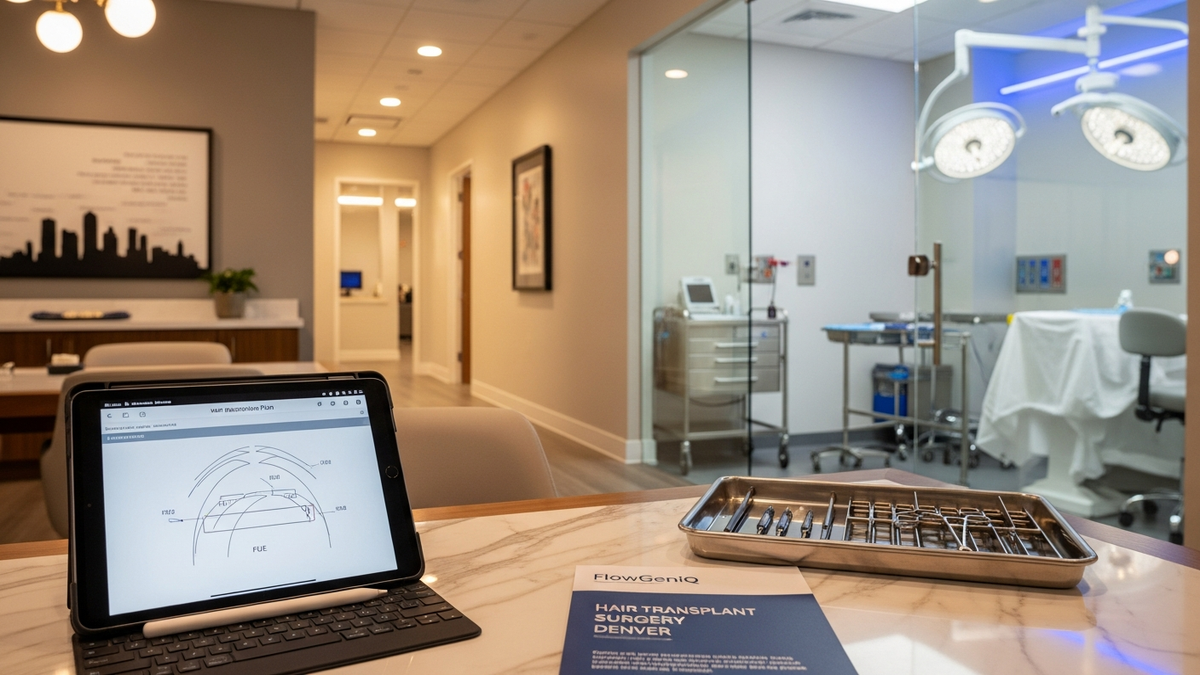
Most Denver patients exploring hair transplant surgery are considering FUE because it avoids a linear strip scar. FUE uses follicular unit extraction—removing individual grafts from the donor area and implanting them into targeted sites.
Step 1: Consultation and candidacy assessment
We start with a detailed evaluation of your pattern of loss, donor availability, and your expectations. This is where we determine whether surgery is the right fit or whether a non-surgical pathway may be better for your stage.
Step 2: Surgical procedure day
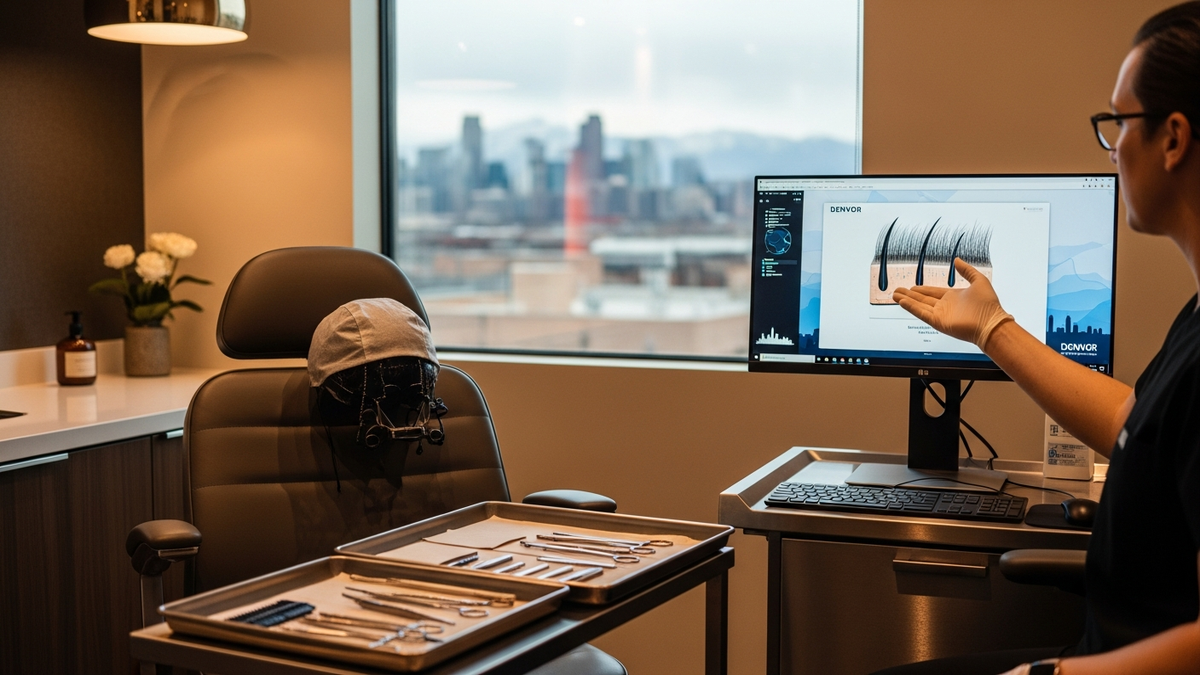
Our FUEsion approach is performed in a comfortable clinic setting using local anesthesia. The day typically involves:
- Donor extraction under controlled protocols
- Graft processing and preparation
- Implantation into planned recipient sites
Procedure length can vary depending on graft count and the number of zones being addressed.
Step 3: Early growth and shedding
Many patients experience initial shedding after transplantation. This can feel concerning, but it’s often a normal part of the cycle as follicles adjust. Growth usually begins gradually over the following months.
Step 4: Full results timeline
Visible improvement commonly starts around the 6-month mark, with fuller maturation often taking 12–18 months depending on individual factors such as growth rate, density targets, and hair characteristics.
How We Design Natural-Looking Density
When we talk about natural results, we mean more than “hair where there used to be none.” We focus on:
- Hairline artistry: The shape should complement your facial proportions.
- Density distribution: Coverage should look realistic—not uniformly thick everywhere.
- Graft direction and angle: Implanted hair should mimic natural flow.
- Recipient site planning: Placement must consider scalp conditions and long-term stability.
Why donor supply planning is critical
Donor hair is finite. We help Denver patients build a plan that respects future loss patterns so you can avoid “overharvesting” early and leaving insufficient coverage for later stages.
Ideal Candidates for Hair Transplant Surgery in Denver
Many people ask whether they’re a good candidate. While every case is unique, hair transplant surgery Denver is often considered for:
- Male pattern hair loss (commonly evaluated using the Norwood scale)
- Receding hairline and temple thinning
- Crown thinning or diffuse top-of-scalp loss
- Scar repair (when appropriate donor and scar conditions exist)
- Stable hair loss or hair loss managed with complementary therapy
When surgery may not be the best first step
Some patients are early in their hair loss journey or have patterns that may respond better to non-surgical strategies first. If that’s the case, we’ll discuss options rather than pushing surgery by default.
Hair Transplant vs. Non-Surgical Options: What’s Right for You?
Not every patient needs surgery immediately. Depending on your stage and goals, non-surgical treatments can be helpful for early or mid-stage hair loss, and some patients combine pathways for a fuller approach.
Non-surgical regrowth support
If you’re exploring alternatives to surgery, you may want to review Non-Surgical Hair Regrowth to understand how active scalp support can be used in appropriate cases.
Technology-assisted planning tools
We believe clarity reduces anxiety. You can also explore a Graft and Cost Calculator to get a sense of planning inputs before your consultation.
What About Women? Female Hair Transplant in Denver
Female hair loss often presents differently than typical male pattern baldness. For women, we focus on preserving surrounding hair, respecting parting and facial framing, and targeting the pattern of thinning with a refined approach.
If you’re looking specifically at surgical options for women, you can review Female Hair Transplant to understand how we tailor treatment plans for Ludwig-scale patterns and other female-specific causes.
Beyond the Scalp: Beard and Eyebrow Transplant Options
Hair restoration isn’t limited to the scalp. Some Denver patients want to restore facial hair density or improve eyebrow definition.
- For beard goals, see the Beard Transplant option.
- For eyebrow restoration, explore the Eyebrow Transplant approach.
Hair Transplant Reviews: How to Evaluate Trust
When you’re comparing clinics, you want evidence—not vague promises. A strong way to evaluate fit is to review patient stories and results, then ask detailed questions about planning and recovery.
We encourage you to read Hair Transplant Reviews to understand the patient experience and outcomes we aim to deliver.
Recovery in Denver: What the First Weeks Feel Like
Recovery is a major decision factor for anyone considering hair transplant surgery Denver. While everyone heals differently, most patients can expect a structured early phase.
First 24–72 hours
You may experience tenderness and mild swelling. We provide post-procedure instructions to support healing and protect implanted grafts.
Days 5–7
Many patients can return to routine work activities around this window, depending on how their scalp feels and the nature of their job.
Weeks 2–4
As shedding and early healing progress, the scalp may look different than you expect. We’ll guide you on gentle care and what changes are normal.
Months 3–6 and beyond
Growth becomes more noticeable gradually. Patience is key—results typically evolve over 12–18 months.
Costs and Graft Planning: What Influences Your Estimate?
Cost is one of the biggest questions we hear in Denver. Pricing typically depends on graft count, the number of zones, donor characteristics, and the complexity of the case.
To help you plan, we offer a Graft and Cost Calculator that can guide your expectations before you speak with our team.
What we consider during planning
- Donor density and the quality of follicles
- Hair loss pattern and coverage goals
- Hairline design requirements
- Recipient site strategy
- Any special considerations (scars, prior surgery, etc.)
Technology Support at FUEsion Hair Clinics Denver
Many people want to know how technology fits into hair transplant surgery Denver. We view technology as a support layer for planning and consistency—not a replacement for surgical expertise.
AI and AR-assisted workflow
Our AI and AR-assisted approach supports decision-making around planning details such as zones, density targets, and visualization. The goal is to help you understand what’s possible before you commit.
Where this fits in the overall care model
Even with advanced tools, the surgeon still determines the final plan based on your scalp and donor characteristics. That’s why we combine technology with a thorough clinical assessment.
To learn more about our surgical pathway, you can explore Hair Transplant and the FUEsion surgical highlights.
Steps You Can Take Before Your Denver Consultation
If you’re preparing for hair transplant surgery Denver, these actions can make your consultation more productive:
- Gather your history: When did thinning start? Any family history? Any prior treatments or surgeries?
- Bring photos: Front, temples, crown, and a few different lighting angles.
- List medications: Include any hair loss therapies you’re using.
- Write your goals: Are you prioritizing hairline restoration, crown density, or both?
- Ask about timeline and maintenance: Understand what growth stages look like and whether adjunct therapy is recommended.
Frequently Asked Questions
How long does hair transplant surgery Denver take?
Procedure time varies based on graft count and the number of zones treated. Many patients complete surgery in a single day under local anesthesia, with duration typically spanning several hours.
When will I see results after a FUE hair transplant?
Most patients notice early changes around the 6-month period. Full maturation often takes 12–18 months, depending on your growth cycle and the density plan.
Is hair transplant surgery permanent?
Transplanted follicles are generally considered permanent because they come from donor areas that are resistant to the hormone patterns that drive common hair loss. Ongoing hair loss in non-transplanted areas can still occur, which is why long-term planning matters.
Will I have a scar with FUE?
FUE typically avoids a linear scar because it extracts individual follicular units rather than removing a strip of tissue. There may be small dot-like extraction sites, which often heal over time.
Who is a good candidate for hair transplant surgery in Denver?
Good candidates typically have sufficient donor density, realistic expectations, and a hair loss pattern that can be addressed with appropriate graft planning. In some cases, non-surgical regrowth support may be recommended first.
External Evidence: What Research Says About FUE
While individual outcomes vary, credible medical literature supports the importance of technique and graft handling in achieving strong results.
- Graft survival and technique: According to a review article in Dermatologic Surgery, outcomes in FUE depend heavily on surgical technique and graft processing, with reported high graft survival rates when performed under appropriate protocols (PubMed (Dermatologic Surgery review search)).
- Hair loss prevalence: According to the American Academy of Dermatology, hair loss affects millions of people in the United States, including both men and women (American Academy of Dermatology, American Academy of Dermatology website).
- Female pattern hair loss: According to DermNet NZ, female pattern hair loss is a common condition with distinct patterns and treatment considerations (DermNet NZ).
Stats to frame expectations (with sources):
- Hair loss is widespread: the American Academy of Dermatology notes that hair loss affects tens of millions of people in the U.S. (American Academy of Dermatology, aad.org).
- Hair transplant results depend on growth cycles: clinical reviews commonly describe progressive improvement over months, with full maturation often taking about a year or more (DermNet NZ and dermatology review literature, dermnetnz.org).
Book Your Consultation in Denver
If you’re ready to explore whether hair transplant surgery Denver is right for you, we’ll help you understand your options with a clear, surgeon-guided plan. At FUEsion Hair Clinics Denver, our goal is to make the decision process feel calm, informed, and personalized.
We also invite you to review our Hair Transplant service overview and consider how our planning approach supports natural density.
Next step: Tell us what you want to restore—hairline, crown, temples, or density—and we’ll guide you toward the best pathway.
About This Guidance (E-E-A-T)
This article is written by our clinical content team at FUEsion Hair Clinics Denver to help patients understand hair restoration options. Our recommendations reflect general medical information and common planning principles; your personal plan should be determined by a qualified surgeon after an individual assessment.
Author attribution: Content reviewed for clinical accuracy by the FUEsion Hair Clinics Denver medical team.
For a deeper look at our surgical approach, visit the service page for Hair Transplant and explore how our technique supports natural-looking outcomes.
When you’re ready to move forward, you can also start with our planning tools and patient experience resources.
Need a quick starting point? You can learn more about FUEsion Hair Clinics Denver and our hair transplant surgery overview in Denver.

Professional Disclaimer
This content is provided for general educational purposes only by FUEsion Hair Clinics Denver. It is not a substitute for professional advice, diagnosis, or treatment. Readers are advised to consult qualified professionals for personalized recommendations.
Medical Information Disclaimer
This content is provided for general educational purposes only by FUEsion Hair Clinics Denver. It is not a substitute for professional advice, diagnosis, or treatment. Readers are advised to consult qualified professionals for personalized recommendations.