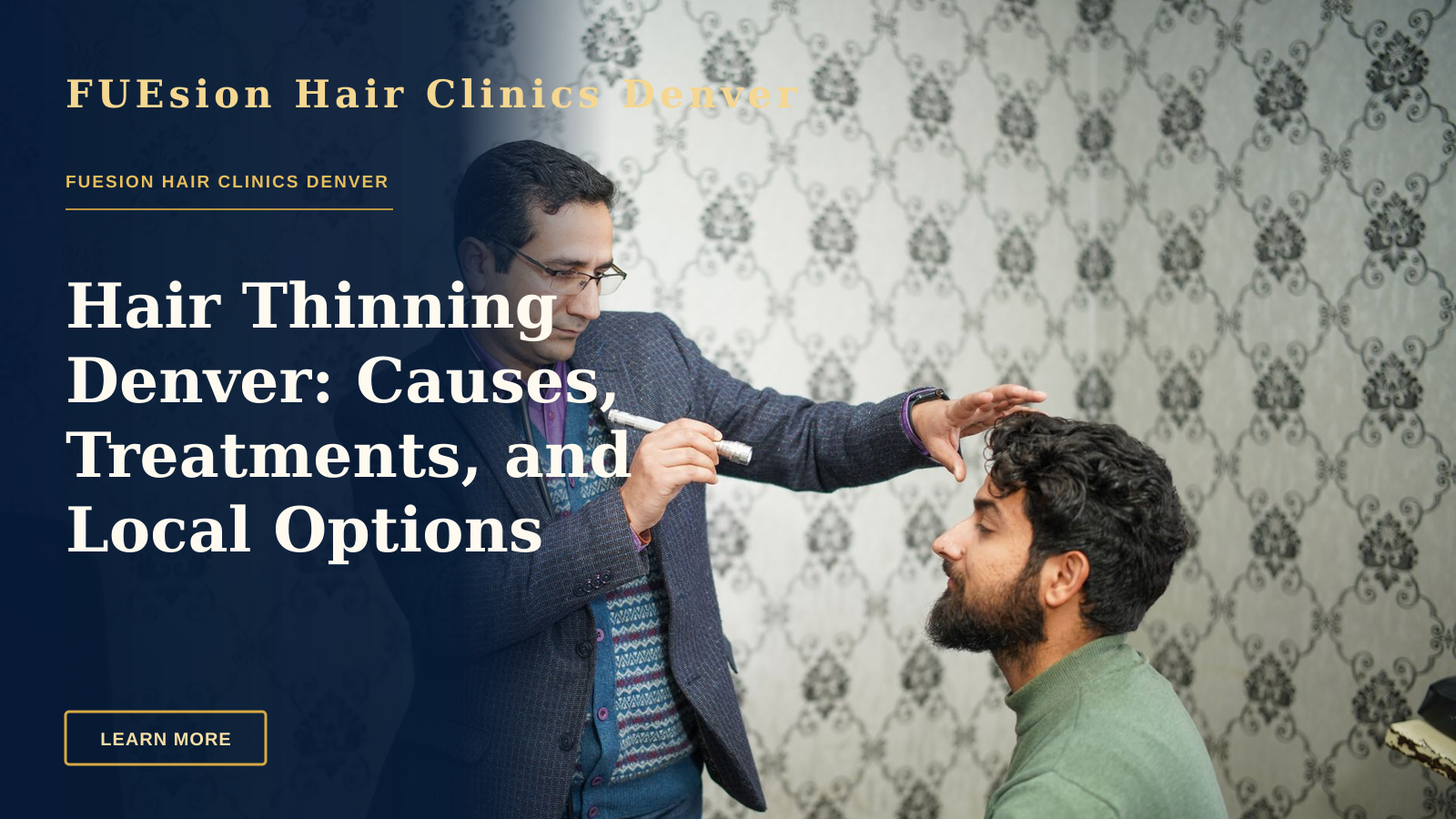
hair thinning Denver is the focus of this practical guide for clinicians and learners. Noticing hair thinning in Denver can feel sudden and worrying, but understanding the causes and realistic treatment paths makes it far easier to choose an effective plan. This guide explains why hair thins, how to tell reversible loss from permanent patterns, and what practical local options—both non‑surgical and surgical—look like for Denver residents.
If you want an immediate, practical next step, try a photo‑based simulation so you can see realistic results before you commit. FUEsion Hair Clinics offers an AI Hair Simulator and a free consultation process that pairs photo‑based planning with surgeon‑led evaluations. Below you'll find timelines, safety considerations, decision checkpoints, and local resources that will help you evaluate whether to start medical therapy, pursue non‑surgical scalp rejuvenation, or plan a hair transplant.
Patient Journey & Consultation
Taking the first step after noticing hair thinning usually means getting a structured assessment and a clear action plan. At an efficient clinic, this starts with a rapid response to your inquiry, a photo assessment or video consult, and a documented plan that outlines goals, expected timelines and any required tests. According to Nutritional Correction for Hair Loss, Thinning of Hair, and Achieving New Hair Regrowth (scholarly source), this source provides relevant background for the discussion.
At clinics offering both virtual and in‑person care, patients typically receive an appointment confirmation within a day and a substantive reply within a few business hours. A good consultation should include a clinical hair and scalp exam, a discussion of family history and medications, and a review of non‑surgical options like topical or device therapies versus surgical options such as FUE transplants.
We recommend running simple digital pre‑work before your consultation so the visit is focused on decisions, not discovery. Tools like graft calculators and AI simulations convert your concerns into visual goals and realistic graft estimates, which helps the clinician build a personalized plan during your surgeon consult.
- Fast response and appointment confirmation—expect an initial reply within 24 hours for consultations.
- Free virtual consultation available—useful if you live outside Denver or prefer remote planning.
- Digital tools (simulator + graft calculator) let you visualize results and arrive informed.
- Surgeon‑led plan with documented goals and follow‑up schedule.
After the consult the pathway typically splits into conservative management (medical/topical/device), non‑surgical scalp activation like InFuze™, or surgical planning for AI & AR assisted FUE. The 12‑month review is an important milestone if you pursue a transplant, as some clinics use that checkpoint to confirm growth benchmarks and schedule any agreed corrective steps.
Ready to take the next step?
Speak directly with Dr. Sanders. No obligation. Completely free.
Find out if you're a candidate for FUE Hair Transplants or non-surgical hair regrowth options.
Book Your Free ConsultationSimulator
Seeing a likely outcome changes how people plan. The AI Hair Simulator provides a clinician‑calibrated preview of hairline, density and style options using a single frontal photo. It also produces a personalized graft estimate and cost range so you arrive at your consultation with a tangible objective.
The simulation workflow is quick: upload a clear, well‑lit frontal photo, let the AI analyze your hair pattern, and receive a before/after preview along with an estimated graft count and cost range. For many patients this reduces anxiety, clarifies goals, and speeds decision‑making because the visual is shared and documented during the surgeon consultation.
Because the simulator is image‑based and clinically informed, it becomes a useful tool during the surgeon visit: your photo results are saved and used to refine recipient density plans, graft counts and styling choices that match your facial features and personal preferences.
- Upload one clear frontal photo for the most accurate preview.
- Receive an AI-generated graft estimate that informs realistic expectations.
- Get an instant, clinically-informed cost estimate to guide budgeting.
- Bring your simulation to the consultation to document the agreed aesthetic plan.
Use the simulator early in your decision process to convert subjective hopes into an objective target you and your surgeon can work toward.
See your potential results before you commit
AI Hair Simulator
Our AI Hair Simulator uses your own photo to show realistic hairline, density and style options — and generates a personalized cost estimate so you walk into your consultation knowing exactly what you want and what it costs.
Get Free AccessReady to take the next step?
Book a Free ConsultationWhy Hair Thinning Happens (Common Causes)
Understanding the cause of thinning helps prioritize treatments. The most common drivers are genetic pattern loss (androgenetic alopecia), hormonal changes, medical conditions, nutritional deficits, medications, and stress‑related shedding. Each cause produces a distinct clinical pattern and timeline that affects treatment choice.
Genetic pattern hair loss typically progresses slowly and responds best to medical therapy plus restoration when the donor area is stable. Telogen effluvium (shedding after illness, stress, or hormonal shifts) often stabilizes within months and may respond to nutritional and medical support. Other causes—thyroid disease, iron deficiency, autoimmune conditions—require targeted medical evaluation because treating the underlying issue is the priority.
Local environmental differences in Denver—such as higher altitude, lower humidity, and UV exposure—can aggravate scalp dryness or hair breakage, but they are rarely primary causes of true pattern thinning. If you’re noticing more shedding or thinner density after moving to Denver, an exam that includes bloodwork and scalp assessment will help distinguish breakage from follicular miniaturization.
Services & Procedures
When hair thinning progresses beyond what topical therapy can control, many patients evaluate both non‑surgical and surgical options. Below is a clear, enumerated menu of services with the key facts that help you compare time, invasiveness, and expected timelines.
We offer personalized planning for every patient, and each treatment pathway includes pre‑op assessment, intra‑procedural protocols and post‑op follow‑up. Use the Services page to schedule or to read deeper technical descriptions for specific procedures.
Core services include surgical transplants, targeted non‑surgical regeneration and adjunctive therapies used to maximize outcomes and graft survival. These options are selected based on the extent of thinning, donor availability, patient goals and timeline.
- Hair Transplant (AI & AR Assisted FUE / FUEsion Hair Transplant) — Duration: 4–7 hours (4–10 hours for larger cases). Anesthesia: local. Downtime: return to work in 5–7 days. Results visible from 6 months, full at 12–18 months. Graft survival: >95%.
- Beard & Eyebrow Transplants — Beard grafts typically 300–2,500; eyebrow 50–400 grafts per brow; precise angulation to recreate natural lay.
- InFuze Non‑Surgical / InFuze™ Restoration — Uses InFuze™ ScalpPulse Technology for scalp activation and targeted infusion; no surgery, no downtime; suitable early‑to‑mid stage or as adjunct to transplants.
- FUT & PRP — FUT offered where clinically indicated; PRP therapy used as an adjunct for follicular stimulation and healing support.
Each service includes personalized planning and post‑operative care. For appointments and additional procedural detail, visit our Services page and bring your simulation results to your consultation to help define density and graft counts.
See your potential results before you commit
AI Hair Simulator
Our AI Hair Simulator uses your own photo to show realistic hairline, density and style options — and generates a personalized cost estimate so you walk into your consultation knowing exactly what you want and what it costs.
Get Free AccessAdditional booking resources: View all services or Book a free consultation. See our Gallery for representative results.
Want personalized advice?
Schedule Your AssessmentTrust & Guarantee (FUEsion Assurance)
Choosing a provider for hair thinning and restoration involves more than technique: it requires clear commitments on growth, artistry and follow‑up. The FUEsion Assurance program documents those commitments so expectations and remedies are transparent before you proceed.
The Assurance is confirmed during consultation and becomes part of your post‑op plan. The formal 12‑month review is the actionable checkpoint for Growth Assurance remedies. Transparency about benchmarks, documented hairline agreements and included aftercare reduces the risk of confusion if outcomes need refinement.
Here are the Assurance pillars that define the program and how they protect patients.
- Growth Assurance — If growth falls short of the agreed benchmark at the 12‑month review, supplemental grafts will be provided at no cost when indicated.
- Artistry Assurance — The agreed hairline and aesthetic plan are documented prior to surgery; corrective work is provided if the executed outcome deviates significantly.
- Aftercare Assurance — Post‑operative care, follow‑up visits and surgeon access are part of every package.
- Satisfaction Assurance — The clinic commits to addressing concerns until agreed objectives are met.
To activate the Assurance, the surgical plan and benchmark metrics are agreed during the surgeon consultation and recorded in your post‑op plan. The 12‑month review is the formal evaluation point for any Growth Assurance supplements. If you want to understand the full terms or ask specific questions, discuss them during your consultation so you know exactly how remedies will be handled.
Ready to take the next step?
Speak directly with Dr. Sanders. No obligation. Completely free.
Find out if you're a candidate for FUE Hair Transplants or non-surgical hair regrowth options.
Book Your Free ConsultationFor more details visit the Assurance and Terms pages and raise any specific questions at your consult: Read the FUEsion Assurance.
Technology & Technique — What To Expect From Modern FUE
If you’re considering a transplant for persistent thinning, modern FUE combines careful donor mapping with precise extraction and artistic recipient site creation. Proprietary workflows now include AI & AR guidance to improve mapping, extraction geometry and implantation precision.
Key technical advantages that matter for graft survival and naturalness include microscopic donor assessment, micro‑punch extraction sized to the follicle, careful graft handling with controlled holding solutions, and surgeon‑crafted recipient sites at natural angulation. These factors influence both survival rates and aesthetic outcomes.
For those exploring non‑surgical routes, technologies like InFuze™ Restoration use ScalpPulse Technology to stimulate microcirculation and infuse growth compounds. InFuze sessions are an option for early‑to‑mid stage thinning or as an adjunct to maximize transplant outcomes.
These technological elements are why some clinics report graft survival rates above traditional averages; when evaluating providers, ask about microscopic assessment, graft management protocols and whether the procedure is performed by licensed surgeons (not non‑medical technicians).
See how we can help you
Get Started TodayResults & Social Proof
Before/after photos and patient reports help set realistic expectations. Look for galleries with representative cases that match your hair type and the degree of thinning you’re experiencing. Realistic galleries show the staged timeline—shedding at 2–3 months, visible changes by 6 months and final density at 12–18 months.
Good practices when reviewing results: verify that images are from real patients, compare similar baseline stages, and ask whether the clinic documents long‑term follow up. Many clinics publish both gallery cases and written testimonials so you can evaluate technical skill and patient experience.
For Denver‑specific examples and representative outcomes, review local gallery pages and testimonials. These help you align expectations with likely timelines and aesthetic decisions.
See your potential results before you commit
AI Hair Simulator
Our AI Hair Simulator uses your own photo to show realistic hairline, density and style options — and generates a personalized cost estimate so you walk into your consultation knowing exactly what you want and what it costs.
Get Free AccessHow To Choose a Provider in Denver
Evaluating clinics for hair thinning treatment is partly technical and partly practical. Ask whether procedures are performed by licensed medical professionals, whether the clinic documents graft survival benchmarks, and whether post‑op surgeon access and a formal review process are included in the package.
Practical considerations include cost transparency, availability of virtual consults if you live outside Denver, and whether the clinic provides pre‑visit tools (simulator, graft calculator) so you can make an informed decision in one or two visits. Confirm whether the provider offers both surgical and non‑surgical options so you can move between modalities if your needs change.
Before booking, review the clinic’s gallery and assurance terms and prepare a short list of questions: who will perform the extraction and implantation, what are written growth expectations, what graft survival benchmarks do they use, and what remedies are available if goals aren’t met.
Conclusion
Hair thinning in Denver is common and treatable across a spectrum from medical and device therapies to non‑surgical scalp rejuvenation and advanced FUE transplants. Your best next step is an evidence‑driven consultation that combines a photo simulation, a graft estimate and a surgeon‑led plan so you can compare options side‑by‑side.
If you want to visualize a likely outcome before booking, use an AI Hair Simulator and Graft Calculator to create a photo‑based starting point. Then schedule a free surgeon consultation to confirm diagnosis, review realistic timelines (visible change by 6 months; full results by 12–18 months for transplants) and document any growth or artistry guarantees in writing.
For Denver residents seeking a local pathway, the clinic provides free virtual consultations, in‑person evaluations and documented assurance for growth and artistry. Start with the simulator and a consultation to get a personalized plan and clear next steps.
FAQ
Q: How quickly will I see improvement after treatment?
A: For non‑surgical therapies you may notice scalp and texture changes in weeks and measurable growth in months. For hair transplants, transplanted hairs typically shed and then regrow—expect initial regrowth around 3–4 months, visible changes by 6 months, and full results at 12–18 months.
Q: Is a transplant painful and how long is recovery?
A: Modern FUE is performed under local anesthesia and is generally well tolerated. Typical recovery allows a return to normal non‑strenuous work in 5–7 days. Full cosmetic settling takes longer as transplanted hairs cycle and thicken.
Q: Can I try non‑surgical options first?
A: Yes. InFuze™ Restoration and medical therapies are sensible first steps for early to mid‑stage thinning or as adjuncts to surgery. A surgeon or hair specialist can help sequence therapies based on donor status and goals.
Q: How do I verify a clinic’s claims?
A: Request surgeon credentials, examples of comparable cases in the gallery, documented growth benchmarks, and written policies on follow‑up and corrective care. Use the simulator and bring the outputs to your consultation to ensure plans are aligned with visual goals.
Medical Information Disclaimer
This content is provided for general educational purposes only. It is not a substitute for professional advice, diagnosis, or treatment. Readers are advised to consult qualified professionals for personalized recommendations.
Have questions? We have answers.
Speak With an Expert