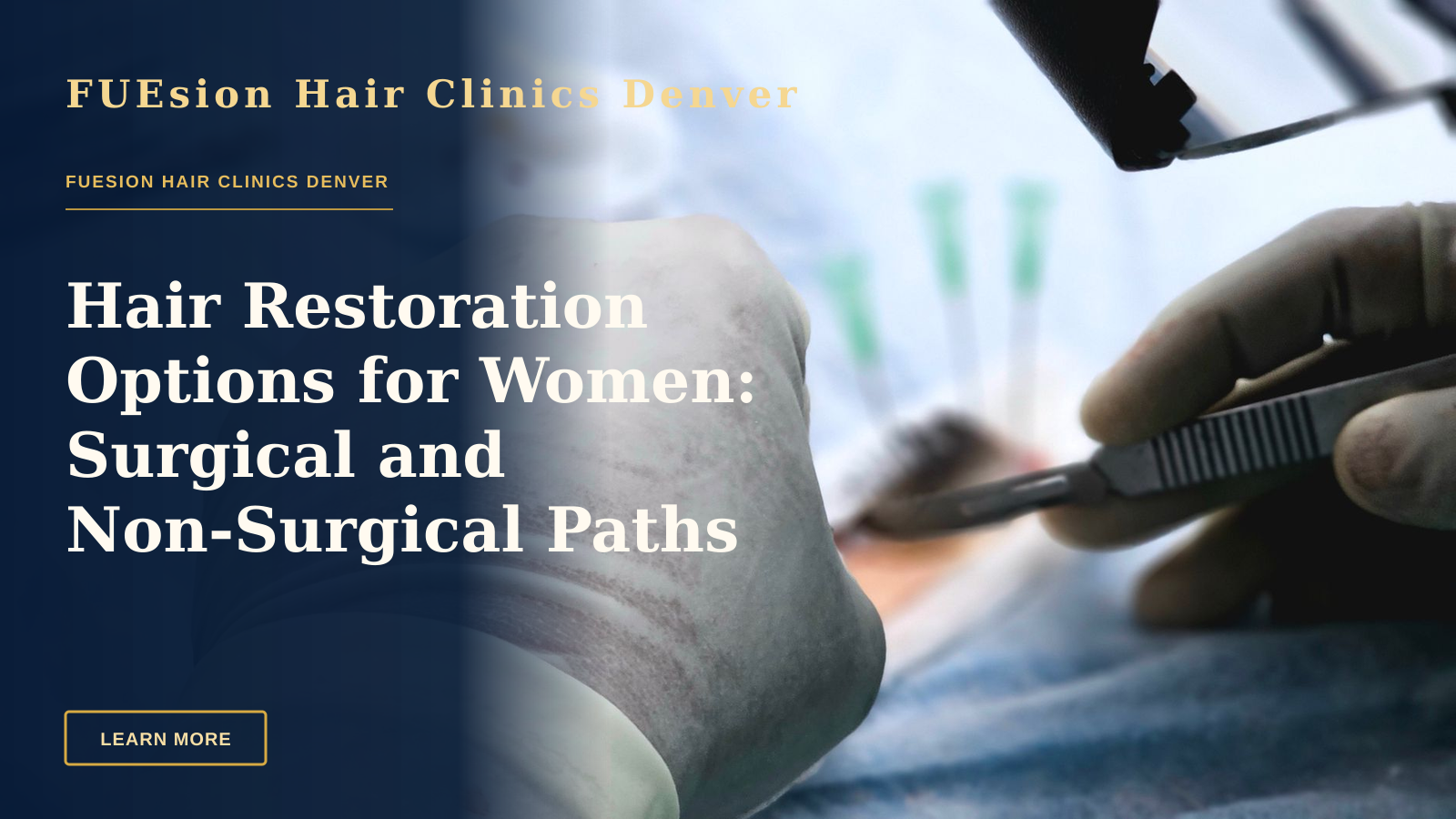
If you're searching for hair restoration options for women, you likely want solutions that respect female hair patterns, minimize visible scarring and preserve existing hair. Women experience hair thinning and loss differently than men — diffuse thinning, widened part lines, post‑partum loss and traction alopecia require tailored evaluation and a mix of surgical and non‑surgical strategies to restore density and confidence.
This article outlines the evidence‑backed options available today, how clinicians decide between them, and what realistic timelines and expectations look like. Where relevant, we'll describe how proprietary tools and workflows—like AI‑assisted planning, InFuze™ ScalpPulse Technology and surgeon‑led FUE procedures—fit into a woman’s care pathway and how free tools (an AI Hair Simulator and Graft Calculator) can clarify goals before you commit.
Patient Journey & Consultation
Deciding among hair restoration options for women begins with a clear, documented plan. The patient journey at modern clinics typically starts with easy contact and rapid triage: you can request a free consultation online or by phone and expect a response within the timelines published on clinic sites. Virtual consultations are increasingly common and allow you to meet surgeons or senior clinicians without traveling. According to Different options in revision surgical hair restoration (scholarly source), this source provides relevant background for the discussion.
A typical consultation includes medical history, hair and scalp examination, and a discussion of goals. Digital pre‑work such as running a Graft Calculator and uploading photos to an AI Hair Simulator helps the team generate photo‑based graft estimates and visual outcomes in advance. This makes the surgeon consultation more productive because the team can focus on feasibility, technique and tradeoffs rather than initial discovery.
When a surgeon is involved, they document an aesthetic plan and treatment roadmap that addresses female‑specific patterns (for example Ludwig patterns or diffuse thinning). The FUEsion workflow records agreed hairline design and outcome benchmarks — an important step when expectations and artistry matter most.
- Fast first contact and confirmed response windows to schedule consults.
- Free virtual consultations for nationwide and international patients with secure video options.
- Pre‑consult tools (Graft Calculator, AI simulation) to visualize results and estimate graft needs.
- Surgeon‑led planning that documents the agreed aesthetic plan and growth benchmarks.
After your consult you’ll receive a personalized plan that explains whether you’re a better candidate for non‑surgical regrowth (early–mid stage), a surgical approach (permanent grafting for stable donor zones), or a combination pathway. The formal review checkpoints — including a 12‑month growth review when applicable — are scheduled up front so you understand monitoring and potential corrective steps.
Ready to take the next step?
Speak directly with Dr. Sanders. No obligation. Completely free.
Find out if you're a candidate for FUE Hair Transplants or non-surgical hair regrowth options.
Book Your Free ConsultationSimulator
Seeing is believing when evaluating hair restoration options for women. An AI Hair Simulator lets you upload a clear frontal photo and receive a clinically informed preview of potential outcomes, showing hairline shape, density and style choices without any medical commitment. These preview tools also return an AI‑generated graft estimate and a personalized cost range so you arrive at consultation informed.
Good simulations are powered by medical‑grade image analysis and combine pattern recognition with graft‑count logic to suggest realistic density improvements for female hair loss presentations. Using the simulator prior to a surgeon consult improves the conversation: you and the surgeon can align on target density, donor availability and whether a staged approach will be needed.
How it works in practice: upload a well‑lit frontal photo, let the AI scan and estimate graft needs, then view before/after previews and an instant cost estimate. You can save or share the results with your surgeon so the in‑person or virtual consult focuses on fine‑tuning technique and timelines rather than discovery.
- Quick, photo‑based visualization that clarifies realistic expectations.
- Integrated graft estimation to help determine if surgery is appropriate now or later.
- Personalized cost estimates so financial planning begins before the consult.
- No signup required — launch the simulation and bring the results to your appointment.
Try the AI Hair Simulator before your consultation to shape the discussion around feasible goals and timelines: it’s a practical bridge from online research to a personalized surgical or non‑surgical plan.
See your potential results before you commit
AI Hair Simulator
Our AI Hair Simulator uses your own photo to show realistic hairline, density and style options — and generates a personalized cost estimate so you walk into your consultation knowing exactly what you want and what it costs.
Get Free AccessReady to take the next step?
Book a Free ConsultationHow Hair Restoration Options Differ for Women
Women’s hair loss commonly presents as diffuse thinning across the crown, a widened part line, or region‑specific loss (post‑partum or traction‑related). These patterns demand different tactics than male pattern baldness: preserving surrounding hair, avoiding visible scarring and accounting for lower donor density are frequent considerations.
Non‑surgical options are often the first line for early‑stage loss. They include topical therapies, medical regimens, PRP/PRF, low‑level laser therapy, and newer multi‑modal scalp activation systems. When thinning is significant or the hairline needs structural change, surgical options such as FUE hair transplant can provide permanent restoration.
Key differences to weigh when choosing a path:
- Regrowth vs Replacement — Non‑surgical methods aim to stimulate existing follicles; surgical grafting permanently replaces lost follicles.
- Downtime and recovery — Non‑surgical treatments typically have zero downtime; modern FUE offers minimal downtime but requires a healing period and staged density planning.
- Donor limitations — Women's donor density may limit the maximum single‑session graft count; surgeons plan distribution to maintain natural appearance.
- Cosmetic goals — Female patients often prioritize soft, feminine hairlines and natural parting that require artistic recipient‑site creation.
In many cases, a combined strategy is best: non‑surgical therapies to improve hair thickness and scalp health, followed by targeted surgical grafting to rebuild density in strategically chosen areas.
Services & Procedures
Women seeking hair restoration options benefit from a comprehensive menu that covers both surgical and non‑surgical pathways. Procedures are tailored to female patterns of loss and include pre‑op planning, surgeon‑led execution and documented post‑op follow up. Providers typically offer virtual or in‑person consults to determine which service or combination suits your needs.
The surgical centerpiece for permanent restoration is an advanced FUE approach. Non‑surgical options are offered both as standalone care for early loss and as adjuncts to surgery to maximize graft uptake and improve surrounding hair quality. Every plan should include realistic timelines and scheduled reviews to monitor growth and decide on next steps.
Core services you can expect to find and how they apply to female patients:
- Hair Transplant (AI & AR Assisted FUE / FUEsion Hair Transplant) — Sessions typically last 4–7 hours (longer for larger cases), use local anesthesia and have a return‑to‑work window of about 5–7 days. Visible results start around 6 months and mature at 12–18 months; reported graft survival is over 95% in this workflow.
- InFuze Non‑Surgical / InFuze™ Restoration — Uses ScalpPulse Technology to stimulate the scalp and deliver targeted compounds with no surgery and zero downtime; suitable for early‑to‑mid stage loss or as an adjunct.
- PRP therapy — Platelet‑rich plasma as a follicular stimulant, frequently combined with other modalities.
- Eyebrow & Scar Repair — Fine‑angled grafting for brows or surgical correction and camouflage for prior strip scars and other defects.
We recommend consulting a surgical team to review the full services menu and choose a plan that balances donor availability, aesthetic goals and recovery preferences. For bookings and full procedural details, review the Services page and bring your simulator results to a consultation to make the most informed choice: Services.
See your potential results before you commit
AI Hair Simulator
Our AI Hair Simulator uses your own photo to show realistic hairline, density and style options — and generates a personalized cost estimate so you walk into your consultation knowing exactly what you want and what it costs.
Get Free AccessWant personalized advice?
Schedule Your AssessmentTrust & Guarantee (FUEsion Assurance)
When choosing among hair restoration options for women, the warranty and follow‑up framework matters. The FUEsion Assurance is an industry‑first program designed to protect outcomes across growth, artistry, aftercare and satisfaction. The Assurance is documented during the consultation and becomes part of the post‑operative plan so expectations are clear from the outset.
The program contains several explicit promises that translate into real‑world protections for patients. The 12‑month review is the formal checkpoint: if growth falls short of the pre‑agreed benchmark, supplemental grafting is provided where indicated, at no additional cost. This feedback loop reduces financial and outcome risk for patients seeking permanent restoration.
Assurance pillars and what they mean for you:
- Growth Assurance — A guaranteed minimum graft survival/growth benchmark with supplemental grafts available at the 12‑month review when indicated.
- Artistry Assurance — The agreed hairline and aesthetic plan are documented; corrective work is provided if results materially deviate from that plan.
- Aftercare Assurance — Follow‑up appointments, post‑op care and surgeon access are included throughout recovery and growth monitoring.
- Satisfaction Assurance — The clinic commits to addressing concerns until published outcome objectives are met.
If you’re considering a consultation, ask how the Assurance is documented during your surgeon visit and review the formal terms at the consultation stage. For more details or to schedule a consult that includes a review of Assurance terms, use the consultation page linked below to set up your appointment.
Ready to take the next step?
Speak directly with Dr. Sanders. No obligation. Completely free.
Find out if you're a candidate for FUE Hair Transplants or non-surgical hair regrowth options.
Book Your Free Consultation
Technology & Technique
For women, technique and technology determine both naturalness and the preservation of remaining hair. Advanced workflows combine microscopic donor assessment, calibrated micro‑punch extraction and careful recipient site creation to maximize graft viability and mimic natural hair direction and density.
Proprietary systems that are particularly relevant include AI & AR Assisted FUE for donor mapping and extraction geometry, and InFuze™ ScalpPulse Technology for multi‑modal scalp activation without surgery. When surgery is indicated, surgeon‑performed FUE with micro‑punch tools and a specialized graft holding solution supports graft survival rates reported at over 95% in this workflow.
Women often require nuanced recipient site artistry — typical implantation site angles are crafted to produce soft parting and a feminine hairline. Combining non‑surgical scalp reactivation (to thicken miniaturized hairs) with carefully placed grafts gives many patients the most natural long‑term result.
- AI & AR Assisted FUE improves donor mapping and placement precision.
- InFuze™ ScalpPulse Technology provides non‑surgical scalp activation and targeted compound infusion with no downtime.
- Microscopic donor assessment and calibrated punches help maintain donor integrity, which is especially important when donor reserves are modest.
If you value minimal scarring, natural density and documented graft survival, discuss the clinic’s technology stack and lab protocols during your consultation so you understand how surgical choices affect long‑term outcomes.
See how we can help you
Get Started TodayResults, Recovery and Practical Considerations
Expect a staged timeline for meaningful change. Most protocols report early shedding and a regrowth phase: initial shedding may occur in the first 2–3 months after transplant or aggressive stimulation, new hairs start to appear around 3–6 months, and full maturation occurs by 12–18 months. Non‑surgical technologies often show measurable regrowth in months but require maintenance treatments.
Recovery and daily‑life impact differ significantly between options. Non‑surgical therapies typically have no downtime and can often be performed during a lunch hour. FUE procedures require local anesthesia and a short recovery window; many patients return to desk work within about a week, while full cosmetic settling takes longer.
When weighing options, consider donor availability, the risk of further diffuse loss, pregnancy plans, medication interactions and your tolerance for ongoing maintenance. A staged plan — starting with non‑surgical strengthening and moving to targeted grafting if needed — is often the most conservative and practical approach for women.
Conclusion
Choosing hair restoration options for women is a personalized decision that depends on pattern and stage of loss, donor characteristics, cosmetic goals and lifestyle. Non‑surgical approaches such as InFuze™ ScalpPulse Technology and PRP can improve thickness and are excellent first‑line or adjunctive measures. For permanent replacement where donor hair is suitable, advanced AI & AR Assisted FUE offers permanent, natural results with minimal scarring when performed by experienced surgeons.
Use the free digital tools — an AI Hair Simulator and the Graft Calculator — to preview realistic outcomes and clarify expectations before you schedule a surgeon consultation. During the consult, confirm how outcome protections (like the FUEsion Assurance) are documented and whether a formal 12‑month review is included in your plan. With the right evaluation and a staged plan, many women achieve meaningful, long‑lasting improvement without compromising natural hair.
Primary next step: run the AI Hair Simulator to see a photo‑based preview and then book a free consultation to review a tailored plan with an expert clinician.
FAQ
Q: Can women get the same FUE transplants as men?
Yes — women can undergo FUE transplants, but the approach is adapted for female hair patterns. Surgeons plan graft placement and density to preserve natural parting and feminine hairlines while accounting for donor density.
Q: When should I choose non‑surgical options over surgery?
If your loss is early‑stage, diffuse or you want to avoid surgery, start with non‑surgical treatments like InFuze™ ScalpPulse or PRP. These can sometimes stabilize or improve density enough to postpone or reduce the extent of future surgery.
Q: Are results guaranteed?
Outcome programs such as the FUEsion Assurance document growth benchmarks, artistry standards and aftercare commitments; the 12‑month review is a formal checkpoint for remedying growth shortfalls when indicated. Discuss the specific assurances during your consultation.
Medical Information Disclaimer
This content is provided for general educational purposes only. It is not a substitute for professional advice, diagnosis, or treatment. Readers are advised to consult qualified professionals for personalized recommendations.
Have questions? We have answers.
Speak With an Expert