Searching for a clear comparison between FUE vs FUT hair transplant? This guide puts the two most common surgical approaches side‑by‑side so you understand the practical differences—what each procedure feels like, how recovery and scarring compare, and which option is usually better for different goals.
If you’re evaluating clinics, it’s also important to know what modern clinics offer: proprietary techniques, precise graft handling, and documented assurances. For example, some centers now combine AI & AR Assisted FUE and advanced graft‑holding protocols to improve graft survival and aesthetic outcomes. Where non‑surgical options make sense, technologies like InFuze™ ScalpPulse Technology provide adjunct or alternative routes to measurable regrowth with no downtime.
Patient Journey & Consultation
Choosing between FUE and FUT begins with how clinics evaluate you and plan treatment. At modern practices the first step is a structured consultation that clarifies medical history, donor supply, goals and realistic expectations. Many clinics—including those that use advanced AI tools—offer free virtual consultations and respond quickly to requests so you can start the process without travel. According to Controversies: FUE and donor depletion: Donor area overharvesting FUE/FUT (scholarly source), this source provides relevant background for the discussion.
During the consultation you should receive a documented plan that includes estimated graft counts, a hairline design and a timeline for recovery and results. Clinics that follow best practices will also explain what triggers a recommendation for FUT (strip) vs FUE and will record any agreed design so you can reference it later.
Practical booking and communication expectations vary by clinic, but good practices include prompt acknowledgement of consult requests and clear pre‑op instructions. Many providers confirm consultation requests within 24 hours and commit to steady post‑op follow‑up.
- Initial contact and scheduling (online or phone) with timely confirmation.
- Free virtual consultation that reviews photos, goals and candidacy.
- Photo‑based planning using simulation tools for realistic expectations.
- Documented surgical plan including graft estimate and design.
- Clear post‑op and follow‑up schedule, including long‑term review.
These steps protect both patient and surgical team by setting measurable expectations. If you want to start by discussing candidacy now, book a free consultation with an expert clinician to review your case and ask about documented outcome assurances.
Ready to take the next step?
Speak directly with Dr. Sanders. No obligation. Completely free.
Find out if you're a candidate for FUE Hair Transplants or non-surgical hair regrowth options.
Book Your Free ConsultationSimulator
One practical way to compare FUE vs FUT is by visualizing the expected result before committing. Our AI Hair Simulator analyzes a clear frontal photo, estimates graft needs and presents a clinically‑informed before & after—helpful for knowing whether a small FUE session or a larger FUT session better matches your goals.
Simulation tools reduce uncertainty. They let you explore hairline shapes, density preferences and a personalized cost estimate in minutes. Sharing these outputs with your surgeon leads to a more accurate and efficient in‑clinic consult.
How the simulator typically works is straightforward and clinically useful: you upload a photo, the AI estimates graft count and generates a preview. Bring that output to your consultation and the surgeon will tailor the plan to your scalp characteristics, donor density and aesthetic objectives.
- Upload a clear, well‑lit frontal photo for the most accurate preview.
- Receive an instant graft estimate to understand treatment scale.
- See a realistic before & after and a cost range to prepare for the consult.
- Save and share the simulation with your surgeon for a faster planning visit.
If you haven’t visualized options yet, try the AI Hair Simulator to see what different approaches could look like on your own photo. It’s a quick way to move from general questions to a specific plan that your surgeon can refine.
See your potential results before you commit
AI Hair Simulator
Our AI Hair Simulator uses your own photo to show realistic hairline, density and style options — and generates a personalized cost estimate so you walk into your consultation knowing exactly what you want and what it costs.
Get Free Access
Ready to take the next step?
Book a Free ConsultationFUE vs FUT: Key Differences
FUE (Follicular Unit Extraction) and FUT (Follicular Unit Transplantation or strip) are both surgical hair restoration techniques, but they differ in how donor hair is harvested and in their tradeoffs for scarring, session size and recovery.
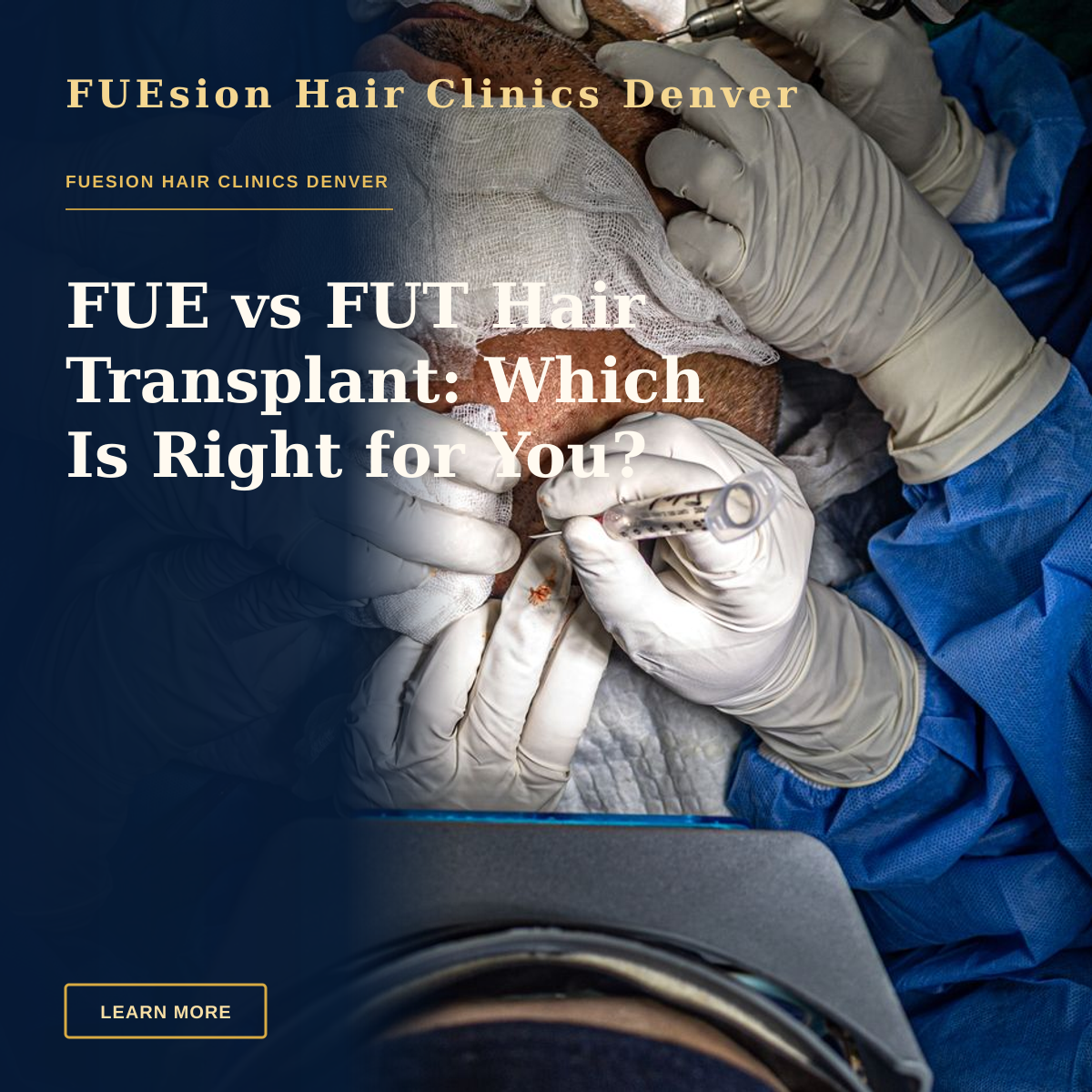
FUE removes individual follicular units from the donor area using micro‑punches, leaving tiny round punctate scars that are usually imperceptible at hair lengths of a few millimeters. FUT removes a linear strip of scalp from the donor area, which is then dissected into grafts; this leaves a linear scar that can be concealed with longer hair.
Modern surgical protocols affect outcomes substantially. Proprietary approaches—such as AI & AR Assisted FUE and calibrated micro‑punch sizes—aim to reduce follicle transection and preserve viability. Some practices report graft survival advantages with these enhancements, which can be an important factor when choosing a technique.
- Scarring: FUE produces small dot scars; FUT produces a single linear scar.
- Donor yield per session: FUT can allow large graft counts in one session; FUE sessions are often staged for very large counts.
- Hair length flexibility: FUE can be preferable if you prefer short hairstyles that would reveal a linear scar.
- Repeat procedures: FUE allows harvesting from broader donor areas over time; FUT removes a strip so donor reserve must be managed differently.
These are general patterns; a surgeon’s assessment of your donor density, hair caliber, scalp laxity and aesthetic goals determines the recommended approach. If you’re comparing options, discuss both techniques during your consultation and ask how the clinic measures and protects graft survival.
Services & Procedures
Clinics offering comprehensive hair restoration typically present an enumerated menu so you can compare logistics, timelines and what’s included. Below is a concise listing of common surgical and non‑surgical services and the practical facts you need to reference when planning a procedure.
Whether you’re considering FUE or FUT, understanding procedure duration, anesthesia, downtime and expected result timing helps set realistic expectations. Use this menu to match your availability, coverage needs and desired time to visible improvement.
Here are the core services and brief facts to compare:
- Hair Transplant (AI & AR Assisted FUE / FUEsion Hair Transplant) — Duration: 4–7 hours (4–10 hours for larger cases). Anesthesia: local. Downtime: return to work in 5–7 days. Results: visible from 6 months, full at 12–18 months. Graft survival: >95% (reported for this proprietary protocol).
- Beard Transplant — Typical graft counts 300–2,500; duration 3–8 hours; downtime ~5 days; permanent growth.
- Eyebrow Transplant — 50–400 grafts per eyebrow; 2–4 hours; careful angulation for natural lay.
- Female Hair Transplant — Specialized protocols (no strip removal) for female patterns and preservation of surrounding hair.
- InFuze Non‑Surgical / InFuze™ Restoration — ScalpPulse Technology with no surgery and no downtime; suitable for early–mid stage loss or adjunctive care.
- FUT (Follicular Unit Transplantation) — Offered where clinically indicated (strip technique) per patient assessment.
Beyond these headline offerings, full programs often include PRP therapy, scalp micropigmentation, scar repair, hairline lowering, free virtual consultations, AI simulation and graft calculators. Each package typically covers personalized treatment planning and post‑operative care as standard.
To review services in detail or to book a consult, see our Services page and use the AI Hair Simulator to preview your goals before the visit.
See your potential results before you commit
AI Hair Simulator
Our AI Hair Simulator uses your own photo to show realistic hairline, density and style options — and generates a personalized cost estimate so you walk into your consultation knowing exactly what you want and what it costs.
Get Free AccessAdditional booking links: View all services | Book a free consultation | See before & afters.
Want personalized advice?
Schedule Your AssessmentTrust & Guarantee (FUEsion Assurance)
Choosing a clinic that stands behind outcomes is one of the most important decision factors. The FUEsion Assurance is an example of an industry‑first program that formalizes commitments around growth, artistry, aftercare and satisfaction. These assurances are documented during consultation and referenced in the post‑op plan so both clinician and patient share clear benchmarks.
The Assurance centers on measurable checkpoints and remedies. The formal 12‑month review is the activation point for the Growth Assurance, where graft survival and density are compared against the agreed benchmark and supplemental grafting is provided if agreed thresholds aren’t met.
Beyond growth guarantees, the Assurance documents the aesthetic plan before surgery and provides corrective paths if the executed result deviates from the agreed design. It also ensures structured follow‑up and access to your surgical team during recovery and monitoring.
- Growth Assurance — Minimum graft survival/growth benchmarks with supplemental grafts at the 12‑month review if indicated.
- Artistry Assurance — Agreed hairline and aesthetic plan with corrective remedies if needed.
- Aftercare Assurance — Post‑operative care and surgeon access included for recovery and growth monitoring.
- Satisfaction Assurance — Commitment to address concerns until published outcome objectives are met.
Ask for a written assurance or guarantee during your consultation so expectations and remedies are clear. If you’d like to discuss how assurance programs apply to your case, schedule a free consultation to review terms and activation points.
Ready to take the next step?
Speak directly with Dr. Sanders. No obligation. Completely free.
Find out if you're a candidate for FUE Hair Transplants or non-surgical hair regrowth options.
Book Your Free ConsultationHow to Choose Between FUE and FUT
Deciding between FUE vs FUT comes down to several clinical and lifestyle factors: donor density, desired session size, hair‑length preferences, and priorities around scarring and recovery. Your surgeon’s evaluation should include microscopic donor assessment and a realistic graft estimate.
Consider these decision points when you discuss options with your surgeon:
- If you prefer very short hair that might expose a linear scar, FUE is often preferred.
- If you need a very large number of grafts in a single session and have adequate scalp laxity, FUT can be efficient.
- If maximizing graft survival is your top priority, ask about the clinic’s extraction, graft‑holding and implantation protocols—innovations like AI & AR guidance and proprietary graft solutions are designed to protect viability.
- For patients who want to avoid surgery or supplement results, non‑surgical options like InFuze™ ScalpPulse Technology can be effective adjuncts or alternatives with no downtime.
A thoughtful consult will weigh these factors and present a staged plan where appropriate (for example, FUE sessions spaced over time or FUT followed by localized FUE). Simulation outputs and documented graft estimates simplify these choices.
See how we can help you
Get Started TodayRecovery, Risks and Expected Timeline
Recovery is a practical consideration in any surgical choice. Typical FUE sessions last 4–7 hours (longer for very large cases) and most patients can return to desk work in about 5–7 days. Visible shedding and early regrowth begin around 3 months, with noticeable change at 6 months and full maturation by 12–18 months.
FUT involves wound closure of a strip donor site; some patients experience a slightly longer initial recovery and must plan for scar care. All procedures carry risks—temporary numbness, infection, or less than expected growth—so choose a clinic with defined aftercare and a formal review process.
Ask your surgeon for a detailed aftercare plan and a timeline for milestones, including the 12‑month review where long‑term growth metrics are assessed and any agreed remedies are discussed.
Conclusion
Both FUE and FUT are effective hair restoration procedures; the right choice depends on your anatomy, goals and tolerance for scarring and recovery. FUE offers flexibility and minimal linear scarring, while FUT can be efficient for large‑volume sessions when clinically appropriate. Modern enhancements—AI & AR guidance, precise micro‑punch extraction, and improved graft preservation—can influence graft survival and final aesthetic naturalness, so evaluate technique as well as surgeon skill.
If you’re deciding between FUE vs FUT hair transplant, start with a photo‑based simulation and a free consultation so a surgeon can assess donor supply and present a personalized plan. Use these tools to compare expected graft counts, timelines and the clinic’s assurances so you walk into surgery informed and confident.
Ready to visualize your options? Try the AI Hair Simulator to preview results and then book a free consultation to review technique choices and the clinic’s outcome assurance.
FAQ
Which technique gives better survival — FUE or FUT?
Graft survival depends heavily on surgical technique and handling. Proprietary FUE protocols that use AI & AR guidance, calibrated micro‑punches, microscopic graft assessment and optimized graft holding solutions report very high survival rates (clinic‑reported >95%). Ask your surgeon for their documented graft survival metrics rather than relying on technique alone.
Will I need more than one session?
It depends on the size of the area and donor availability. Small‑to‑moderate restorations often complete in one FUE session; large restorations may be staged or performed with FUT when a single large graft count is needed. A preoperative graft estimate from a surgeon or simulator helps set expectations.
Can I avoid surgery entirely?
Non‑surgical options like InFuze™ Restoration with ScalpPulse Technology can provide measurable regrowth for early‑to‑mid stage loss or serve as adjunctive therapy. Discuss candidacy during your consultation.
Medical Information Disclaimer
This content is provided for general educational purposes only. It is not a substitute for professional advice, diagnosis, or treatment. Readers are advised to consult qualified professionals for personalized recommendations.
Have questions? We have answers.
Speak With an Expert