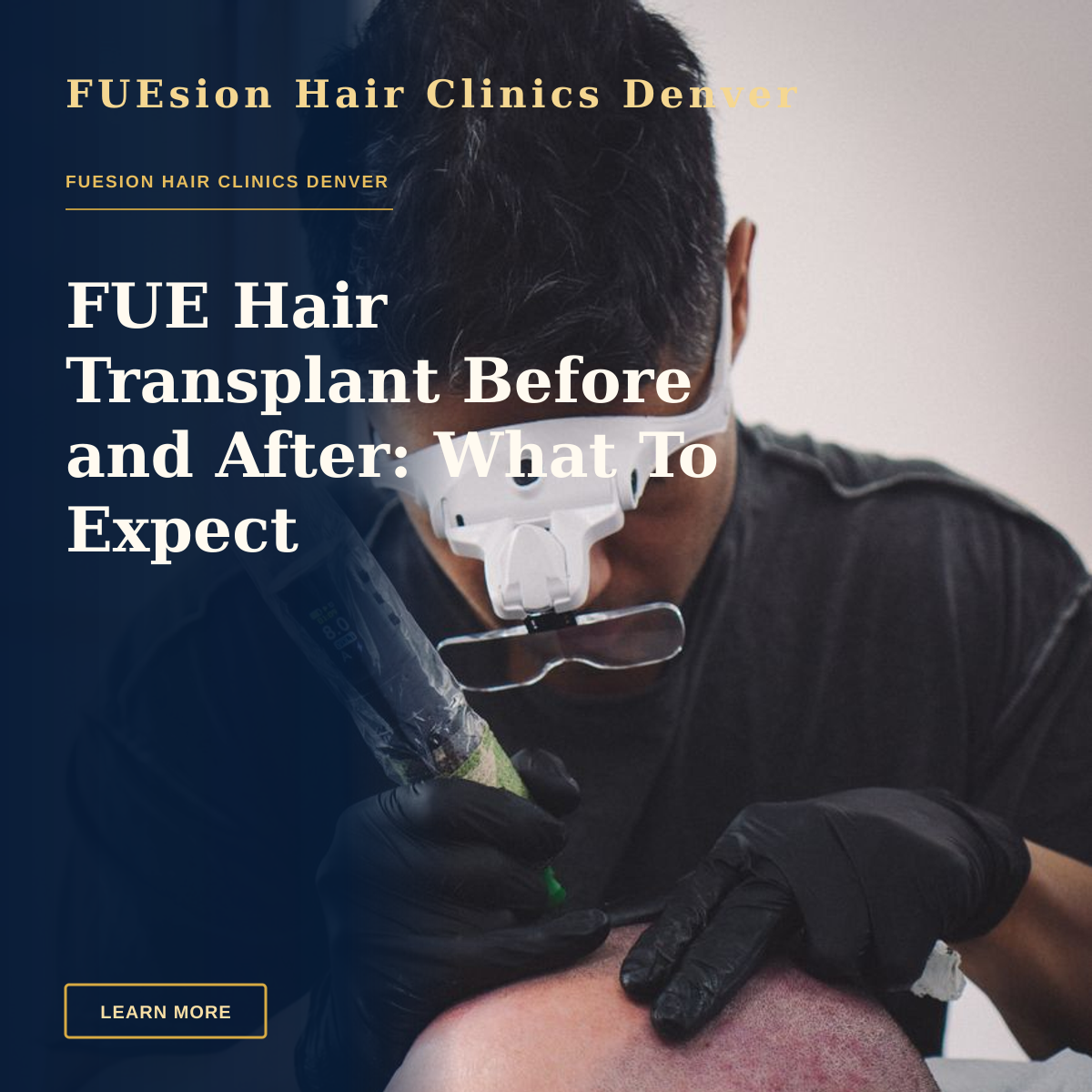
If you're searching for "FUE hair transplant before and after," you likely want three things: honest examples of real outcomes, a clear timeline for change, and a way to know which images are relevant to your own case. This guide answers those questions directly and shows how to interpret before-and-after photos so you can form realistic expectations.
FUE (follicular unit extraction) produces gradual, permanent change: early shedding and the first new growth usually start around three months, visible improvement by six months, and full results most commonly at 12–18 months. When clinics publish before-and-after galleries, they are showing snapshots of that timeline — but photos alone don't tell the whole story. Good evaluation combines images, documented timelines, procedure details and clinic guarantees.
Where branded tools are relevant, we'll point them out. For example, FUEsion Hair Clinics offers an AI Hair Simulator and a Graft Calculator to preview likely results and costs, plus a documented Assurance that covers growth and artistry. Use this article to learn how to read before-and-after images, what to expect at each stage, and the practical next steps to visualize and verify results for your own hair type and goals. According to Kinky Hair after FUE Technique: Case Report (scholarly source), this source provides relevant background for the discussion.
Patient Journey & Consultation
Understanding before-and-after photos starts with the patient journey. A transparent clinic will document each step of care: from an initial assessment to a personalized surgical plan, and through the 12‑month review where final benchmarks are checked. At many clinics, including those that use advanced simulation tools, the consultation is the point where your goals are recorded, expectations are set, and any visual plan is agreed and saved.
Typical contact and scheduling practices speed up decision-making and reduce surprises. Consultation requests are usually acknowledged quickly; for example, many clinics confirm within 24 hours and respond to general inquiries in 2–4 business hours. Virtual consultations let you review photos, graft estimates and simulated outcomes before committing to in‑person visits.
Before your consultation, running a graft estimate and saving example photos you like will make the conversation more efficient. Surgeons will examine donor density, hair caliber and pattern, then document a hairline and density plan. When a clinic pairs this documented plan with a formal follow-up schedule, you get verifiable before-and-after milestones to compare against.
- Book a free consultation to have goals formally documented and the 12‑month growth benchmark set.
- Bring clear, well-lit photos (front, both sides, and top) so the surgeon can compare your baseline to planned outcomes.
- Run a graft estimate and simulation ahead of time to understand likely graft counts and cost ranges.
These actions let you evaluate before-and-after photos in context: the same visual gain may require different graft counts depending on hair characteristics. For clinics that provide them, the documented 12‑month review and corrective pathways (if benchmarks are unmet) are essential parts of an accountable patient journey. To start this process, book a consultation that documents your goals and planned checkpoints: Book a Free Consultation.
Ready to take the next step?
Speak directly with Dr. Sanders. No obligation. Completely free.
Find out if you're a candidate for FUE Hair Transplants or non-surgical hair regrowth options.
Book Your Free ConsultationSimulator
Seeing a curated before-and-after photo is helpful, but seeing a preview of what you might look like is more useful. The AI Hair Simulator (photo-based) analyzes your frontal image, estimates graft needs and generates an instant, clinically-informed preview plus a personalized cost estimate. This removes a lot of guesswork when interpreting generic gallery photos.
The simulator workflow is straightforward: upload a clear, well-lit frontal photo, let the AI analyze hair pattern and deficiencies, and receive a preview with graft estimates and expected density changes. You can save or print the simulation to bring to your consultation — it becomes part of the documented aesthetic plan your surgeon reviews.
Because simulations are driven by your own photo and clinically-informed heuristics, they are more relevant than viewing random gallery cases. They also provide a bridge between aspirational photos and what your donor supply and hair characteristics will realistically support.
- Upload a clear frontal photo for the most accurate simulation results.
- Get an instant graft estimate so you can compare the visual preview with the surgical plan.
- Share your simulation with the surgeon during the consultation to finalize the hairline and density plan.
The simulator is free and designed to be used before your first appointment so the consultation is focused on personalization rather than generic options. Try the tool yourself to generate a tailored before-and-after preview: Launch the AI Hair Simulator.
See your potential results before you commit
AI Hair Simulator
Our AI Hair Simulator uses your own photo to show realistic hairline, density and style options — and generates a personalized cost estimate so you walk into your consultation knowing exactly what you want and what it costs.
Get Free AccessReady to take the next step?
Book a Free ConsultationHow to Read FUE Before-and-After Photos
Not all before-and-after images are created equal. To evaluate photos effectively, check for consistent lighting, matching camera angles, neutral facial expressions, and standardized hair styling. Pay attention to timestamps or captions that indicate how many months post-op the "after" shot was taken; early photos can under-represent final outcomes.
Key visual cues to compare include hairline design, frontal density, crown coverage and natural hair direction (cowlicks and orientation). Good galleries will indicate graft counts, the procedure type (FUE versus FUT), and whether adjunct therapies (PRP, InFuze non‑surgical sessions) were used — that context matters when assessing how similar your expected result might be.
When a clinic pairs photos with documented timelines (e.g., 6 months, 12 months) and graft counts, you get a verifiable comparison. Also look for clinics that publish consistent cases across hair types — Caucasian, Asian and Afro-textured hair yield different visual density with the same graft counts, so a gallery that reflects diverse outcomes is more credible.
Services & Procedures
Our practice offers a comprehensive menu of surgical and non‑surgical hair restoration services. Each service is described so you can match a before-and-after example to the actual procedure used. We document duration, anesthesia, downtime and typical timelines so every gallery image can be interpreted alongside the treatment facts.
Key surgical and non‑surgical offerings include FUE transplants performed with AI & AR guidance, specialty procedures like eyebrow and beard transplants, and a non‑surgical InFuze™ option that uses ScalpPulse Technology for measurable regrowth with zero downtime. Every surgical plan includes microscopic donor assessment, customized punch sizing and graft holding protocols to preserve viability.
Below is a concise summary of the most requested services and what each means for before-and-after comparisons.
- Hair Transplant (AI & AR Assisted FUE / FUEsion Hair Transplant) — 4–7 hours (longer for large cases), local anesthesia, return to work in 5–7 days, visible change by 6 months and full results at 12–18 months. Graft survival >95% when performed using calibrated graft handling and micro‑punch extraction.
- InFuze Non‑Surgical / InFuze™ Restoration — Uses ScalpPulse Technology to stimulate the scalp and infuse targeted compounds. No surgery, no downtime; appropriate for early‑to‑mid stage loss or as an adjunct to transplants.
- Eyebrow & Beard Transplants — Precision angulation and lower graft counts (eyebrows: ~50–400 grafts) with short procedure times and naturalizing implantation for hair direction consistency.
For bookings and deeper procedural pages, see our Services section and procedural descriptions. Use the gallery to compare like-for-like cases and the simulator plus graft calculator to set expectations before your consultation. To explore full service descriptions, visit our main services page or View all services. You can also Book a free consultation or See before & afters in the gallery.
See your potential results before you commit
AI Hair Simulator
Our AI Hair Simulator uses your own photo to show realistic hairline, density and style options — and generates a personalized cost estimate so you walk into your consultation knowing exactly what you want and what it costs.
Get Free AccessWant personalized advice?
Schedule Your AssessmentTrust & Guarantee (FUEsion Assurance)
Surgical outcomes are easier to trust when a clinic backs them with documented remedies and timelines. The FUEsion Assurance is an industry‑first, fully enumerated assurance program that covers growth, artistry, aftercare and overall satisfaction. The Assurance is agreed during consultation and the 12‑month review is the formal checkpoint for Growth Assurance remedies.
The Assurance framework provides clear recourse if outcomes diverge from the documented plan. Specifically, the Growth Assurance promises supplemental grafts at no cost when an agreed benchmark (set at consultation) isn't met at the 12‑month review. Artistic and aftercare assurances ensure the hairline design and follow-up access are delivered as promised.
Knowing these safeguards exist makes before-and-after comparisons more meaningful because you can verify that the clinic stands behind its published cases and will remediate shortfalls when they occur.
- Growth Assurance: If agreed growth benchmarks aren't reached at 12 months, supplemental grafts are provided when indicated.
- Artistry & Aftercare: The hairline and post‑op plan are documented and accessible, with follow-ups and surgeon access included.
- Satisfaction Commitment: The clinic will address concerns and work toward the documented outcome until you are satisfied.
For specifics on how the Assurance is documented and activated, the terms are reviewed during the consultation and confirmed in your post‑operative plan. If you want to discuss Assurance details during your assessment, schedule a consult here: Book Your Free Consultation. For the full policy and FAQs see the Assurance page or our Terms & Conditions.
Ready to take the next step?
Speak directly with Dr. Sanders. No obligation. Completely free.
Find out if you're a candidate for FUE Hair Transplants or non-surgical hair regrowth options.
Book Your Free ConsultationWhat Real Results Look Like: Timeline & Expectations
Understanding the timeline behind before-and-after photos helps you place each image on the recovery curve. Typical stages are: immediate post-op (grafts visible; scabbing), 2–8 weeks (transient shedding), 3–6 months (new hairs emerge; visible improvement), and 12–18 months (mature density and texture).
When you view an "after" image, confirm the post-op interval. An eight-week photo will look very different from a 12‑month photo. Also confirm whether any adjunct therapies were used — PRP or InFuze treatments can accelerate early activation and are sometimes used to enhance density in combination with FUE.
Measure outcomes by documented goals (hairline shape, coverage area, and density targets), not just by single images. If a clinic provides graft counts and timelines alongside images, you can make an apples-to-apples comparison to your simulation and graft estimate.
See how we can help you
Get Started TodaySafety, Recovery & Graft Survival
Patient safety and graft handling influence final before-and-after outcomes. High survival rates rely on microscopic donor assessment, appropriate punch sizing, minimal transection, and optimal graft holding solutions. Clinics that publish technical details (e.g., micro‑punch sizing, microscopic sorting, and controlled graft preservation) demonstrate process transparency that correlates with consistent results.
Typical downtime after FUE is short: many people return to work in 5–7 days, though swelling and scabbing resolve gradually. Non‑surgical options like InFuze™ Restoration require no downtime and are a different category of before-and-after because they stimulate existing follicles rather than transplanting new ones.
When evaluating before-and-after photos, ask whether the clinic documents graft survival rates and the methods they use. Some systems report graft survival above common industry averages when they use calibrated extraction, AI/AR guidance and proprietary graft solutions.
How to Compare Clinics and Photos
To judge before-and-after images effectively, compare like-for-like details: procedure type (FUE vs FUT), graft count, patient age, hair texture, and post-op interval. Favor clinics that publish full-case timelines with multiple angles rather than single static images. Also value tools that let you preview your own likely outcome — that personalization beats generic galleries for decision-making.
Finally, prioritize clinics that combine surgeon-led procedures (no technician-only major steps), transparent documentation, and a remediation policy if benchmarks aren't met. These factors make a before-and-after image portfolio a meaningful part of your decision-making process.
Conclusion
FUE hair transplant before-and-after photos are a valuable resource when evaluated with context: matching angles, documented timelines, graft counts and disclosure of adjunctive treatments. Use a photo-based AI simulator and a graft calculator before your consultation so you can compare simulated outcomes to published galleries on a like-for-like basis. Expect new growth to begin around three months, visible change by six months and mature results at 12–18 months.
If you want a practical next step, run a personalized simulation to see a photo-based preview and receive a graft estimate, then bring those results to a surgeon-led consultation where your goals and the FUEsion Assurance are documented. That sequence turns a gallery image into an actionable, verifiable plan for your own results.
Primary next step: try the AI Hair Simulator to generate a before-and-after preview using your own photo. If you prefer to speak with a clinician right away, book a free virtual consultation and have your plan documented, including the 12‑month review and Assurance terms.
Launch the AI Hair Simulator • Book Your Free Consultation
FAQ
Q: When will my "after" picture show the final result?
A: Full, mature results are typically seen at 12–18 months. Photos taken earlier (3–6 months) show improvement but not final density or texture.
Q: Are before-and-after photos reliable across different hair types?
A: Photos are useful but must be compared by hair type, graft count and post-op interval. Textured hair can visually appear denser with fewer grafts; always ask for same‑type examples.
Q: Can I simulate my own before-and-after?
A: Yes. Photo-based AI simulators provide clinically-informed previews and cost estimates to help you set realistic expectations before the consultation.
Medical Information Disclaimer
This content is provided for general educational purposes only. It is not a substitute for professional advice, diagnosis, or treatment. Readers are advised to consult qualified professionals for personalized recommendations.
Have questions? We have answers.
Speak With an Expert