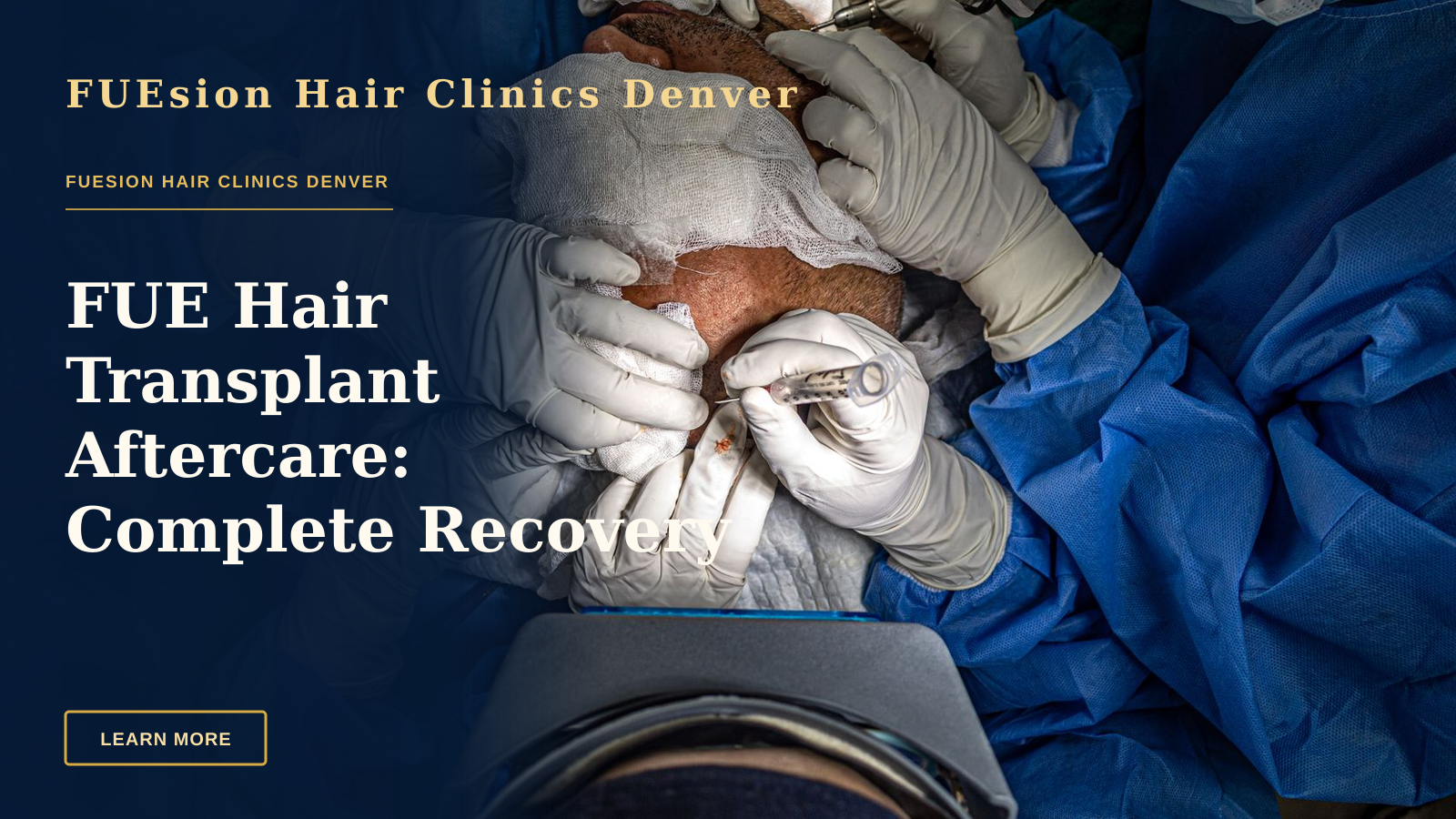
FUE hair transplant aftercare determines how well your grafts survive, how natural your result looks, and how quickly you return to normal life. Good aftercare reduces swelling and infection risk, protects delicate grafts in the first 7–14 days, and supports the biological processes that lead to new hair growth over months.
This guide explains the timeline, daily care steps, warning signs, and long‑term habits that maximize outcomes after Follicular Unit Extraction (FUE). Where the clinic's protocols matter, we reference modern techniques used in advanced practices — from micro‑punch extraction and calibrated graft handling to the surgical angles used for natural hair direction. If you want to move from planning to action, the article also explains tools you can use to visualize results and how follow‑up works under the FUEsion Assurance program.
Patient Journey & Consultation
A clear aftercare plan begins before surgery. During your free virtual consultation, the surgical team documents your baseline, discusses medical risks, and outlines the personalized recovery steps you'll follow after your procedure. This is the moment to share medications, recent illnesses, or lifestyle factors (smoking, vigorous exercise) that affect healing. According to Surgical Flow and Set-up for FUE Transplant Cases (scholarly source), this source provides relevant background for the discussion.
We recommend using pre-visit digital tools to create realistic expectations and streamline planning. Running the Graft Calculator and saving simulator images for the consult helps surgeons create a recovery timeline matched to your graft count and procedure type. The consultation also confirms how the FUEsion Assurance will apply to your case and schedules your 12‑month review.
What to expect from scheduling through the 12‑month review:
- Fast scheduling and response: consultation requests are acknowledged quickly and often confirmed within 24 hours.
- Photo‑based planning: upload photos to the AI tools so the surgeon can pre‑visualize placement and density before day one.
- Clear documentation: your surgical plan, expected downtime and aftercare instructions are provided in writing before the procedure.
- Follow‑up roadmap: the formal 12‑month review is used to verify growth benchmarks and discuss any remedies under Assurance.
After your consult, you'll receive written aftercare instructions and contact details for urgent questions. Use them — quick, small decisions in the first two weeks (how you sleep, when you wash, what activities you avoid) have outsized effects on graft survival and final aesthetics.
Ready to take the next step?
Speak directly with Dr. Sanders. No obligation. Completely free.
Find out if you're a candidate for FUE Hair Transplants or non-surgical hair regrowth options.
Book Your Free ConsultationSimulator
See your potential results before you commit. The AI Hair Simulator uses your own photo to show realistic hairline, density and style options and returns an instant AI‑informed cost estimate. This visual planning reduces surprises and helps you align on the exact hairline and density you expect — which is crucial because the post‑op plan and corrective options follow the documented design.
The simulator analyzes hair pattern and estimates graft needs so surgeons can tailor extraction and implantation planning. Bringing those images to your consultation speeds decision‑making and helps determine aftercare tailored to the graft count and recipient area density.
- Quick upload: a well-lit frontal photo produces the most accurate preview.
- Graft estimate: the tool feeds into your surgical plan so aftercare can be calibrated to the procedure size.
- Printable plan: save or print your simulated before/after to confirm aesthetic goals with your surgeon.
Using the simulator before surgery improves communication, reduces the chance of redesign after the procedure, and gives you a clear reference for recovery milestones. If you haven't tried it yet, run the simulator to get an image-based expectation and a personalized estimate.
See your potential results before you commit
AI Hair Simulator
Our AI Hair Simulator uses your own photo to show realistic hairline, density and style options — and generates an personalized cost estimate so you walk into your consultation knowing exactly what you want and what it costs.
Get Free AccessReady to take the next step?
Book a Free ConsultationWhy Aftercare Matters for FUE Hair Transplants
FUE grafts are tiny, delicate skin plugs that need a stable environment to reestablish blood flow and resist mechanical trauma. Early preservation of the grafts and protecting the recipient sites from shear, infection, and excessive moisture directly affects survival rates and aesthetic integration. Advanced clinics report high graft survival when surgical technique is paired with disciplined aftercare protocols.
Two clinic-level factors that influence aftercare recommendations are extraction and graft handling. Micro‑punch extraction, calibrated tool sizing and a controlled graft holding solution reduce transection and improve viability. When grafts are handled carefully and implanted at the planned angles and density, your aftercare focuses more on protection and less on correcting surgical trauma.
Understanding expected timelines helps set practical aftercare goals: mild swelling and scabbing are common in days 1–7, initial shedding (the telogen phase) often occurs by 2–8 weeks, and visible regrowth generally begins around month three with full maturation by 12–18 months. Clinics using modern techniques often cite visible improvement by 6 months and final density by 12–18 months.
Services & Procedures
FUEsion offers a full suite of surgical and non‑surgical hair restoration services. Each treatment comes with a clear duration, anesthesia plan and expected downtime so you can plan recovery. Knowing the procedure type and graft count before surgery informs the intensity and length of aftercare needed.
Key services include surgical FUE transplants and non‑surgical InFuze™ Restoration using ScalpPulse Technology. Surgical procedures typically require local anesthesia and a short recovery period, while non‑surgical options have no downtime and can be used as adjunctive therapy during the healing phase.
Below is a concise rundown of primary services and what they mean for aftercare planning.
- Hair Transplant (AI & AR Assisted FUE / FUEsion Hair Transplant) — Duration: 4–7 hours (longer for large cases). Anesthesia: local. Downtime: return to work in 5–7 days. Results visible from 6 months, full at 12–18 months. Graft survival: >95%.
- InFuze Non‑Surgical / InFuze™ Restoration — Uses ScalpPulse Technology, no surgery and no downtime; suitable for early–mid stage loss or as an adjunct to surgery.
- Beard, Eyebrow & Female Transplants — Specialized graft counts and angulation; aftercare emphasizes gentle skin care and precise orientation to preserve aesthetic outcomes.
- Supportive services — PRP therapy, scalp micropigmentation and scar repair to complement surgical results and reduce recovery impact.
Use the Services page for detailed procedure pages and scheduling. If you want to estimate grafts and see a simulated outcome before booking, run the Graft Calculator or the AI Hair Simulator to prepare for your consult.
For an overview of all offerings and to schedule, visit our main site: FUEsion Hair Clinics. You can also view specific procedure pages and book consults through the Services and Consultation links.
See your potential results before you commit
AI Hair Simulator
Our AI Hair Simulator uses your own photo to show realistic hairline, density and style options — and generates a personalized cost estimate so you walk into your consultation knowing exactly what you want and what it costs.
Get Free AccessWant personalized advice?
Schedule Your AssessmentTrust & Guarantee (FUEsion Assurance)
Aftercare confidence is strengthened by a clear guarantee. The FUEsion Assurance documents how outcomes and follow‑up are managed, and it defines remedies if growth benchmarks or aesthetic objectives are not met. The Assurance is discussed and confirmed during your consultation and again in the post‑op plan.
Key pillars of the Assurance include commitments to growth, artistry, aftercare and satisfaction. If growth falls short of the agreed benchmark at the 12‑month review, supplemental grafts are provided when indicated at no charge. This shifts some of the post‑op uncertainty into a formal checkpoint and remediation process.
- Growth Assurance — Minimum graft survival/growth benchmark with supplemental grafts at the 12‑month review if needed.
- Artistry Assurance — Aesthetic plan is documented pre‑op and corrective work is provided if outcomes deviate significantly.
- Aftercare Assurance — Post‑operative care, follow‑up appointments and surgeon access are included during recovery and growth monitoring.
- Satisfaction Assurance — Committed remediation until published outcome objectives are met.
These terms are activated via documented consultation notes and the formal 12‑month review. If you want to learn how Assurance is applied to your recovery plan, book a free consult — your surgeon will document the expected growth benchmarks and explain the formal review process in detail.
Ready to take the next step?
Speak directly with Dr. Sanders. No obligation. Completely free.
Find out if you're a candidate for FUE Hair Transplants or non-surgical hair regrowth options.
Book Your Free ConsultationPractical Day‑by‑Day Aftercare Plan (First 3 Months)
Aftercare focuses first on protecting grafts (days 0–14), then on gentle stimulation and monitoring (weeks 2–12). Below is a practical, clinic-aligned schedule you can adapt with your surgeon's specific instructions.
Days 0–3 (Procedure day + immediate): Rest, keep head elevated for 48–72 hours to reduce swelling, avoid touching or rubbing the graft sites, and follow the clinic's dressing instructions. Most clinics schedule a gentle cleanse within 24–48 hours or provide a disposable spray kit to keep grafts clean without manual scrubbing.
Days 4–7: Scabs form and should not be picked. You can usually return to desk work in 5–7 days unless otherwise advised. Avoid strenuous activity, heavy lifting and bending that increases blood pressure to the scalp.
- Sleep with your head elevated on pillows and avoid direct pressure on the grafts.
- Use prescribed topical/antibiotic agents exactly as directed — do not substitute home remedies without consulting your surgeon.
- Avoid alcohol and smoking during the early healing phase; both impair blood flow and can reduce graft survival.
Weeks 2–8: Shedding of transplanted hairs is common—this is a normal telogen phase and is not failure. Continue scalp hygiene with gentle shampooing per the clinic's instructions and avoid sun exposure or tanning beds on the scalp for several weeks.
Months 3–12: New growth typically appears around month 3. Maintain regular follow-ups and discuss adjunctive therapies (PRP or InFuze™ Restoration) if recommended to optimize thickness and timing. Track milestones with photos every 1–2 months to document progress leading to the 12‑month review.
See how we can help you
Get Started TodayCommon Complications & When to Contact Your Surgeon
Most recovery issues are minor and manageable with prompt communication. Contact your surgical team immediately if you experience increasing redness, persistent or worsening pain, fever, sudden swelling after initial improvement, or pus/drainage from the donor or recipient sites. These can indicate infection or other complications that benefit from early intervention.
Other issues that warrant contact include unexpected pigment changes, numbness that gets worse instead of better, or signs that grafts are being displaced (for example, a large area of grafts lifting). Keep in mind that temporary numbness and mild sensitivity are common and often improve over months.
- Infection signs: increasing warmth, redness, pus, or fever — call your clinic immediately.
- Uncontrolled swelling or bleeding — seek urgent advice rather than delaying.
- Severe pain not relieved by prescribed medication — contact the surgeon or clinic for guidance.
For any concerning signs, use the contact directions provided at your consult so the clinic can triage and manage the issue quickly. Timely intervention preserves grafts and reduces the need for corrective procedures later.
Long‑Term Care: Protecting Your Investment
Once grafts mature, long‑term care focuses on maintaining scalp health and managing ongoing hair loss with evidence‑based therapies if indicated. This may include topical minoxidil, oral therapies, low‑level laser therapy or periodic InFuze™ sessions to support native follicles and transplanted grafts. Discuss a combined maintenance plan during follow‑ups so your transplanted hair ages naturally with surrounding hair.
Continue to monitor scalp health, protect from UV exposure, and follow up annually to track density. The formal 12‑month review is the time to evaluate final density against the agreed benchmark and activate any remedies under FUEsion Assurance if needed.
Conclusion
FUE hair transplant aftercare is the bridge between a technically excellent surgery and a natural, long‑lasting result. The first 14 days protect grafts from mechanical damage and infection; months 2–6 are about biological recovery and early regrowth; months 6–18 are where density and cosmetic maturity appear. Following a clinic‑specific aftercare plan, staying in close contact with your surgeon, and using preoperative simulation tools will reduce uncertainty and help you achieve the outcome you planned.
If you want a tailored aftercare plan that matches your graft count and lifestyle, start with a free consultation and run the AI tools to visualize outcomes. For a practical next step, try the AI Hair Simulator to create a photo‑based plan and then book a free consultation to confirm the surgical roadmap and post‑op instructions. Your surgeon will document the recovery milestones and how the FUEsion Assurance supports your long‑term satisfaction.
FAQ
- How long before I can wash my hair after an FUE transplant?
- Instructions vary by clinic, but most modern protocols allow a gentle first wash within 24–48 hours or a clinic‑assisted cleanse within the first 48 hours. Follow your surgeon's exact schedule to avoid dislodging grafts.
- When can I resume exercise after FUE?
- Light activity can usually resume after about 7 days, but avoid heavy lifting, intense cardio, and contact sports for 2–4 weeks depending on your graft count and surgeon's advice.
- Will I lose transplanted hair during recovery?
- Yes. A temporary shedding phase is normal and expected; new growth typically begins around 3 months with noticeable improvements by 6 months.
- Can non‑surgical therapies help during recovery?
- Adjuncts like PRP or InFuze™ Restoration may be recommended to support healing and stimulate surrounding follicles. Discuss options with your surgeon during consultation.
- What if my grafts don't meet the growth benchmark?
- The FUEsion Assurance documents a 12‑month review and provides for supplemental grafting at no charge when agreed benchmarks are not met and when clinically indicated. Discuss the specifics during your consult.
Medical Information Disclaimer
This content is provided for general educational purposes only. It is not a substitute for professional advice, diagnosis, or treatment. Readers are advised to consult qualified professionals for personalized recommendations.
Have questions? We have answers.
Speak With an Expert