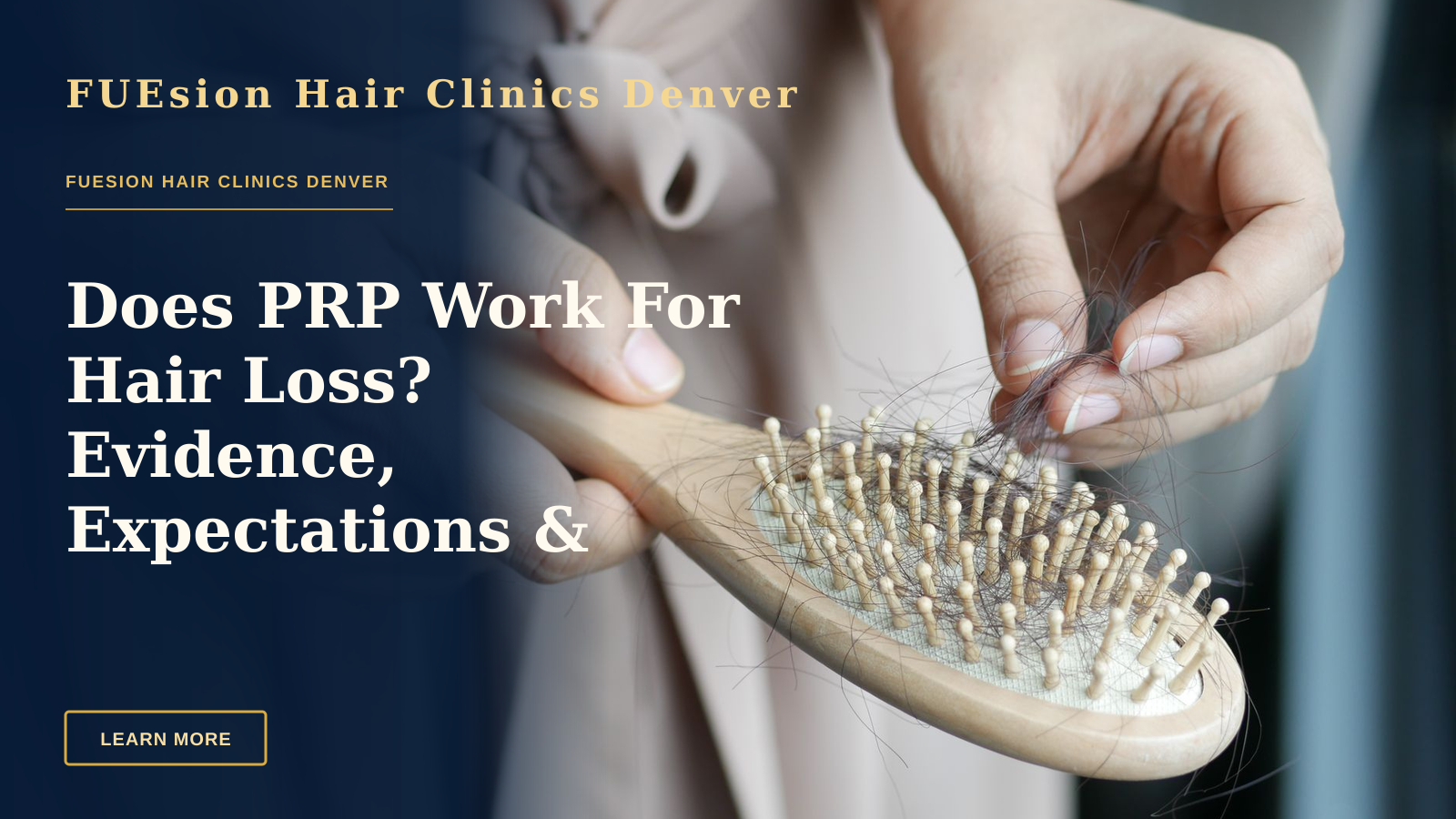
Does PRP work for hair loss? Short answer: for many patients with early or moderate thinning—particularly androgenetic alopecia—platelet‑rich plasma (PRP) can deliver measurable hair‑count and thickness improvements, but results vary and multiple treatments are typically needed.
This article explains how PRP is thought to work, what published studies and clinical experience show, who is most likely to benefit, and how PRP fits alongside other non‑surgical options (like InFuze™ ScalpPulse Technology) and surgical solutions. If you want to evaluate PRP as a standalone therapy or as an adjunct to a transplant, you’ll finish this piece knowing what questions to ask at consultation and how a clinic-led pathway typically looks.
Patient Journey & Consultation
Start by discussing your goals and medical history with a qualified clinician. At many clinics, including our network, initial contact can be made online or by phone; consultation requests are acknowledged promptly and often confirmed within 24 hours. A free virtual consultation lets you explain your concerns, share photos, and review initial recommendations without obligation.
During a typical free virtual consult you’ll get a structured assessment: the clinician evaluates hair loss pattern, density and donor characteristics, discusses non‑surgical and surgical options, and outlines realistic outcomes. If you’ve already used the Graft Calculator or AI simulation tools, bring those results—clinicians use them to refine graft counts or decide if PRP is a reasonable first step.
Key steps in the patient journey are transparent and scheduled so you know what to expect at each stage. The in‑person or video consult is where diagnostic details are confirmed, the treatment plan is documented, and any warranties or guarantees (such as growth benchmarks) are explained and recorded.
- Initial contact and scheduling: online or phone booking with quick confirmation.
- Free virtual consultation to assess hair loss and discuss options.
- Pre‑visit digital tools (Graft Calculator, Simulator) to visualize outcomes.
- Personalized plan and documented expectations before any treatment.
- Follow‑up and formal review checkpoints to measure progress.
After the consultation your clinician will provide a written plan that specifies the recommended course (number of PRP sessions, timing, adjuncts such as topical therapy), potential timelines for seeing change, and follow‑up appointments for monitoring. If you’re also considering surgical options, this is where surgeon input and a combined regimen are planned.
Ready to take the next step?
Speak directly with Dr. Sanders. No obligation. Completely free.
Find out if you're a candidate for FUE Hair Transplants or non-surgical hair regrowth options.
Book Your Free ConsultationSimulator
See a realistic preview before you commit. Our AI Hair Simulator analyzes a frontal photo of your scalp to estimate graft needs and to produce a visual before/after preview along with a personalized cost estimate. Using a simulator ahead of your consult helps clarify realistic goals and narrows the clinical discussion to specific plans.
Powered by FlowMediq AI, the simulator provides a clinically informed preview that a surgeon can use during your in‑person or virtual consultation. The tool’s graft estimate and image preview are particularly useful if you’re weighing PRP against surgical options or planning PRP as an adjunct to a transplant.
How the simulator works is simple and fast: upload a clear frontal photo, let the AI analyze your hair pattern and estimate graft counts, then review the before/after preview and a cost range. Save or share the results with your surgeon to speed up the personalized plan during consultation.
- Upload a clear, well‑lit frontal photo for most accurate simulation.
- Receive an instant AI estimate of grafts and visual outcomes.
- Use the result to compare PRP alone vs combined strategies.
- Bring the preview to your free consult for a surgeon‑guided plan.
Launch the simulator before your appointment to make the consultation time more productive: you’ll arrive with visual goals and a clinician‑ready starting point for discussion.
See your potential results before you commit
AI Hair Simulator
Our AI Hair Simulator uses your own photo to show realistic hairline, density and style options — and generates a personalized cost estimate so you walk into your consultation knowing exactly what you want and what it costs.
Get Free AccessReady to take the next step?
Book a Free ConsultationHow PRP Works And What The Evidence Says
Platelet‑rich plasma (PRP) is an autologous blood product: a sample of your blood is centrifuged to concentrate platelets and growth factors, then the platelet‑rich fraction is injected into the scalp. The rationale is biological—growth factors in platelets can stimulate local microcirculation, reduce inflammation and encourage the anagen (growth) phase in susceptible hair follicles.
Clinical studies and systematic reviews report that PRP can produce measurable improvements in hair density and thickness for many patients with androgenetic alopecia. Outcomes are variable—some patients show clear gains, others modest change. Most published trials and reviews agree that PRP is most effective for early‑stage thinning rather than extensive, advanced hair loss.
Evidence caveats to keep in mind: protocols differ between clinics (platelet concentration, injection technique, number and timing of sessions), and long‑term maintenance needs are still being defined. Because protocols vary, comparing results between studies (and between clinics) requires asking about exact preparation and injection methods.
For balanced summaries of the literature and clinical guidance, independent medical resources and peer‑reviewed reviews are useful starting points: they describe consistent, moderate evidence of benefit with variability tied to technique and patient selection. For example, expert reviews note measurable short‑term gains and highlight the need for repeat sessions and standardized protocols for more predictable outcomes. PubMed hosts the primary literature and reviews for further reading.

Services & Procedures
We offer a comprehensive menu of surgical and non‑surgical hair restoration services so patients can choose or combine approaches based on goals and clinical suitability. Each service is provided with transparent timing, anesthesia, downtime and expected result windows to help you plan treatment and recovery.
Our key offerings range from surgical transplants to non‑surgical scalp therapies and digital planning tools. PRP is part of this spectrum as an adjunctive follicular stimulation therapy that can be combined with other treatments or used alone in early thinning. Below is a concise description of the primary services we provide and the facts that matter when you compare options.
- Hair Transplant (AI & AR Assisted FUE / FUEsion Hair Transplant) — Duration: 4–7 hours (4–10 hours for larger cases). Anesthesia: local. Downtime: return to work in 5–7 days. Results visible from 6 months; full at 12–18 months. Graft survival: >95%.
- Beard & Eyebrow Transplants — Precision grafting: beard (300–2,500 grafts), eyebrow (50–400 grafts per eyebrow) with surgical angulation for natural lay.
- Female Hair Transplant — Specialized protocols for female patterns and preservation of surrounding hair; no strip removal.
- InFuze Non‑Surgical / InFuze™ Restoration — InFuze™ ScalpPulse Technology delivers multi‑modal scalp activation and targeted infusion of growth compounds with no downtime.
- FUT & PRP Therapy — FUT offered where clinically indicated. PRP is available as an adjunctive stimulation therapy.
- Scalp Micropigmentation, Scar Repair & Hairline Lowering — Cosmetic refinement and reconstructive options to complement regrowth efforts.
- Digital Tools — Free Virtual Consultation, AI Hair Simulator / AI Hair Studio and Graft Calculator to visualize results and estimate graft counts.
These services are delivered by licensed medical professionals using our advanced protocols, and personalized aftercare is included with every package. If you want a comprehensive comparison or are considering PRP as a first step before surgery, use our services page to review details and schedule a consult.
For bookings and to review full procedural pages, visit our Services page and the in‑clinic resources listed on the site.
View all services • Book a free consultation • Gallery
See your potential results before you commit
AI Hair Simulator
Our AI Hair Simulator uses your own photo to show realistic hairline, density and style options — and generates a personalized cost estimate so you walk into your consultation knowing exactly what you want and what it costs.
Get Free AccessWant personalized advice?
Schedule Your AssessmentTrust & Guarantee (FUEsion Assurance)
We back procedures and plans with an industry‑first assurance designed to protect outcomes and the patient experience. The FUEsion Assurance documents the growth, artistry and aftercare commitments you receive when you enter a surgical or combined treatment plan with us.
Growth benchmarks are reviewed formally at the 12‑month checkpoint. If growth falls short of the agreed benchmarks at that review, we will supplement results with additional grafts at no cost when indicated. Artistry, aftercare and satisfaction promises are all covered and documented during consultation and in the post‑op plan.
Below are the core pillars that define the Assurance and how it supports patients through the entire journey:
- Growth Assurance — Minimum graft survival/growth benchmarks with supplemental grafts available if the 12‑month review shows underperformance.
- Artistry Assurance — Agreed hairline and aesthetic plan; corrective work if delivered results deviate significantly from the documented design.
- Aftercare Assurance — Comprehensive post‑operative care, follow‑up appointments, and surgeon access throughout recovery and monitoring.
- Satisfaction Assurance — Commitment to address concerns and pursue agreed objectives until you are satisfied.
Activation of the Assurance is discussed and recorded during consultation; the formal Growth Assurance checkpoint is the 12‑month review when needed remedies are agreed and scheduled. For full terms and details, we review Assurance specifics during your free consultation.
Read the FUEsion Assurance • Terms & Conditions • Contact
Ready to take the next step?
Speak directly with Dr. Sanders. No obligation. Completely free.
Find out if you're a candidate for FUE Hair Transplants or non-surgical hair regrowth options.
Book Your Free ConsultationIs PRP Right For You? Comparing Options
PRP is generally best suited to people with early‑to‑moderate androgenetic alopecia or localized thinning where follicles are miniaturized but not fully fibrosed. It is less likely to restore dense hair in long‑standing, extensive bald areas—that’s where transplants excel. PRP is frequently used as an adjunct to improve scalp health and support transplanted grafts.
Compare common choices:
- PRP alone — Non‑surgical, office‑based, limited downtime; good for early thinning and for patients preferring non‑surgical care. Multiple sessions typically required.
- InFuze™ ScalpPulse (non‑surgical) — Multi‑modal scalp activation and targeted infusion; no downtime and is intended for early‑to‑mid stage loss or as adjunctive therapy.
- FUEsion Hair Transplant (surgical) — Permanent restoration for larger defects or advanced thinning; performed with AI & AR Assisted FUE by licensed surgeons and supported by graft survival protocols.
Which is best depends on your pattern of loss, goals, timeline and tolerance for downtime. If you want to avoid surgery and your thinning is early, starting with PRP or InFuze may be reasonable. If you want fuller, permanent density in a balding region, transplant planning (with PRP as a supplement) is often recommended.
See how we can help you
Get Started TodayPractical Next Steps: What To Ask And Expect
If you’re considering PRP, bring these questions to your consultation so you can compare clinics and protocols fairly:
- What exact PRP preparation and platelet concentration do you use?
- How many sessions do you recommend and at what intervals?
- Do you combine PRP with topical or oral therapies (minoxidil/finasteride) or with InFuze treatments?
- What outcomes should I expect at 3, 6 and 12 months, and how do you measure them?
Typical PRP regimens in clinical practice often start with a course of 3 monthly sessions, then maintenance treatments every 3–6 months, but protocols do vary. Ask clinics for before/after photos, documented outcome measures, and whether they offer a combined plan (for example PRP plus InFuze, or PRP around the time of a transplant) to maximize results.
Conclusion
Does PRP work for hair loss? For many people with early or moderate thinning, PRP produces measurable improvements in hair density and thickness and can be a valuable non‑surgical option or adjunct to transplantation. Results are variable and depend on patient selection, the PRP protocol used, and realistic expectations about timelines and maintenance.
If you’re uncertain which path to take, use the free AI Hair Simulator and Graft Calculator to visualize options, then book a no‑obligation consultation to review a documented plan and Assurance terms. Combining objective simulation tools with a surgeon‑led consult is the most reliable way to decide whether PRP, InFuze™, or a transplant (or a planned combination) matches your goals.
Main call to action: try the AI Hair Simulator now and bring your results to a free consultation to get a personalized, documented plan.
Launch the AI Hair Simulator • Book a Free Consultation • Explore our Technology
FAQ
How long until I see results from PRP?
Most patients notice signs of change by 3–6 months with more visible improvement by 6–12 months. A documented review at 12 months helps determine whether additional sessions or adjuncts are needed.
Is PRP painful and is there downtime?
PRP is an in‑office procedure performed with local anesthetic or topical numbing. Downtime is minimal—most people return to normal activities within 24 hours though some redness or mild soreness is common.
Can PRP be combined with a hair transplant?
Yes. Many surgeons use PRP peri‑operatively to support graft survival and scalp health; PRP can also be used post‑op as part of a combined regimen. Your surgeon will document any combined plan and how it integrates with the FUEsion Assurance.
Medical Information Disclaimer
This content is provided for general educational purposes only. It is not a substitute for professional advice, diagnosis, or treatment. Readers are advised to consult qualified professionals for personalized recommendations.
Have questions? We have answers.
Speak With an Expert