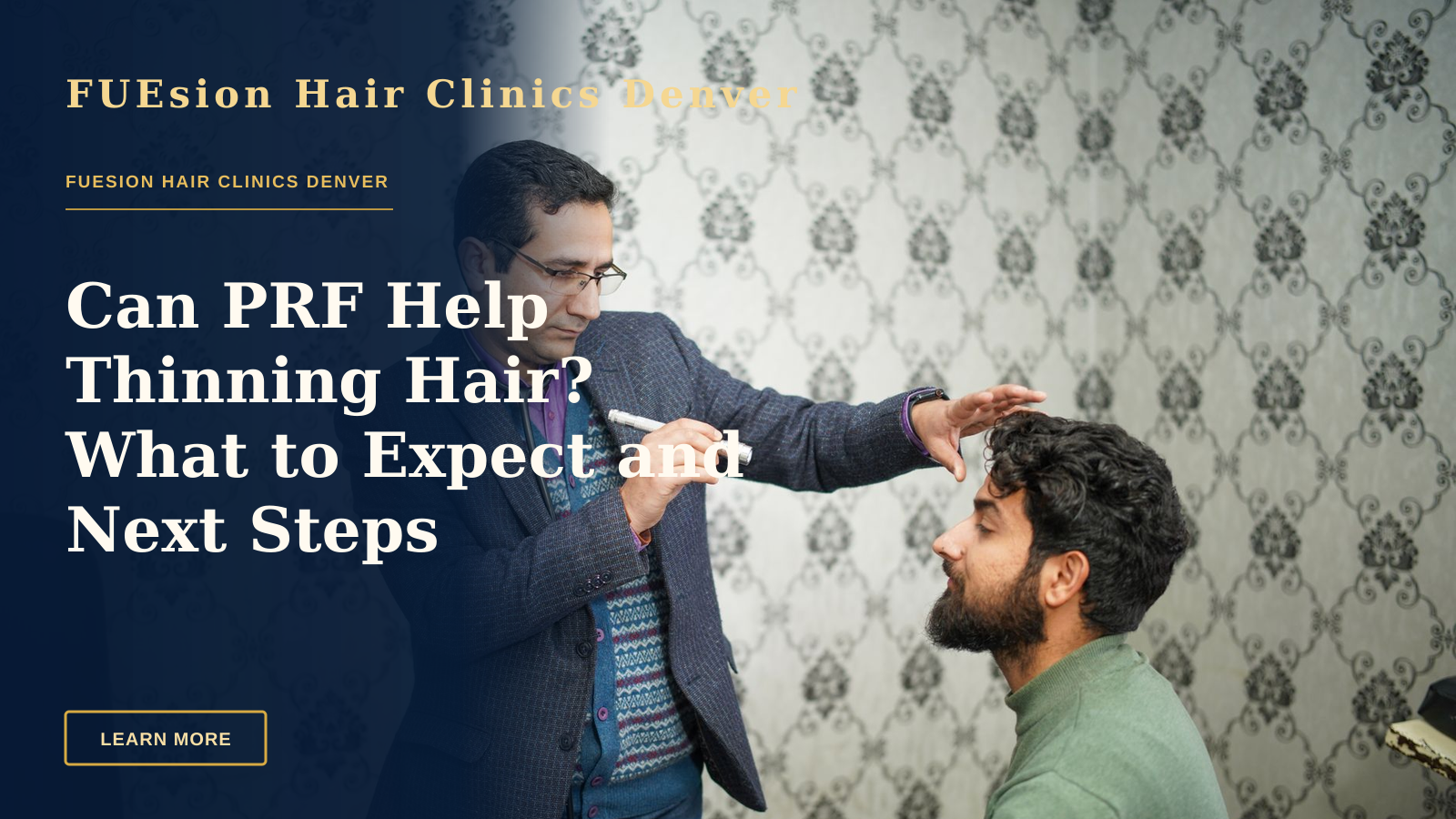
Can PRF help thinning hair? In short: platelet-rich fibrin (PRF) can be a useful tool for some people with thinning hair, but outcomes vary and it is not a single cure-all. PRF is a growth-factor–rich, fibrin-based concentrate derived from a patient’s own blood that clinics use to stimulate scalp tissue and support dormant follicles. Whether it’s likely to help you depends on the cause and stage of your hair loss, the exact PRF protocol, and whether it’s used alone or combined with other therapies.
At FUEsion Hair Clinics we offer clinician-guided regenerative options alongside surgical restoration. Our practice includes PRP/PRF-style regenerative therapies as adjuncts, non-surgical InFuze™ ScalpPulse Technology sessions, and surgical solutions such as the FUEsion Technique. This article explains what PRF is, what the clinical experience shows, how it’s commonly used in practice, who is most likely to benefit, and practical next steps including our free simulation and consultation tools.
Patient Journey & Consultation
Beginning with a clear diagnostic pathway is important when you’re exploring PRF for thinning hair. At our clinics you can start with a free virtual consultation or an in-person visit; consultation requests are acknowledged quickly and our team aims to respond within published timelines. The consult is where we document hair loss pattern, goals and whether regenerative therapy, surgical restoration, or a combined plan is most appropriate. According to Invited Commentary: Can the genetic TrichoTest help optimize treatment for hair loss? (scholarly source), this source provides relevant background for the discussion.
We recommend that prospective patients run the Graft Calculator and the AI Hair Simulator before or during the consult so the clinical team has a photo-based starting point. During the surgeon consultation a personalized plan is created and our FUEsion Assurance terms are discussed and documented so expectations and remedies are clear.
Typical steps in the patient flow include initial contact and scheduling, a free virtual consultation, digital pre-work with our simulation tools, surgeon review and written plan, the selected procedure or non-surgical regimen, and routine follow-up culminating in a formal 12‑month review for surgical cases. This structure gives patients reliable access to surgeons and continuity of care throughout the process.
- Free Virtual Consultation to assess candidacy and goals.
- Use the AI Hair Simulator and Graft Calculator to visualize options and refine expectations.
- Surgeon-led planning with documented aesthetic and growth objectives.
- Structured aftercare and follow-up, including a formal 12‑month review when applicable.
These steps are designed to reduce uncertainty. If you’d like to discuss whether PRF or another option is right for you, book a no‑obligation consult through our Book a Free Consultation page and a member of our team will guide the next steps.
Ready to take the next step?
Speak directly with Dr. Sanders. No obligation. Completely free.
Find out if you're a candidate for FUE Hair Transplants or non-surgical hair regrowth options.
Book Your Free ConsultationSimulator
See your potential results before you commit. Our AI Hair Simulator / AI Hair Studio uses your own photo to show realistic hairline, density and style options — and it generates a personalized cost estimate so you walk into your consultation informed and confident.
The simulator is powered by FlowMediQ AI and provides a clinically informed preview based on your current hair pattern. Upload a clear, well-lit frontal photo and the system will scan for graft needs and generate a before/after visualization together with a cost estimate you can bring to the consult.
Typical use flow is simple: upload your photo, let the AI estimate grafts and visualize outcomes, then save or share the results for discussion with your surgeon. Using simulation before you meet the team focuses the conversation on realistic, documented goals rather than abstract hopes.
- Quick photo-based visual previews with no sign-up required.
- Instant graft and cost estimates to inform budgeting and planning.
- Share results directly with your surgeon to speed personalized planning.
The simulator is a practical first step for anyone weighing surgical and non-surgical options; launch it to visualize likely outcomes and prepare for a detailed surgeon consultation.
See your potential results before you commit
AI Hair Simulator
Our AI Hair Simulator uses your own photo to show realistic hairline, density and style options — and generates an instant personalized cost estimate so you walk into your consultation knowing exactly what you want and what it costs.
Get Free AccessReady to take the next step?
Book a Free ConsultationWhat Is PRF And How Might It Help Thinning Hair?
Platelet-rich fibrin (PRF) is an autologous concentrate derived from a patient’s blood. Compared with older platelet concentrates, PRF includes a fibrin matrix that traps platelets and leukocytes and releases growth factors and signaling proteins more gradually at the treatment site. The rationale for use in hair loss is that these biologically active factors can stimulate local microcirculation, reduce inflammation, and provide growth signals to hair follicles that are weakened or in a dormant state.
In clinical practice PRF is delivered by a series of scalp injections in areas of thinning. Providers often consider PRF when hair loss is early-to-moderate, when a patient prefers minimally invasive options, or as an adjunct to surgical restoration to support graft survival and scalp health. Because PRF is an autologous product, allergic reactions to the concentrate itself are not expected; however, technique, sterility, and post-injection protocols affect safety and tolerability.
It’s important to frame expectations: PRF is generally considered regenerative support rather than a guaranteed restorative cure. Results vary by patient, protocol, and underlying diagnosis (for example, androgenetic alopecia versus telogen effluvium), so candidacy assessment is key.

Services & Procedures
We offer a comprehensive, fully enumerated menu of surgical and non‑surgical hair restoration services — each described with the key facts you need to reference in content. Our services span regenerative injections, non-surgical scalp activation, and surgeon‑performed hair transplants so patients can select a single treatment or a combined roadmap tailored to their goals.
Below is a concise overview of the core services available and how they are typically delivered in a clinical pathway. Use these options to compare what you need against your goals, time availability and recovery tolerance.
- Hair Transplant (AI & AR Assisted FUE / FUEsion Hair Transplant) — 4–7 hours, local anesthesia, return to work in 5–7 days, visible results from 6 months and full at 12–18 months; graft survival >95% as part of our FUEsion Technique.
- InFuze Non‑Surgical / InFuze™ Restoration — ScalpPulse Technology delivers multi‑modal stimulation and targeted compound infusion with no downtime; useful for early–mid stage loss or as adjunctive therapy.
- PRP / PRF and Adjunctive Therapies — Platelet‑derived concentrates offered as follicular stimulants and adjuncts to improve scalp environment and support growth.
Other listed services include beard and eyebrow transplants, female hair transplant protocols, FUT when indicated, PRP therapy, scalp micropigmentation, scar repair, hairline lowering, and a free virtual consultation pathway. Every patient receives a personalized plan and ongoing post‑operative care backed by our assurance program and documented goals at the time of consultation.
For more details and bookings you can review our Services page and see representative clinical cases in the Gallery. If you want an instant, photo‑based estimate before booking, try our AI Hair Simulator and the Graft Calculator to refine graft planning and cost expectations.
See your potential results before you commit
AI Hair Simulator
Our AI Hair Simulator uses your own photo to show realistic hairline, density and style options — and generates a personalized cost estimate so you walk into your consultation knowing exactly what you want and what it costs.
Get Free AccessServices and scheduling are centrally coordinated — see the Services and Locations pages for booking options and site details.
Want personalized advice?
Schedule Your AssessmentTrust & Guarantee (FUEsion Assurance)
We back every procedure with an industry‑first, fully enumerated assurance program called the FUEsion Assurance. The Assurance documents expected outcomes, care pathways and remedies so patients have clear recourse if published benchmarks are not met. The Assurance is confirmed and documented during consultation and forms part of the post‑op plan.
The Assurance is structured around practical, patient‑first promises that are activated during follow-up. The formal 12‑month review is the checkpoint for growth benchmarks in surgical cases; if agreed thresholds aren’t met we provide corrective options at no additional charge where clinically indicated.
- Growth Assurance — Minimum graft survival/growth benchmarks with supplemental grafting at the 12‑month review if benchmarks are not met.
- Artistry Assurance — The agreed hairline and aesthetic plan are documented and corrected if the outcome differs materially from the plan.
- Aftercare Assurance — Post‑operative care, follow-ups and surgeon access are included in every package.
- Satisfaction Assurance — We commit to addressing concerns until the published outcome objectives are achieved.
These assurances are reviewed and signed during your consult so expectations and remedies are clear. To discuss Assurance terms with a clinician, schedule a complimentary consultation through our Book a Free Consultation page.
Ready to take the next step?
Speak directly with Dr. Sanders. No obligation. Completely free.
Find out if you're a candidate for FUE Hair Transplants or non-surgical hair regrowth options.
Book Your Free ConsultationDoes The Evidence Support PRF For Thinning Hair?
Clinical evidence for platelet concentrates in hair loss is growing but still heterogeneous. Small trials and case series report measurable improvements in hair density, hair shaft thickness and patient satisfaction for a subset of patients with pattern hair loss. Direct comparisons between PRF and PRP protocols are limited; PRF proponents point to the fibrin matrix’s sustained release of growth factors as a theoretical advantage, while critics note that high‑quality randomized trials remain fewer in number.
What this means in practice is that PRF is a promising adjunct for patients with early to moderate thinning, but expectations should be cautious and individualized. Because protocols vary (volume injected, centrifugation method, frequency of sessions), comparing reported outcomes across studies is difficult. A thoughtful clinician will explain the limits of the literature, outline the proposed regimen, and set measurable goals before treatment begins.
If you’re evaluating the science, ask your provider for the exact protocol they use and whether they track outcomes systematically. The most reliable clinical guidance is personalized and evidence‑informed rather than one‑size‑fits‑all.
See how we can help you
Get Started TodayHow PRF Is Typically Used In Practice And Who Might Benefit
In practice, PRF is most often offered as a course of scalp injections spaced over several weeks or months. Clinicians may recommend repeating treatments periodically to maintain effects. PRF can be used alone for patients seeking minimally invasive care, or alongside other therapies: medical treatments (topical or oral), InFuze™ ScalpPulse Technology sessions to enhance scalp delivery, or as an adjunct to hair transplantation to improve scalp health and support graft take.
Good candidates typically include patients with early androgenetic thinning, those with diffuse thinning but preserved donor supply, and patients seeking to enhance density without surgery. People with long-standing, extensive baldness or severely depleted donor zones are more likely to need surgical restoration for meaningful density improvement.
- Best suited for early–moderate thinning and those seeking minimally invasive options.
- Often combined with medical therapy or surgical planning for better outcomes.
- Not a substitute for hair transplantation when significant permanent density is required.
Evaluating Providers: Questions To Ask
Choosing the right clinic and clinician matters especially with regenerative therapies where technique and follow-up predict outcomes. Ask about the clinician’s experience with PRF, how they prepare PRF (centrifugation protocol and device), session frequency, outcome tracking and what benchmarks they use to judge success. Also inquire about safety practices, anesthesia, recovery expectations and costs.
At a surgeon‑led clinic you should expect physician oversight, clear documentation of the plan, and structured follow-up. If PRF is part of a combined roadmap, ask how it interacts with other steps (for example, timing relative to a transplant or use with InFuze™ ScalpPulse Technology).
Practical questions to ask your provider:
- How many PRF treatments do you usually recommend and at what interval?
- Do you use PRF alongside other modalities (topical/oral medicines, laser, InFuze™)?
- How do you measure and document clinical improvement?
- What are the realistic expectations and possible side effects?
Conclusion
Can PRF help thinning hair? For many patients the answer is yes — PRF can support scalp health and stimulate weakened follicles, particularly in early or moderate thinning. However, outcomes vary, evidence is still maturing, and PRF works best when paired with a clear diagnostic assessment and an individualized plan. If your goal is meaningful, lasting density and you have significant hair loss, surgical restoration (AI & AR Assisted FUE / FUEsion Hair Transplant) or a combined approach may be more appropriate.
If you want to explore PRF as a standalone therapy or as part of a combined roadmap, a practical next step is a no‑obligation consultation. Use the AI Hair Simulator and Graft Calculator to document your goals first, then discuss a personalized plan and FUEsion Assurance terms during your consult. To start, book your free consultation or try the AI Hair Simulator for an instant visual estimate.
FAQ
Is PRF better than PRP for hair loss?
Both are platelet-derived autologous concentrates; PRF contains a fibrin matrix that may slow growth-factor release. Comparative evidence is limited, so ‘‘better’’ depends on the clinical protocol and patient‑specific factors. Ask your clinician to explain their chosen method and outcome tracking.
How long until I might see changes with PRF?
Changes are typically gradual. Some patients report early improvement in scalp quality and hair texture within weeks, while measurable density changes usually take several months. Treatment frequency and combination therapies affect timing.
Are there risks with PRF injections?
Because PRF is autologous, allergic reactions to the product are uncommon. Risks largely relate to injection technique, infection control, temporary soreness, bruising, and transient swelling. Choosing an experienced clinician reduces these risks.
Can PRF replace a hair transplant?
Not usually. PRF can improve follicle function and density in early cases, but it does not create large amounts of new donor hair. For extensive, longstanding balding, transplantation remains the definitive method to restore significant permanent density.
Medical Information Disclaimer
This content is provided for general educational purposes only. It is not a substitute for professional advice, diagnosis, or treatment. Readers are advised to consult qualified professionals for personalized recommendations.
Have questions? We have answers.
Speak With an Expert